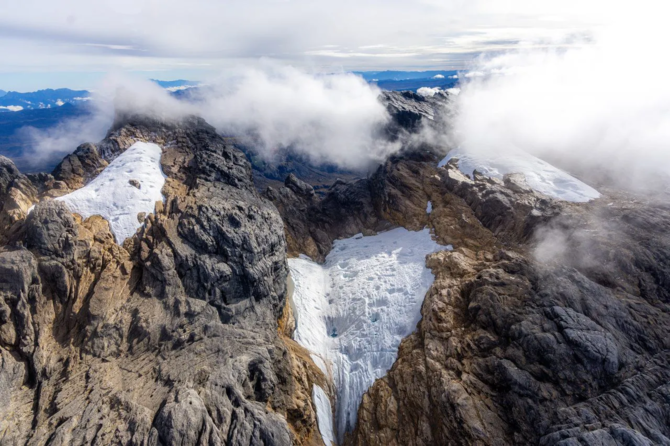
Indonesia’s “eternal snow” — the last remaining tropical glaciers in Asia — could disappear entirely by 2027, according to the country’s meteorological agency. Scientists warn that rising global temperatures have significantly accelerated the melting process.
Located atop Puncak Jaya in Papua Province, Indonesia’s easternmost region, the Carstensz Glacier and East Northwall Firn are remnants of the last Ice Age and have existed for approximately 5,000 years. Surrounded by dense tropical rainforest, these glaciers represent a rare and fragile natural phenomenon.
According to Indonesia’s Meteorological, Climatology, and Geophysics Agency (BMKG), the glaciers have experienced dramatic reductions in both area and thickness over the past three decades. Based on current rates of retreat, the ice is expected to disappear completely by 2026 or 2027.
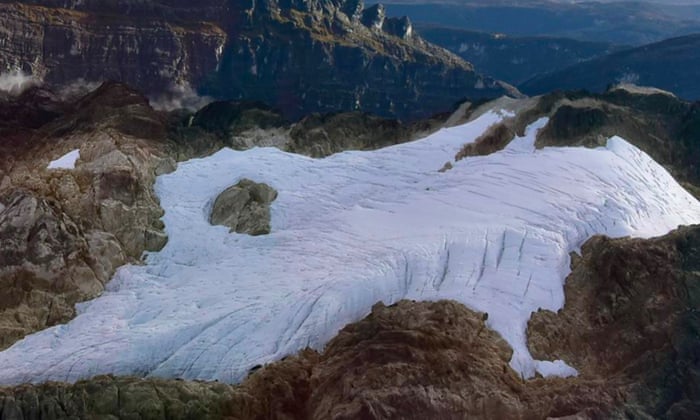
“The loss of ice in Puncak Jaya has been dramatic over the last century,” BMKG stated.
Historical records show that around 1850, at the start of the Industrial Revolution, glaciers in the Puncak Jaya range covered roughly 19.3 square kilometers. By September 2025, that area had shrunk to just 0.09 square kilometers. The two glaciers that survive today are the last remnants of a group of six; the other four have already vanished.
While long-term atmospheric warming remains the primary cause of the melting, El Niño events have accelerated the process. El Niño raises ocean and air temperatures across the tropics, intensifying glacier loss. BMKG noted that a forecast El Niño event in late 2026 could further hasten the glaciers’ disappearance.
Climate change has also altered precipitation patterns in the region. More rainfall and less snowfall mean that the glaciers lose their reflective snow cover, exposing darker ice that absorbs more heat and melts more quickly.
The glaciers’ thickness has declined sharply in recent years, dropping from 32 meters in 2010 to 22 meters in 2016 and falling to about 8 meters by 2021.

Puncak Jaya’s glaciers are among the last tropical glaciers on Earth, joining a small number of remaining ice fields in South America and Africa. Their disappearance is considered a stark warning about the impacts of climate change, as tropical glaciers are highly sensitive indicators of rising global temperatures.
“This event indicates that regional warming has exceeded a critical threshold beyond which recovery is no longer possible under current climate trajectories,” BMKG said.
Beyond environmental concerns, the loss carries significant cultural implications. Known locally as Nemangkawi Ninggok, or the “Peak of the White Arrow,” Puncak Jaya is regarded as a sacred site by Indigenous communities in Papua. The disappearance of its snow-capped peaks represents not only an ecological loss but also the erosion of an important spiritual and cultural symbol.
BMKG also warned that glacier loss could affect water supplies in mountain valleys and disrupt ecosystems, including bird species and habitats that depend on stable water sources.
“The disappearance of these ‘eternity glaciers’ carries deep consequences,” the agency said, adding that the loss of this iconic natural landmark also highlights Indonesia’s vulnerability to climate change and rising sea levels.
Related Topics :
Jazan Municipality Launches Investment Opportunities in Jazan
New Graduates Revive Jeddah’s Architectural Heritage
Saudi Fig: Fruit of Heritage & Growth