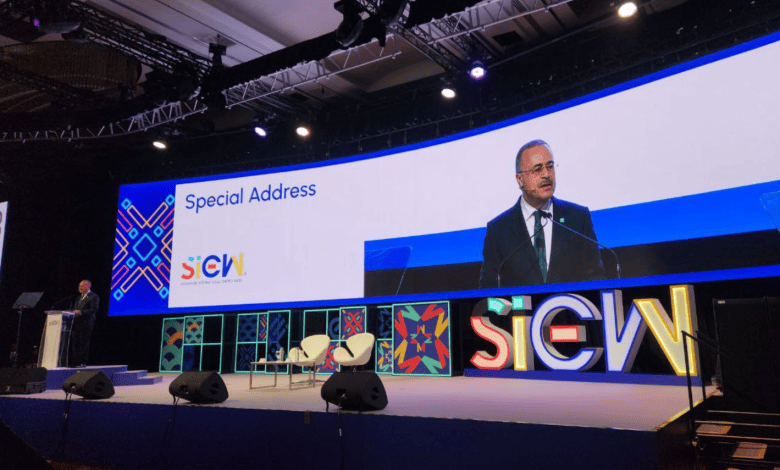
Saudi Aramco President and CEO, Amin Nasser, has on Monday called for a new energy transition plan that gives more voice for Asia and the Global South.
Speaking at the Singapore International Energy Week (SIEW 2024), the head of the oil giant expressed concern over the current plan’s slow and unequitable progress in the developing nations.
Asia’s Significance
In his remarks at the SIEW 2024, Nasser highlighted the significance of Asia for the global economy. “Asia now accounts for almost half of world GDP, as well as half of the world’s population.”
“This year alone, Asia is likely to contribute roughly 60% of global economic growth. And Asia consumes more than half of global energy supplies. Crucially, 84% of that consumption is still supplied by conventional energy,” he said.
“Asia is vital to the global economy, our shared climate ambitions, and the hopes and dreams of billions of people,” Aramco CEO added.
However, Asia is not gaining much attention in the current energy transition planning. Nasser said: “This may be Asia’s century. But Asia’s voice and priorities, like those of the broader Global South, are hard to see in current transition planning, and the whole world is feeling the consequences. Transition progress is far slower, far less equitable, and far more complicated than many expected.”
Failed Promises
Nasser added that the current transition plan is ignoring reality, hence it has failed to deliver in three key areas. The first is providing affordable energy. “Electricity prices in Europe rose as much as three to five-folds in many countries over the past two decades, despite the shift to renewables,” he explained.
The second is the slow progress in renewable energy. “Wind and solar combined supply under 4% of world energy,” he said.
Meanwhile, the third one is that transition will be costly for everyone, with total global costs estimated between $100-$200 trillion by 2050. This may require $6 trillion from developing countries each year.
A New Transition Plan
The Saudi Aramco chief warned that trying to force developing countries to implement an unworkable, unaffordable transition plan would threaten their economic progress and social cohesion.
Hence, he called for an “ideology-free approach” which prioritizes “systematic emissions reduction, where the impact is greater, at an acceptable cost, within reasonable timeframes, and whatever the source or technology”.
Nasser called this “a multi-source, multi-speed, and multi-dimensional approach” which aims to meet the security, affordability, and sustainability needs of all countries.
A Focus on Asia
The Aramco chief called for “A Transition Plan 2.0” which puts Asia at its core. It must take into account each country’s priorities, especially those of the Global South. Furthermore, the world must accelerate the development of new energy sources and lower carbon technologies that can be cost-effective.
The new plan must also encourage investments in proven and reliable energy sources, such as oil and gas, which developing nations need and can afford. This also entails prioritizing the reduction of greenhouse gas emissions associated with those energy sources.
Oil Demand
In his speech, Nasser said that, unlike most forecasts, oil demand will not decline anytime soon. “Even when the growth in global oil demand stops at some point, no abrupt drop in overall demand is anticipated,” he said.
The oil giant head explained that “more than 100 million barrels per day would realistically still be required by 2050,” in contrast with predictions that oil demand could fall to 25 million barrels per day by that time. He warned that a shortfall of 75 million barrels a day would be “devastating” for energy security and affordability.
Moreover, Nasser pointed out that oil demand is at “an all-time high” despite substantial investments in the global energy transition. Additionally, gas demand has increased by 70% since 2000.
“So, rather than an energy transition, we are really talking about energy addition, where just the growth is mostly met by alternatives, instead of replacing conventional energy in any meaningful way,” he said.