KAUST Partners With Jameel Motors, Toyota to Accelerate Decarbonization Efforts
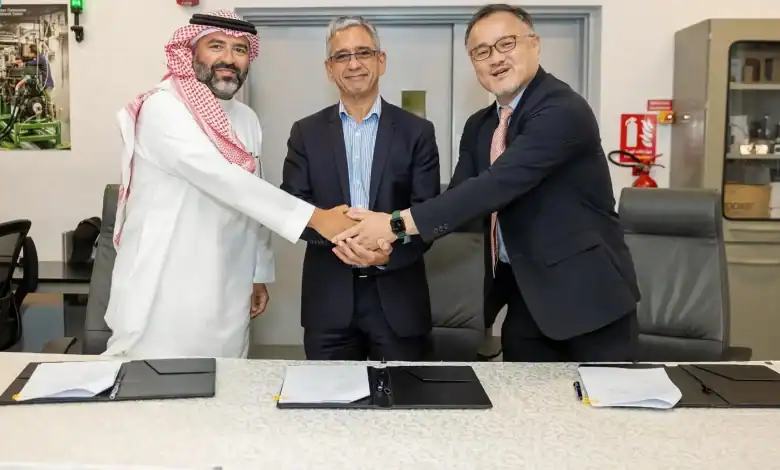
King Abdullah University of Science and Technology (KAUST) has signed a strategic partnership with Abdul Latif Jameel Motors and Toyota Motor Corporation (TMC) to support the Kingdom’s decarbonization efforts.
Fuel Cell Technologies
According to the Saudi Press Agency (SPA), the partnership aims to develop fuel cell technologies and drive hydrogen innovation to boost the decarbonization process in the transportation sector and beyond.
It stands as a testament to KAUST’s commitment to designing fuel cells compatible with the region’s unique environmental conditions. The deal also accelerates Saudi Vision 2030 to achieve net zero carbon emissions by 2060.
Saudi Green Future
KAUST has recently embarked on serious attempts to promote sustainable solutions and fulfill a greener future for Saudi Arabia and beyond.
As a fundamental part of this partnership, KAUST has acquired Proton Electrolyte Membrane (PEM) fuel cell modules from TMC.
Consequently, the university established a state-of-the-art laboratory under its Clean Energy Research Platform (CERP) dedicated to advancing this cutting-edge technology.
“We are excited to collaborate with TMC and Abdul Latif Jameel Motors to drive the adoption of hydrogen fuel cell technology in Saudi Arabia, aligning with the Kingdom’s Vision 2030 and net-zero goals for 2060. Through our Clean Energy Research Platform (CERP), we are focused on advancing research that will optimize hydrogen fuel cells for the region’s specific conditions, ensuring their efficiency and reliability,” said Professor Mani Sarathy, KAUST’s Physical Science and Engineering Department.
Intensifying Efforts
Sarathy and his team at CERP are currently intensifying their efforts to explore the performance, durability, and environmental integration of PEM fuel cells.
In order to boost the environmental benefits of these fuel cells, the team has commenced to conduct experimental and modeling studies to evaluate various aspects such as temperature sensitivity, humidity effect and overall efficiency.
Ambitious Goals
Sarathy also commended the Kingdom’s vast renewable energy resources and its outstanding position in producing green and blue hydrogen through carbon capture, utilization and storage technology.
Moreover, the professor noted that the Kingdom has set an ambitious goal to produce approximately 2.9 million tons of hydrogen by 2030 at competitive costs for local use and export.
Related Topics:
KAUST Accelerates Scientific Research with 67 Projects in AI, Cybersecurity, Bioinformatics
Saudi Green Economy: KAUST, NEOM Partner to Boost Hydrogen Technologies
KAUST Announces Construction of Saudi Arabia’s First Regional Research Vessel