The big picture: Saudi Arabia’s Ministry of Finance released on Wednesday its Preliminary Budget Statement for the 2027 fiscal year. The document projects total government expenditure at SAR 1,392 billion ($371.2 billion). Meanwhile, the government anticipates total revenues of SAR 1,202 billion ($320.5 billion). This leaves an estimated fiscal deficit of SAR 191 billion ($50.9 billion), representing roughly 3.6% of gross domestic product (GDP).
Why it matters: The budget statement balances strategic developmental spending with disciplined public finance management. Consequently, the policy framework supports sustained economic expansion while advancing Saudi Arabia’s economic transformation under Vision 2030. State spending specifically prioritizes high-yield economic and social development projects, reinforcing financial sustainability despite volatile global energy markets.
By the numbers: Here are the core fiscal estimates from the Ministry of Finance:
- 2027 Projected Expenditures: SAR 1,392 billion ($371.2 billion).
- 2027 Projected Revenues: SAR 1,202 billion ($320.5 billion).
- 2027 Fiscal Deficit: SAR 191 billion ($50.9 billion), or 3.6% of GDP.
- 2028 Revenue Forecast: SAR 1,302 billion ($347.2 billion).
- 2028 Spending Forecast: SAR 1,479 billion ($394.4 billion), generating a deficit of SAR 177 billion ($47.2 billion).
- 2029 Revenue Forecast: SAR 1,351 billion ($360.3 billion).
- 2029 Spending Forecast: SAR 1,544 billion ($411.7 billion), the largest projected expenditure budget in Saudi history, resulting in a deficit of SAR 192 billion ($51.2 billion).
- Non-Oil Revenue Growth: Non-oil revenues surged from SAR 166 billion ($44.3 billion) in 2015 to SAR 505 billion ($134.7 billion) in 2025.
- Non-oil share of GDP: a historic 57.3% in the first half of 2026.
- 2026 Deficit Outlook: Shifting macroeconomic conditions expanded the estimated 2026 deficit to SAR 245 billion ($65.3 billion).
Non-Oil Expansion Cushions Broader Economic Landscape
Between the lines: Geopolitical developments and energy market headwinds impacted Saudi Arabia’s overall economic performance during 2026. Preliminary estimates indicate a 3.6% real GDP contraction for 2026, primarily because oil sector activities declined by 21.8%. However, non-oil activities expanded by 3.2% in 2026, effectively offsetting hydrocarbon declines.
Specifically, non-oil sectors grew by 1.8% during the first half of 2026. As a result, non-oil activities contributed a historic high of 57.3% to real GDP during that period. Robust domestic consumption and expanding private investment inflows fueled this record non-oil milestone.
Furthermore, broader macroeconomic indicators confirm strong underlying fundamentals:
- Inflation remained stable at an estimated 2.1% for full-year 2026.
- Unemployment among Saudi citizens fell to 6.5% in the second quarter of 2026.
What they’re saying: Dr. Mohammed Makni, Professor of Finance and Investment at Al-Imam University, observed that conservative assumptions underpin the SAR 1.2 trillion ($320.5 billion) revenue baseline.
“The Ministry of Finance typically constructs three distinct baseline scenarios: a conservative scenario, a base scenario, and an optimistic scenario,” Dr. Makni stated during an interview. “The SAR 1.2 trillion ($320.5 billion) revenue estimate reflects the base-case model, which incorporates a SAR 191 billion ($50.9 billion) deficit.”
Dr. Makni explained that evolving global conditions alter final budget figures over time. For example, unexpected geopolitical shifts expanded the projected 2026 deficit to SAR 245 billion ($65.3 billion). Therefore, multi-scenario planning gives the ministry the flexibility to navigate regional and global uncertainties.
Similarly, economic researcher and technology consultant Fadwa Al-Bawardi highlighted the critical role of advanced risk management in public finance.
“Saudi Arabia’s financial architecture directly addresses potential external risks, including geopolitical escalation, global supply chain bottlenecks, trade protectionism, elevated interest rates, and energy price volatility,” Al-Bawardi noted. “By employing flexible multi-scenario planning, the government creates sufficient fiscal headroom to absorb sudden external shocks.”
She emphasized that proactive planning maintains macroeconomic stability, safeguarding inflation levels, trade balances, and core performance metrics.
Sustainable Financing and Long-Term Vision 2030 Goals
The bigger picture: Saudi Arabia plans to fund its strategic development projects through comprehensive domestic and international financing channels. Guided by its Medium-Term Debt Management Strategy, the state will issue bonds, sukuk, and loans at competitive rates. Additionally, the government will expand alternative state financing options throughout 2027, including infrastructure funds, project financing, and export credit agencies.
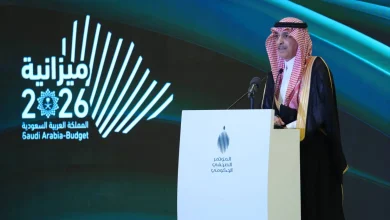
Saudi Minister of Finance Mohammed Al-Jadaan affirmed that a long-term economic perspective guides public money management. “The preliminary estimates for fiscal year 2027 reflect our strategy within a global economic environment marked by ongoing uncertainty and accelerating geopolitical shifts,” Minister Al-Jadaan said. “Saudi Arabia manages its public finances from a long-term perspective. This approach strengthens our ability to adapt to changes and maintain spending on strategic priorities while preserving fiscal sustainability.”
Al-Jadaan added: “The government continuously monitors economic developments and supply chain dynamics. We respond with flexible and proactive policies that support the national economy and accelerate the targets of Saudi Vision 2030.”
Furthermore, Al-Jadaan clarified that planned deficits reflect intentional economic strategy.
“The estimated deficit for 2027 forms part of a fiscal policy that protects Saudi Arabia’s financial strength,” Al-Jadaan emphasized. “We sustain growth, manage emergency needs, and preserve public debt at manageable levels alongside substantial fiscal reserves.”
This release marks the ninth consecutive year that the Saudi government has published a pre-budget statement. This established tradition reinforces fiscal transparency, enhances public disclosure, and provides vital insights for international investors and citizens alike. Ultimately, the statement highlights Saudi Arabia’s resilience, strategic discipline, and rapid transformation into a diversified global economic leader.
Overall, the statement shows a kingdom that spends for growth while it protects its balance sheet. Investors will now watch the final budget to see how far diversification can offset oil-market swings.