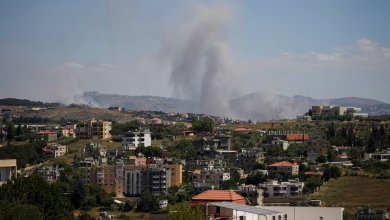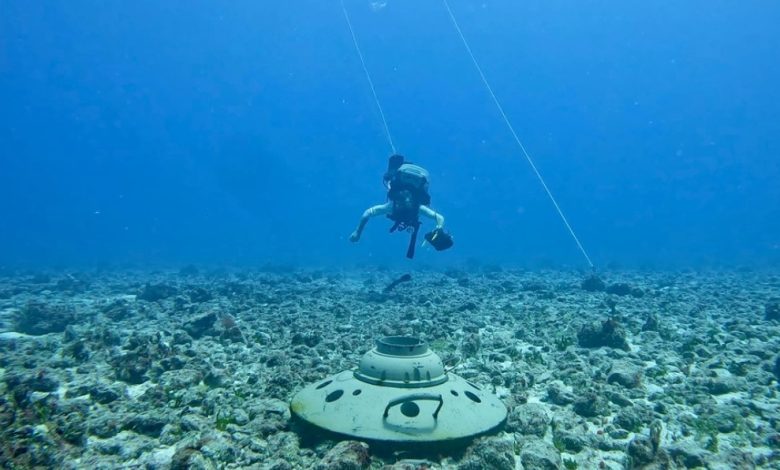
The US is reportedly leveraging artificial intelligence (AI) to counter Iranian mines in the Strait of Hormuz – a critical waterway that Tehran has shut down.
Meanwhile, Iran is exploring unconventional ways to break a US naval blockade on its ports, which has crippled Iranian oil exports and put further strain on its struggling economy.
AI for Mine-Clearing
The US Navy has made a $100 million deal with “Domino Data Lab” AI company to utilize AI-powered underwater drones in accelerating the process of mine detection, Reuters reported.
The new contract expands Domino’s role in supporting the Navy’s Project AMMO (Accelerated Machine Learning for Maritime Operations), aimed at making underwater mine detection faster, more accurate, and less dependent on human sailors.
“Mine-hunting used to be a job for ships. It’s becoming a job for AI. The Navy is paying for the platform that lets it train, govern, and field that AI at a speed required for contested waters that block global trade and imperil sailors,” Domino’s chief operating officer, Thomas Robinson, told Reuters.
Accelerated Process
Updating the Navy’s unmanned underwater vehicles (UUVs) to identify new or previously unseen mines could take up to six months. However, the deployment of Domino’s AI software can speed up the process and cut it into few days.
By integrating various sensor types, such as side-scan sonar and visual imaging, the software enables the Navy to track AI performance in real-time, pinpointing detection failures and deploying immediate updates to refine accuracy in the field.
“If there were UUVs in the Baltic Sea trained on Russian mines, and then they needed to be deployed to the Strait of Hormuz to detect Iranian mines, with Domino’s technology, the Navy could be ready in a week rather than a year,” Robinson explained.
Hormuz Standoff
The Strait of Hormuz has become a point of contention in the ongoing conflict between the US and Iran. It is a strategic maritime corridor linking the Arabian Gulf with the Gulf of Oman and the Arabian Sea, through which around a fifth of daily global oil supplies and LNG supplies pass.
As peace talks stalled, Iran has blocked traffic through the Strait without its permission, leading to a spike in global oil prices. Iran’s new Supreme Leader Mojtaba Khamenei struck a defiant tone on Thursday, saying that a “new management of the Strait of Hormuz will bring calm” to all Gulf nations as Tehran eliminates what he called “the enemy’s abuses of the waterway.”
He also warned that “foreigners who come from thousands of kilometers away to act with greed and malice there have no place in it — except at the bottom of its waters.”
In response, the US has enforced a naval blockade on Iranian ports, ramping up pressure on Tehran to capitulate to Washington’s demands. Furthermore, US President Donald Trump ordered the Navy to destroy any boats placing mines in the Strait of Hormuz. He also added that the US was conducting mine-clearance operations in the waterway.
Unconventional Escalation
As some hardliners in Iran consider the naval blockade an act of war, they could push for a military response. In light of this, Iranian officials suggested Tehran could pivot to new weapons to attack US warships, according to the Wall Street Journal (WSJ).
One of the options floated by the Iranian Revolutionary Guards (IRGC) is to cut phone cables in the Strait of Hormuz, disrupting Internet traffic worldwide.
Recently, the IRGC-affiliated Tasnim news agency published a map of undersea Internet cables, in an implicit threat of targeting the region’s telecommunications infrastructure.
Kamikaze Dolphins
Another unconventional tactic that Iran could use is the deployment of mine-carrying dolphins to launch suicide attacks against US warships, the Iranian officials said.
Iran allegedly bought kamikaze dolphins and other aquatic mammals from a former Soviet navy trainer in 2000, the BBC reported at the time.
The animals were trained to neutralize enemy frogmen using mounted harpoons or by forcibly dragging them to the surface for detention. Moreover, they received training to execute suicide missions, carrying hull-detonating mines directly into enemy vessels.
The dolphins’ chief trainer, Boris Zhurid, who was working in Ukraine, declined at the time to elaborate the role that the dolphins would play. A group of 27 animals, including walruses, sea lions, seals, and a white beluga whale, were transported with the dolphins from Sevastopol in the Black Sea, to the Arabian Gulf.