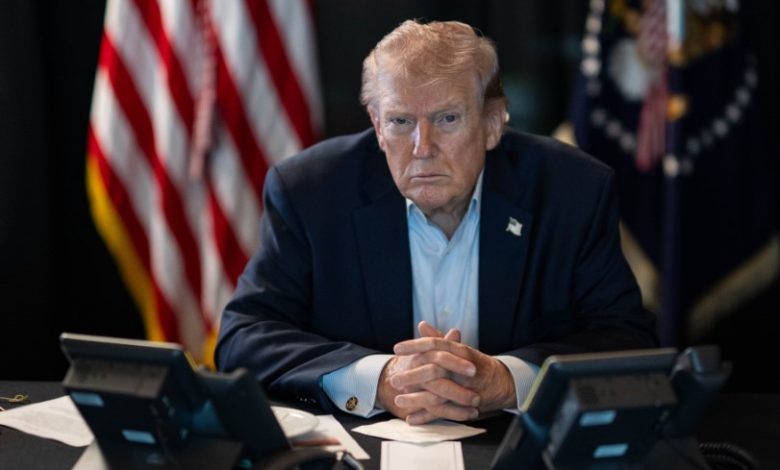
US President Donald Trump doubled down on his threat to “take out” Iran if the country did not reach a deal by his Tuesday night ultimatum.
Iran, meanwhile, rejected a 45-day ceasefire proposed by mediators, saying it wants a permanent end to the war, as it keeps the Strait of Hormuz closed to US and Israeli vessels.
Final Ultimatum
Speaking at a news conference on Monday, Trump reiterated his threat to attack Iran’s energy and transportation infrastructure if the Strait of Hormuz was not reopened by Tuesday’s deadline, set to expire at 8 pm ET Tuesday (12 am GMT Wednesday).
“The entire country can be taken out in one night – and that night might be tomorrow night,” he said, warning that without a deal, Iran would be sent back to the “Stone Ages.”
“Every bridge in Iran will be decimated” by midnight EDT (4 am GMT Wednesday) and “every power plant in Iran will be out of business, burning, exploding, and never to be used again,” Trump vowed.
Ceasefire Proposals
Iran rejected a two-phased ceasefire proposal submitted through Pakistan, noting that it wants a permanent end to the war, according to official IRNA News Agency.
The proposal involved a 45-day ceasefire and the reopening of the Strait of Hormuz, followed by negotiations for a broader peace settlement.
Tehran, for its part, submitted a 10-point plan to end the war. This plan includes ending conflicts in the region, establishing a protocol for safe passage through the Strait of Hormuz, lifting of sanctions and reconstruction.
Meanwhile, Iran and Oman are developing a mechanism to manage the Strait of Hormuz – a critical waterway through which a fifth of global energy supplies pass, the Associated Press (AP) reported.
Ongoing Talks
Despite Iran’s rejection, the talks, led by mediators Pakistan, Egypt and Türkiye, were still underway to de-escalate the conflict.
An unnamed regional official involved in the talks told the AP that efforts had not collapsed. “We are still talking to both sides,” he said. Trump also noted that negotiations continued.
Furthermore, the head of Iran’s diplomatic mission in Cairo, Mojtaba Ferdousi Pour, told the AP that Iran only accepts an end of the war “with guarantees” that it will not be attacked again.
Earlier on Monday, Trump said that Iran’s proposal was inadequate. “They made a proposal, and it’s a significant proposal. It’s a significant step. It’s not good enough,” he told reporters, adding that the Iranians were negotiating “in good faith.”
Defiant Iran
Iran responded to Trump’s threats to bomb bridges and power plants. The spokesperson for the IRGC’s Khatam al-Anbiya Central Headquarters, Ebrahim Zolfaqari, said that “the rude rhetoric, arrogance and baseless threats of the delusional US president, arising from the deadlock he faces and aimed at justifying the repeated defeats of the US military” will not stop Iran from fighting.
In a statement carried by IRNA, Zolfaqari vowed a more forceful retaliation to any US attacks. “If attacks on civilian targets are repeated, our retaliatory response will be carried out far more forcefully and on a much wider scale,” he warned.
Moreover, Iran’s deputy youth and sports minister, Alireza Rahimi, called on young people to form “human chains” around the country’s power plants.
“We will stand hand in hand to say: Attacking public infrastructure is a war crime,” he posted on X.
War Crime Concerns
Trump’s threats to target civilian infrastructure, such as bridges and power plants, have raised concerns over violating international law and constituting a war crime.
The UN Spokesperson, Stephane Dujarric, warned on Monday that international law bans attacks on civilian infrastructure. “Any attack on civilian infrastructure is a violation of international law and a very clear one,” he said.
“Even if specific civilian infrastructure were to qualify as a military objective,” he explained, an attack would still be prohibited if it risks “excessive incidental civilian harm.”
However, Trump told reporters that he was not concerned about accusations of war crimes. “No, not at all,” he said, adding that Iranians are “willing to suffer that in order to have freedom.”