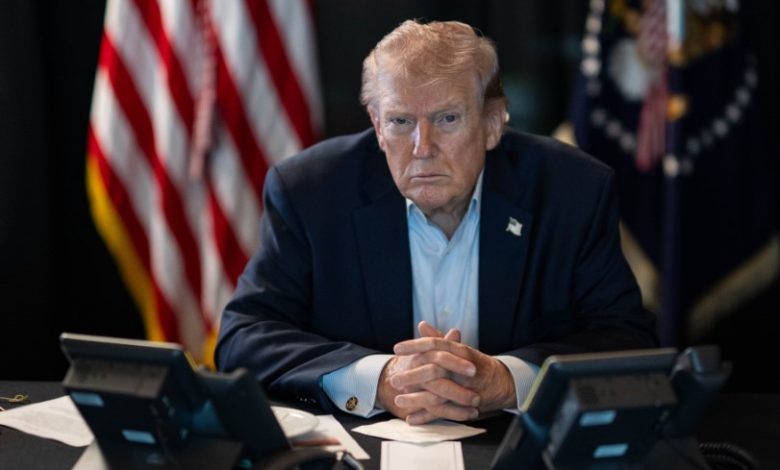
US President Donald Trump rejected Iran’s response to the latest peace proposal as “totally unacceptable,” putting the fragile ceasefire at risk and sending energy prices soaring.
The Iranian response demanded ending the war on all fronts and full sovereignty over the Strait of Hormuz, in addition to compensation for war damages.
Trump’s Rejection
Iran sent its response to the American proposal through Pakistan on Sunday. Trump dismissed the Iranian proposal within few hours in a social media post.
“I have just read the response from Iran’s so-called “Representatives.” I don’t like it — TOTALLY UNACCEPTABLE!” he wrote on Truth Social without providing details.
In an earlier post, Trump accused Iran of “playing games” with the US and the world for decades. “For 47 years the Iranians have been “tapping” us along, keeping us waiting, killing our people with their roadside bombs, destroying protests, and recently wiping out 42,000 innocent, unarmed protestors, and laughing at our now GREAT AGAIN Country. They will be laughing no longer!” he said.
Trump-Netanyahu Call
After receiving the Iranian response, Trump made a phone call with the Israeli Prime Minister, Benjamin Netanyahu, during which they discussed the issue, the US President told Axios.
“It was a very nice call. We have a good relationship,” Trump said of Netanyahu, but he added that the Iran negotiations are “my situation, not everybody else’s.”
In an interview with CBS, Netanyahu said there is “work to be done” on Iran, emphasizing that Israel has been in regular contact with the US over the matter.
He also said that he and Trump agreed on the importance of removing Iran’s stockpile of highly enriched uranium. “Trump has said to me, ‘I want to go in there,’ and I think it can be done physically,” Netanyahu said.
Iran’s Counter-proposal
After 10 days of studying a US proposal, Iran submitted its response on Sunday via Pakistani mediators. The response takes the form of a memorandum of understanding (MoU) that will end the war and start a 30-day period of detailed negotiations to reach a full agreement.
According to Iranian state media, Tehran’s counter-proposal demands an end to fighting on all fronts, including in Lebanon; the recognition of sovereignty over the Strait of Hormuz; ending US naval blockade; and a guarantee that Iran will not come under attack again.
Furthermore, it calls for compensation for war damages, the release of frozen Iranian assets, the lifting of sanctions and ending a US ban on Iranian oil sales. Some of the Iranian demands will take effect upon signing while the others will take place within a 30-day period, an informed source told Tasnim News Agency.
In an interview with Press TV on Sunday, Iranian Foreign Ministry Spokesperson Esmaeil Baqaei said: “For now, we have decided to focus on ending the war, because this issue is a matter of concern for the entire region, for our nation, and for the international community.”
Nuclear Program
Iran’s nuclear program remains one of the most sticking points in negotiations. According to the Wall Street Journal (WSJ), citing sources, the Iranian response does not meet the US demands on the nuclear issue.
Tehran calls for negotiating nuclear issues within the 30-day period, proposing to have some of its highly enriched uranium diluted and the rest transferred to a third country. Moreover, it demands guarantees that it will get back the transferred uranium if negotiations fail or the US exits the agreement at a later stage.
Iran also showed readiness to suspend uranium enrichment for less than 20 years but rejected dismantling its nuclear facilities, the sources said.
However, Iranian state media said that the response did not include anything on the nuclear program. Meanwhile, Tasnim’s informed source dismissed what the WSJ reported about the nuclear issue as “not true.”
The UN nuclear agency estimates that Iran possesses more than 440 kilograms of 60% enriched uranium – a technical hairsbreadth from weapons-grade purity. Tehran stressed that it will protect its nuclear sites against any US infiltration.
“We considered it possible that they might intend to steal it through infiltration operations or heli-borne operations,” Iranian military spokesperson Akrami Nia said in an interview with IRNA news agency on Saturday, emphasizing forces’ “full readiness” to protect uranium storing sites.
Confrontation Threats
The recent days saw a flare-up of tensions in the Arabian Gulf and the Strait of Hormuz. Fresh drone attacks were reported on Sunday in the UAE and Kuwait and a fire erupted on a freighter off the coast of Qatar after a drone strike.
Although Iran has not claimed responsibility for the attacks, Iran’s Revolutionary Guard navy warned that any attack on Iranian oil tankers or commercial vessels would be met with a “heavy assault” on US bases in the region and enemy ships.
Furthermore, Iran’s Supreme Leader Mojtaba Khamenei “issued new and decisive directives for the continuation of operations and the powerful confrontation with the enemies” during a meeting with the head of the joint military command Ali Abdollahi, reported Iranian state media.