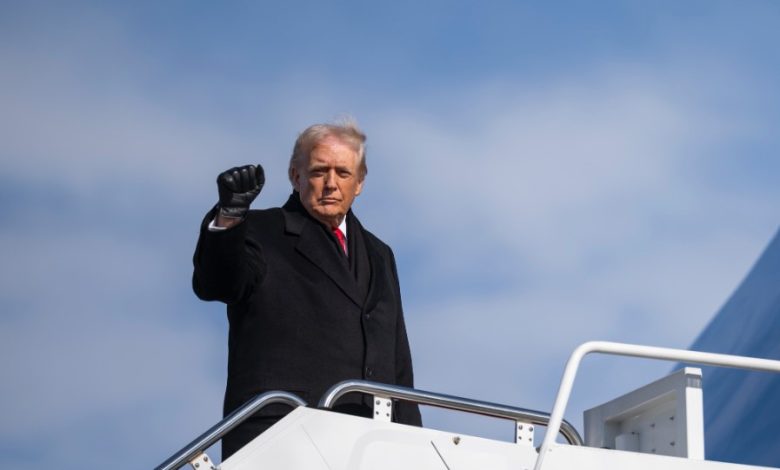
US President Donald Trump indicated he will indirectly participate in Tuesday’s high-stakes negotiations between the US and Iran in Geneva.
Earlier this month, Washington and Tehran restarted negotiations over Iran’s nuclear program amid increased US pressure and a significant military buildup in the Middle East.
Trump’s Involvement
On Monday, Trump said he will have an indirect role in the second round of US-Iran talks set for Tuesday in Geneva, reported Reuters.
Speaking to reporters aboard Air Force One, Trump said: “I’ll be involved in those talks, indirectly. And they’ll be very important.”
American and Iranian delegations have headed to Geneva for a second round of indirect Oman-mediated negotiations on Tuesday, amid a surge in US military and diplomatic pressure aimed at securing a new nuclear deal.
Deal over Strikes
Trump suggested that Iran was motivated to negotiate in order to avoid military strikes. “I don’t think they want the consequences of not making a deal,” he said, adding that Tehran has learned the consequences of the tough posture it adopted in talks last summer when the US bombed its key nuclear sites.
“We could have had a deal instead of sending the B-2s in to knock out their nuclear potential. And we had to send the B-2s,” Trump said, referring to the US stealth bombers that struck the Iranian nuclear facilities. “I hope they’re going to be more reasonable,” he added.
The US joined Israel in its 12-day war with Iran last June, bombing three key nuclear facilities: Natanz, Fordow and Isfahan.
Military Tensions
In recent weeks, the US has been increasing its military footprint near Iran, sending the USS Gerald R. Ford, the world’s largest aircraft carrier, to the Middle East to join the USS Abraham Lincoln Carrier Strike Group deployed there.
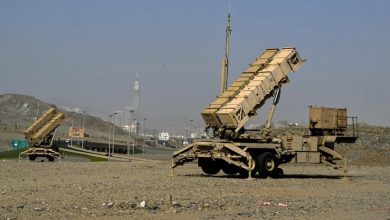
The two aircraft carriers bolster a significant military buildup in the region, which includes several guided-missile destroyers, fighter squadrons, and surveillance aircraft, as well as additional refueling tankers and Patriot and THAAD air defense systems.
Iran, on the other hand, vowed decisive retaliation to any US military action, including closing the Strait of Hormuz, a vital international waterway through which fifth of global oil flows.
Amid the soaring tensions, Iran held a military drill in the Strait of Hormuz on Monday. Known as “Smart Control of the Strait of Hormuz,” the exercise aimed to test the readiness of the Iranian Revolutionary Guards’ naval units to protect the maritime corridor, according to the semi-official Tasnim news agency.
Equitable Deal
The Iranian Foreign Minister, Abbas Araghchi, met on Monday with the International Atomic Energy Agency (IAEA) chief, Rafael Grossi, in Geneva to discuss cooperation with the agency and Tehran’s technical point of view regarding nuclear talks with the US.
Ahead of the meeting, Araghchi said that Iran seeks a “fair and equitable deal.” “What is not on the table: submission before threats,” he posted on X.
Tehran has set red lines for its talks with Washington, rejecting a zero enrichment mandate and the inclusion of its missile capabilities in the negotiations. It made clear it will only discuss curbs on its nuclear program in exchange for sanctions relief.
In light of this, US State Secretary Marco Rubio pointed to the difficulty of reaching a deal with Iran. “I think that there’s an opportunity here to diplomatically reach an agreement that addresses the things we’re concerned about. We’ll be very open and welcoming to that,” he noted.
“But I don’t want to overstate it either. It’s going to be hard. It’s been very difficult for anyone to do real deals with Iran,” Rubio said during a visit to Hungary on Monday.