


The Gulf Cooperation Council (GCC) countries are moving toward a more connected logistical network through a planned landmark railway agreement.
The new project marks the final pillar of the Gulf‘s total regional integration, adding to water and power interconnectivity projects. Saudi Arabia – which directly borders the other five GCC member states – forms the linchpin of these projects, connecting energy, resources, and trade.
A Landmark Moment in Bahrain
Driving the News: GCC Transport Ministers are gathering in Manama, Bahrain, on Sunday, November 8, 2026, to sign the GCC General Railway Agreement, under the patronage of Bahrain’s Crown Prince and Prime Minister Prince Salman bin Hamad Al Khalifa and with the presence of the GCC Secretary-General, Jasem Albudaiwi.
The Big Picture: The agreement aims to connect all six Gulf countries through an integrated rail network to streamline the movement of passengers and freight. The project is set for operational completion by December 2030, with completed cross-border sections eligible for early phased rollout.
Why It Matters: By linking key regional ports, industrial centers, and commercial markets, the railway corridor reduces transit time, cuts freight transport costs, and boosts regional trade and tourism. It also offers a reliable alternative to maritime chokepoints.
What He Said: “This project is one of the most prominent joint infrastructure projects among the GCC countries, given its pivotal role in enhancing economic integration and strengthening supply chains between member states.” – Mohammed Al-Shabrami, Director General of the GCC Railways Authority, in remarks to Al-Eqtisadiah newspaper.
GCC Railway Project: The Unified Land Network
State of Play: The project will connect Saudi Arabia, Kuwait, Bahrain, Qatar, the UAE, and Oman through an integrated network.
By the Numbers:
- 2,117 km: Unified railway track spanning all six GCC states.
- 200 km/h: Passenger train speed.
- 80-120 km/h: Freight train speed.
- 50%: Project completion rate as of May 2026.
- 8+ million: Passenger traffic by 2045.
- 271 million tonnes: Freight traffic by 2045.
The Catalyst: The GCC Supreme Council established the GCC Railways Authority in December 2021. Headquartered in Riyadh, the Authority coordinates with member states on the implementation and operation of the GCC Railway Project, providing technical support for the project.
The Context: The GCC General Railway Agreement is based on four main pillars: project implementation, technical integration, coordination and regional connectivity.
GCC Connectivity Triad
Zoom In: The railway project marks the crown jewel of the GCC infrastructure network, complementing the unified power and water grids.
- GCC Power Grid: Headquartered in Dammam and managed by the GCC Interconnection Authority (GCCIA), the GCC Power Grid serves as a high-voltage backbone linking the national networks of Saudi Arabia, Bahrain, Kuwait, Oman, Qatar, and the UAE. It stabilizes regional electricity during peak loads, bridges maintenance gaps, and monetizes surplus power.
- GCC Water Grid: As a bi-directional network anchored in Saudi Arabia’s Eastern Province, the Gulf Water Interconnection project is a network of pipelines designed to pump water back and forth according to peak demand, seasonal maintenance, or crisis scenarios.
Saudi Arabia: GCC Interconnection Backbone
Between the Lines: Strategically located at the heart of the Arabian Peninsula, Saudi Arabia shares direct borders with the other 5 GCC member states, forming a land bridge connecting the Gulf nations.
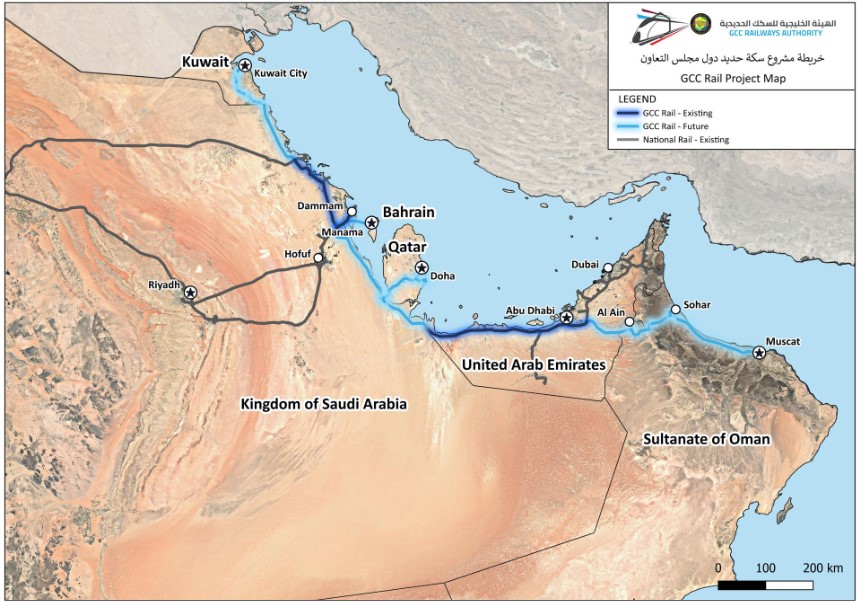
GCC Railway Planned Routes:
- Saudi Arabia – Kuwait: Connects Kuwait City directly to Saudi Arabia’s Eastern Province rail network in Dammam, prioritizing heavy freight to transform industrial trade before rolling out passenger lines.
- Saudi Arabia – UAE: Extends from Dammam through the Dammam–Jubail industrial line to the Al Batha border, linking directly into Abu Dhabi and Al Ain.
- UAE – Oman: Stretches from Al Ain on the UAE border to Oman’s port city of Sohar.
- Saudi Arabia – Qatar and Bahrain: Coastal connections linking Qatar to the mainland near Salwa, while connecting Bahrain via a multi-modal rail bridge along the planned King Hamad Causeway, running alongside the historic King Fahd Causeway.
Mutual Benefits: The railway project will boost intra-GCC tourism and mobility. Whether for Umrah, business, or tourism, Gulf citizens and residents will be able to move seamlessly between cities, bolstering trade and cultural bonds among the GCC nations.
Saudi Rail Transformation Under Vision 2030
Go Deeper: Under the objectives of Vision 2030 and the National Transport and Logistics Strategy (NTLS) to position the Kingdom as a global logistics hub, Saudi Arabia has developed a robust and rapidly evolving railway infrastructure.
SAR Network
The Saudi Arabia Railway (SAR) network already extends to Al-Haditha crossing near the Jordanian border through the North-South Line, effectively paving the way for immediate regional expansion.
Saudi Landbridge Project
The Saudi Landbridge project is a 1,500-kilometer railway network designed to connect the Jeddah Islamic Port on the Red Sea to the ports of Dammam and Jubail on the Arabian Gulf, passing through Riyadh.
The $7-billion project centers on three key lines: a 900-km line to King Abdullah Port, connecting Riyadh and Jeddah; an update for the Riyadh-Dammam corridor for faster trips; and a 172-km line from King Abdullah Port to Yanbu Industrial City on the Red Sea.
The Hejaz Railway Project
The Hejaz Railway is an Ottoman-era line that extended from Damascus to Madinah, transporting pilgrims and troops, with subsidiary lines extending to Aleppo, Beirut and Türkiye. The railway was largely destroyed during World War I. Saudi Arabia, Türkiye, Syria, and Jordan have signed landmark agreements to explore the revival and modernization of the historic Hejaz Railway corridor, with plans to include more Gulf countries, such as Oman.
The Hejaz Railway project will provide a strategic alternative for the Strait of Hormuz and other maritime flashpoints, connecting the Gulf to the Mediterranean and Europe.
The Bottom Line: The signing of the GCC General Railway Agreement heralds a new era for Gulf connectivity, creating a single, synchronized economic bloc powered by shared transport, energy, and water. It also advances Saudi Arabia’s Vision 2030 goal of becoming a global logistics hub.