Saudi Arabia Participates in the Org. for the Prohibition of Chemical Weapons Session in The Hague
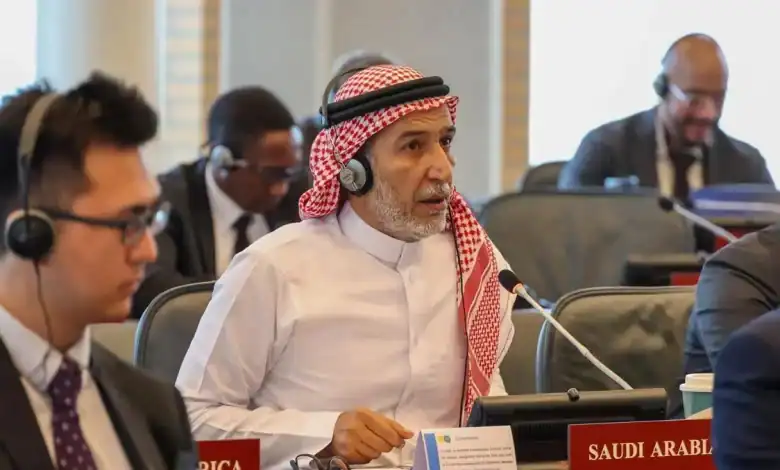
The Saudi delegation took part in the he 106th session of the executive council of the Organization for the Prohibition of Chemical Weapons (OPCW), held in the Hague from July 9 to 12, reported the Saudi Press Agency (SPA).
The delegation was led by Ambassador Ziyad bin Maashi Al-Attiyah, the Kingdom’s Permanent Representative to the OPCW.
Al-Attiyah stressed the Kingdom’s unwavering dedication to enhancing international cooperation aimed at banning all weapons of mass destruction and preventing their proliferation.
The ambassador also emphasized the pivotal role of the OPCW to maintain international peace and security and to implement all provisions of the Chemical Weapons Convention.
In his speech, Al-Attiyah reaffirmed the Kingdom’s instance that the use of chemical weapons and toxic chemicals as weapons anywhere by anyone and under any circumstances is abhorrent and a flagrant violation of both the Chemical Weapons Convention and established principles of international law.
Furthermore, he declared that the Kingdom’s delegation welcomes the OPCW spokesperson’s statement concerning the situation in Ukraine issued on May 7, 2024.
Gaza War
In the same context, Al-Attiyah condemned the Israeli crimes in the Gaza Strip stressing that the Israeli forces have been continuously committing brutal crimes in a systematic bloody manner for nine months since the outbreak of the war between Israel and Hamas.
Moreover, he underscored the significance of implementing recent UN Security Council resolutions regarding the proposal for an immediate and permanent ceasefire in the Strip.

In this regard, the ambassador confirmed Saudi Arabia’s welcome of Palestine’s request to the OPCW’s technical secretariat for closely monitoring the situation in the occupied Palestinian territories.
Al-Attiyah also commended several countries’ recognition of the Palestinian State such as Norway, Spain, Ireland, Slovenia, and Armenia.
“The Kingdom calls on the international community to formally recognize the Palestinian State within its 1967 borders with East Jerusalem as its capital, so that the Palestinian people can obtain their legitimate rights and to achieve a comprehensive, just, and lasting peace,” Al-Attiyah said.
Syria’s Chemical Weapons Program
Saudi Arabia’s delegation welcomed he 27th round of consultations between the OPCW and Damascus.
Al-Attiyah highlighted the importance of keeping a renewed spirit of cooperation within a technical framework to resolve all pending issues.
“We encourage all parties to cooperate in resolving address the pending issues, and we call on all parties involved to work together constructively,” Al-Attiyah stated.
Algeria’s Progress
The session featured Saudi Arabia’s congratulation to Algeria on the designation of its National Institute of Forensic Evidence and Criminology as a new OPCW laboratory, marking a significant milestone for the African continent in the field of chemical analysis.
Difficult Challenges
Al-Attiyah shed light on the fact that there are many challenges that require the activation of all existing mechanisms in the organization.
These mechanisms involved the effective participation of the Chemistry Center or the Scientific Advisory Council and others, to address these challenges and implement the provisions of the agreement, notably those related to artificial intelligence and chemical threats.
Furthermore, Al-Attiyah welcomed the upcoming conference to be held jointly by Morocco and the OPCW technical secretariat in Rabat.
The conference will underscore the role of AI in boosting the implementation of the Chemical Weapons Convention.
Related Topics:
US Report: Israel’s Use of American Weapons Likely Violated International Law
Saudi Arabia confirms its commitment to ban biological weapons
Israeli Defense Minister Heads to US to Discuss Gaza, Lebanon