
Saudi Arabia Through an Egyptian Diplomat’s Eyes: Story of Security, Trust and Shared Destiny
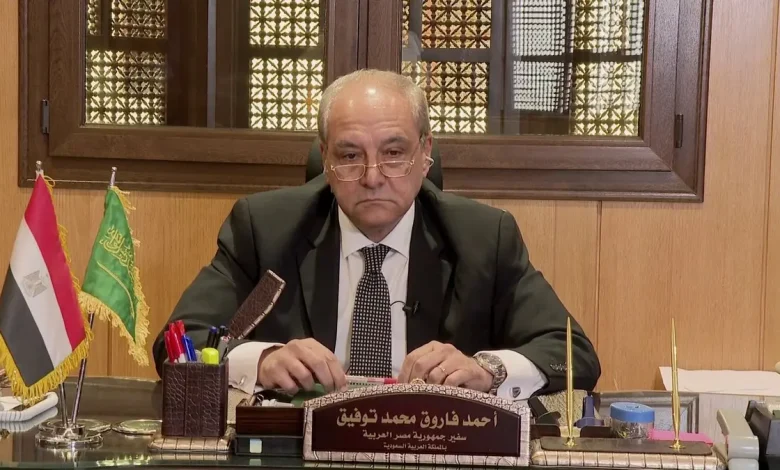
Former Egyptian Ambassador to Saudi Arabia Ahmed Farouk stood before delegates at the Security and History Dialogue Conference in Riyadh. He delivered more than a speech. He offered a personal witness statement, drawn from six years inside one of the Arab world’s most consequential relationships.
Farouk opened by thanking Prince Abdulaziz bin Saud bin Nayef, Saudi Arabia’s Minister of Interior, and the conference organizers for the platform. Then he turned to two threads. The first was the century-long history binding Egypt and Saudi Arabia. The second was his own tenure as ambassador, from 2019 to 2025.
Why it matters: Egypt and Saudi Arabia anchor the Arab world’s security architecture. Their bilateral relationship shapes regional diplomacy, trade and cultural exchange far beyond their borders. A veteran diplomat’s firsthand account therefore carries real weight for anyone tracking Gulf-Egypt ties.
A Relationship Rooted in History
Farouk rejected the idea that Egypt and Saudi Arabia cooperate out of necessity. Instead, he said, each state possesses its own strengths and expertise that complement the other. That complementarity, he argued, has repeatedly turned bilateral cooperation into a striking force on the regional and international stage.
He traced the relationship back to 1926, when the two countries signed their first friendship treaty. Nearly two decades later, in 1945, King Abdulaziz Al Saud traveled to Egypt. It was the founding monarch’s only trip outside the Arabian Peninsula during his reign, and Farouk described it as a milestone that Egyptians still remember.
The bond deepened again in 1953. On his deathbed, King Abdulaziz gathered his sons and left them with a charge concerning Egypt: “I entrust you well with Egypt; if it rises, you rise.” Farouk called that moment a turning point that still guides the kingdom’s approach to Cairo today.
More than 150 treaties, agreements and memorandums of understanding now link the two nations. They span economic, cultural, social, tourism and educational cooperation, Farouk said. Paper alone, however, does not capture what the relationship truly means.
He pointed instead to two moments of crisis as proof. When Egypt faced the Tripartite Aggression in 1956, Saudi Arabia backed Cairo both politically and economically. During the October War of 1973, King Faisal halted oil exports in solidarity with Egypt. That single decision sent shockwaves through global markets and helped shift the course of the conflict.
“The principle of security between the two countries is not slogans or speeches,” Farouk said. “It is honorable positions taken by strong men, translated into reality during crises and hardships.”
Migration numbers reinforce the closeness. More than 2 million Egyptians currently live and work in Saudi Arabia, Farouk said. Close to 1 million Saudis reside in Egypt in turn. Consequently, the Red Sea has never divided the two nations. It has served instead as a bridge for human, cultural and economic exchange.
Vision 2030 and the Security Foundation
Turning to his own posting, Farouk described watching Saudi Arabia transform between 2019 and 2025. He credited Vision 2030, launched under Crown Prince Mohammed bin Salman, with proving a central point. Internal and regional security, he said, underpin prosperity, not just for the kingdom but for the wider Middle East.
Throughout his tenure, Farouk observed that security and stability form the bedrock of Saudi society. They drive development. They also give citizens and residents alike a lasting sense of reassurance. He singled out the rule of law as the “cornerstone” that everyone answers to equally, regardless of status.
‘A Grandmother’s Prayer’
Farouk closed with a personal story from his childhood in 1960s Egypt. He recalled watching a black-and-white television broadcast of a Saudi royal visit to Cairo. The white thobe and ghutra worn by the visiting delegation caught his attention immediately. He asked his grandmother who these visitors were. She told him they were “the sons of the most generous,” from “the land of goodness and safety” that is home to the Prophet.
Decades later, Farouk joined Egypt’s diplomatic corps in 1985. On May 10, 2019, a presidential decree named him Egypt’s ambassador to Saudi Arabia. He said the memory of his grandmother’s words came flooding back the moment he read the announcement.
Farouk drew two lessons from that story. First, he said, it shows how deeply the image of Saudi Arabia sits in the minds of ordinary Egyptians. It is a picture of safety, generosity and faith that never required a diplomatic brief to take hold. Second, he framed his own path to the ambassadorship as proof that a grandmother’s prayer, however long deferred, eventually finds its answer.
He ended his remarks with a message to both nations, stating: “the beloved Kingdom, cradle of Islam and land of the two holy mosques” on behalf of “Egypt, mother of the world and cradle of civilization.” He asked God to protect both countries, their peoples and their leaderships. He also prayed that the security, love and goodwill between them would endure, “for the good of both nations and the entire Arab nation.”