The big picture: Saudi Arabia’s Ministry of Municipalities and Housing approved comprehensive municipal regulations for commercial data centers on Friday. Consequently, this regulatory overhaul strengthens the Kingdom’s digital infrastructure and establishes crystal-clear requirements for international and domestic investors.
Why it matters: Saudi Arabia is advancing rapidly toward becoming a global IT and cloud hub. Therefore, standardized municipal procedures across all regions streamline the establishment, development, and operation of critical digital facilities.
In an official statement, the ministry highlighted the critical role of data centers. Officials stated: “Data centers serve as essential infrastructure for public and private entities to process and store data while ensuring efficient digital services.”
Specifically, these unified national rules apply to standalone commercial data centers located within or outside urban boundaries. Municipal guidelines require operators to select accessible sites with direct connectivity to essential utilities. These utilities include high-capacity electricity, fiber-optic telecommunications, and transport networks.
Operational Guidelines and Urban Standards
Additionally, facilities must adhere to strict urban planning codes regarding building heights, parking allocations, setback distances, and general landscaping. Municipal requirements mandate four parking spaces per 100 square meters while explicitly prohibiting residential external building aesthetics.
Licensing procedures require operators to obtain Civil Defense clearance and hold valid commercial registrations. Operators must also secure formal approval from supervising authorities. Furthermore, the Municipal Licensing Procedures Law governs all license issuances, renewals, amendments, suspensions, and cancellations.
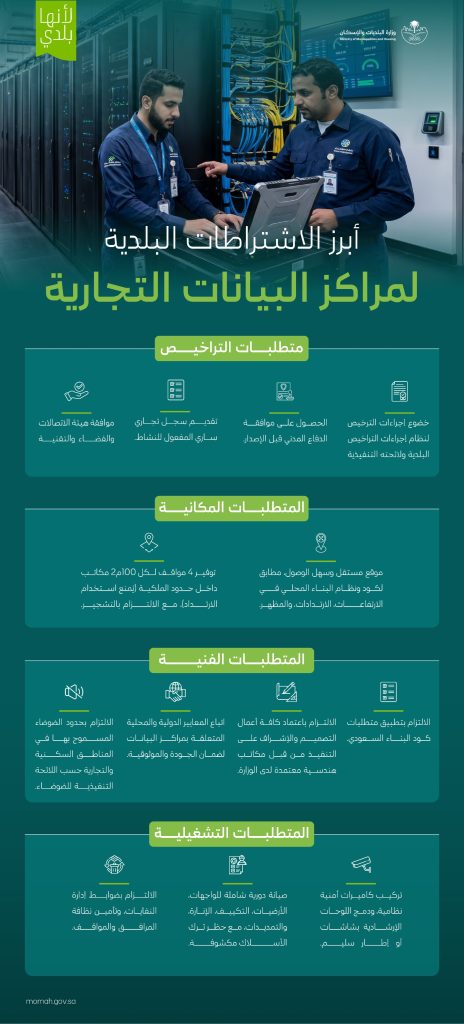
Moreover, operators must strictly apply the Saudi Building Code. Accredited engineering firms must supervise all facility design and construction works directly. Furthermore, facilities must comply with rigorous international and local operational standards. These standards cover fire protection, advanced cooling systems, and redundant backup power.
To enhance site safety, operators must install advanced security surveillance systems. They must also provide universal disability access and manage waste responsibly. Facilities must also display a unified electronic code providing direct access to regulatory documentation.
The ministry underscored the strategic impact of the new regulations. Officials affirmed: “The regulations will provide a reliable environment, encourage IT investment, and enable digital infrastructure to keep pace with digital services expansion.”
Driving Global Tech Ambitions
This regulatory push complements massive national investments under Saudi Vision 2030. The Kingdom has upgraded its national telecommunications backbone, expanded 5G corridors, and launched mega smart-city projects like NEOM. Consequently, tech titans such as Amazon Web Services, Microsoft, and Google continue to deploy billions directly into Saudi cloud regions.
By the numbers:
- SAR 7.1 billion ($1.9 billion): The baseline market value of the Saudi data center industry in 2024.
- SAR 14.6 billion ($3.9 billion): The projected market value by 2030, driven by a 13% compound annual growth rate.
- SAR 375 billion ($100 billion): The sovereign financial backing committed to national AI and tech champions like HUMAIN.
- 5%: The market dominance of Tier 4 ultra-reliable data center facilities across the Kingdom.
- 03 thousand MW: The target IT load capacity that Saudi digital infrastructure will reach by 2030.
- 60+ data centers now operate across the Kingdom, up sharply from a handful in 2021
- SR16 billion ($4.26 billion) invested in the sector since Vision 2030 launched
- 5 billion ($1.2 billion) — Al Moammar Information Systems’ new expansion announced at LEAP 2026
Between the lines: By eliminating procedural discrepancies across municipalities, Saudi Arabia offers global investors total regulatory certainty. Ultimately, these standards safeguard capital and stimulate technological innovation. Furthermore, these comprehensive rules solidify the Kingdom’s standing as the premier regional digital hub.
Meanwhile, the ministry urged all active investors, developers, and operators to review the published guidelines immediately. Additionally, regional municipal branches will oversee local enforcement to ensure complete alignment with national digital strategy. As a result, this unified approach accelerates Saudi Arabia’s digital transformation. It powers next-generation AI applications, enterprise cloud hosting, and secure regional telecommunications across the Middle East. Consequently, municipal authorities scheduled triennial regulatory reviews to adapt ongoing technological advances seamlessly and sustainably.
What’s next: With the municipal code now in force, officials expect a steady stream of new project announcements to follow the LEAP 2026 momentum. For Saudi Arabia, the regulatory clarity is the next building block in an infrastructure-first strategy to anchor the Kingdom’s AI-driven economy for decades to come.