
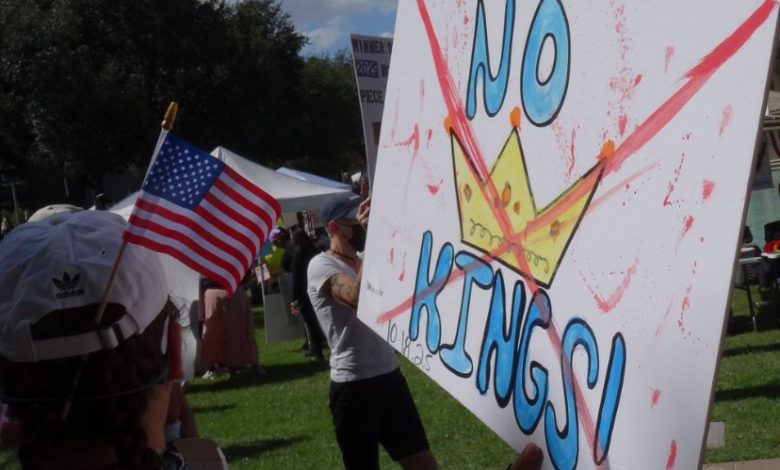
Millions of Americans marched across US cities to protest against President Donald Trump’s policies and the war on Iran, as part of the “No Kings” rallies.
The demonstrations took place as Trump’s approval rate hit a new low in recent polls, threatening his standing ahead of the upcoming midterm election.
Nationwide Protests
On Saturday, March 28, crowds gathered across multiple US cities to protest against Trump’s policies, the rising cost of living, federal immigration enforcement and the war with Iran, in the third round of the “No Kings” rallies that started last year.
Over 3,200 events had been planned in all 50 states. Huge marches took place in New York, Dallas, Philadelphia and Washington, as well as small towns and suburbs, Reuters reported citing event organizers.
Protesters displayed effigies of Trump, Vice President JD Vance and other administration officials, demanding their removal and arrest.
The first “No Kings” rally took place on Trump’s birthday on June 14, 2025. It attracted 4 to 6 million people across 2,100 sites. Then, in October, the second rally took place, drawing 7 million participants in 2,700 cities, according to a crowdsourcing analysis by data journalist G. Elliott Morris.
Major Events
Minnesota, a frontline in Trump’s crackdown on illegal immigration, saw a large rally where protesters carried posters showing the photos of two US citizens shot dead by federal immigration officers in Minneapolis earlier this year.
The event featured a musical performance by Bruce Springsteen and a list of high-profile speakers, including Minnesota Governor Tim Walz and independent US Senator Bernie Sanders of Vermont.
“We will not allow this country to descend into authoritarianism or oligarchy in America. We, the people, will rule,” Sanders told the crowds.
Moreover, New York witnessed a massive rally of tens of thousands of protesters extending over more than 10 blocks in midtown Manhattan. Actor Robert De Niro, one of the organizers, criticized Trump for posing “an existential threat to our freedoms and security.”
Counter-Protests
Some US cities saw counter-protests in support of Trump, including in West Palm Beach, Florida, where verbal clashes occurred between No Kings protesters and pro-Trump supporters, according to CNN.
Meanwhile, an event in Dallas saw clashes when counter-protesters blocked streets, prompting Dallas police to arrest many people. The former leader of the far-right group Proud Boys was present in the counter-protests.
Republicans Reaction
White House spokesperson Abigail Jackson dismissed the protests as the product of “leftist funding networks” with little real public support. The “only people who care about these Trump Derangement Therapy Sessions are the reporters who are paid to cover them,” Jackson said in a statement.
Meanwhile, the National Republican Congressional Committee criticized the Democrats for supporting the rallies. “These Hate America Rallies are where the far-left’s most violent, deranged fantasies get a microphone and House Democrats get their marching orders,” committee spokesperson Mike Marinella said in a statement.
Trump’s Declining Approval
The rallies took place as recent polls showed a sharp decline in Trump’s approval rates. According to a Reuters/Ipsos poll, Trump’s approval rating has fallen to 36%, its lowest since his return to the White House, amid a surge in fuel prices and widespread disapproval of the war on Iran.
The poll found that about 61% of Americans disapproved of the US strikes on Iran, while only 35% approve of the strikes. Also, around 46% of respondents said the war in Iran will make the US less safe in the long run.
Meanwhile, another poll by the AP-NORC Center for Public Affairs Research found that 59% of Americans think that the recent US military action against Iran has gone too far, compared to 26% saying it has been about right.
The US war on Iran, which started on February 28, has caused the average price of gasoline in America to surge by about a dollar a gallon, amid disruption of oil shipments from the Middle East.