Israel Approves Death Penalty Law for Palestinians, Sparks Global Denunciation
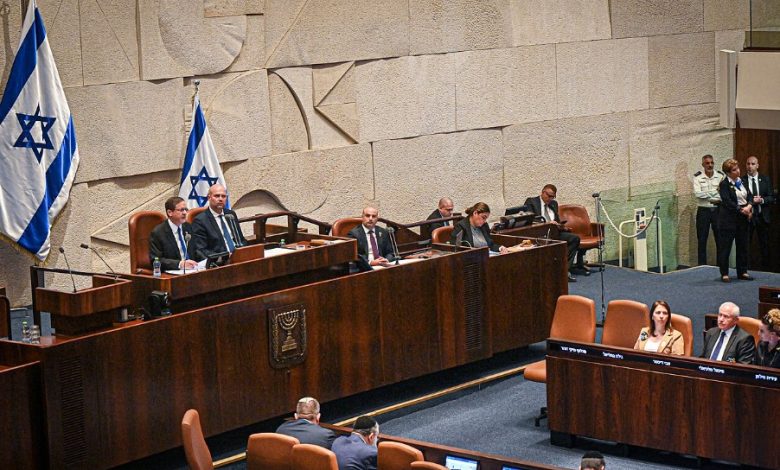
The Israeli parliament (Knesset) has passed a law authorizing the death penalty for Palestinians convicted of terrorism and nationalistic murders.
The controversial law has drawn global criticism for being “discriminatory” and a violation of international law that risks undermining “democratic principles.”
Death Penalty Law
The Knesset passed the law’s third and final reading by 62 votes to 48 on Monday, with Israeli Prime Minister Benjamin Netanyahu and his far-right allies voting in favor.
Under the new law, Palestinians convicted of carrying out deadly attacks aimed at “ending Israel’s existence” will be sentenced to death by hanging within 90 days, with a possible postponement of up to 180 days.
The court can impose life imprisonment instead of the death penalty in unspecified “special circumstances.” The legislation will take effect in 30 days, giving no right to clemency.
The law was championed by the far-right national security minister, Itamar Ben-Gvir, who celebrated the bill’s approval by saying “We made history.”
Tailored for Palestinians
The law states that the death penalty applies to murders committed with the intent to “negate the existence of the state of Israel.”
In practice, this means that it will effectively target West Bank Palestinians convicted of nationalistic crimes, not Jewish Israelis who committed similar crimes.
The legislation is not retroactive and will not apply to prisoners currently in Israeli custody, including Hamas elements who took part in the October 7 attack against Israel in 2023.
Palestinians in the West Bank are governed by military law, while Israeli settlers fall under civilian law. The new legislation amends the military court system in the occupied West Bank, allowing judges to issue death sentences without a unanimous vote.
In light of this, the Association of Civil Rights in Israel condemned the legislation as “an act of institutionalized discrimination and racist violence against Palestinians,” filing an appeal against it with Israel’s Supreme Court.
Palestinian Rejection
The Palestinian Authority (PA), which administers the West Bank, condemned the legislation for seeking to “legitimize extrajudicial killing under legislative cover.” PA President Mahmoud Abbas’ office said that the new law is a breach of international law.
“Such laws and measures will not break the will of the Palestinian people or undermine their steadfastness. Nor will they deter them from continuing their legitimate struggle for freedom, independence, and the establishment of an independent Palestinian state with East Jerusalem as its capital,” Abbas’ office said in a statement.
Meanwhile, the Palestinian movement, Hamas, which controls the Gaza Strip, warned that the adoption of the law “threatens the lives” of Palestinian prisoners in Israeli prisons, urging the international community to take immediate action to “ensure the protection” of Palestinian prisoners from Israel’s “brutality.”
Furthermore, several Arab States strongly condemned the Israeli legislation, including Egypt and Jordan, in addition to the Arab Parliament.
Humanitarian Outcry
The Israeli legislation has parked global reactions, with human rights groups and organizations denouncing the law and calling for its reversal.
The UN Human Rights Office in Palestine urged Israel to “immediately repeal the discriminatory death penalty law” as it violates Israel’s obligations under international law.
“The implementation of this new law would violate international law’s prohibition of cruel, inhuman or degrading punishment,” the office said in a statement on X.
“Additionally, this law further entrenches Israel’s violation of the prohibition of racial segregation and apartheid as it will exclusively apply to Palestinians in the occupied West Bank and Israel, who are often convicted after unfair trials,” it added.
Similarly, Amnesty International said the law is a “public display of cruelty, discrimination and utter contempt for human rights,” calling on Israel to repeal it.
“It dismantles fundamental safeguards to prevent the arbitrary deprivation of life and protect the right to a fair trial, and further empowers Israel’s system of apartheid, which is maintained by scores of discriminatory laws against Palestinians,” the group’s Senior Director of Research, Advocacy, Policy and Campaigns, Erika Guevara-Rosas, said.
European Concerns
The Secretary General of the Council of Europe, Alain Berset, expressed “deep concern” over the Israeli law. “Any application of the death penalty that could be characterized as discriminatory is unacceptable in a state governed by the rule of law,” he said in a statement.
“In this context, the Council of Europe will closely monitor upcoming developments regarding this law. It will examine its implications for the Council of Europe conventions to which Israel is a party, as well as for the cooperation mechanisms in which this state participates,” he added.
Ireland also condemned the adoption of the law. “I am particularly concerned about the de facto discriminatory nature of the Bill as it relates to Palestinians. Ireland urges the Israeli government and parliament to not implement this law,” Ireland Minister for Foreign Affairs Helen McEntee said in a statement.
Ahead of the vote, the UK, France, Germany and Italy voiced their “deep concern” over “the de facto discriminatory character of the bill.” They urged Israeli authorities to abandon plans to pass the law.
A week ago, the European Union (EU) said it “opposes capital punishment in all cases and under all circumstances,” warning that approving the bill would represent a “grave step backward.”