From Sea Lanes to Supply Chains: Saudi Arabia Leverages IMO Seat to Secure Global Trade
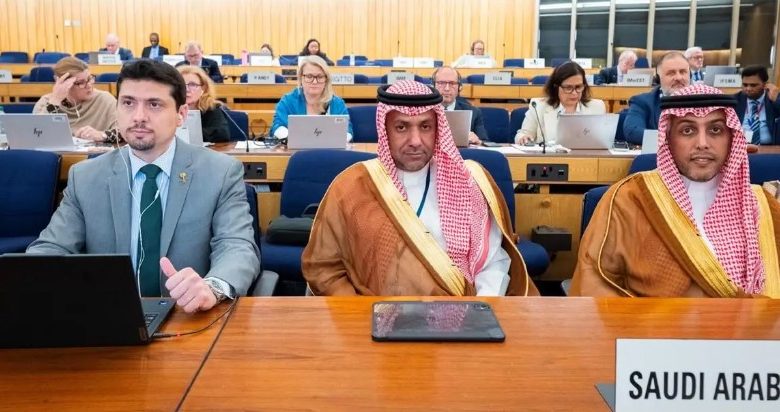
Saudi Arabia has reaffirmed its commitment to maritime security and international maritime cooperation by taking part in the 137th Session of the International Maritime Organization (IMO) Council in London.
The Kingdom’s participation aligns with its commitment to expanding its footprint in international forums, securing global trade corridors, and strengthening maritime cooperation to advance the National Transport and Logistics Strategy (NTLS) and the objectives of Saudi Vision 2030.
Securing IMO Seat
Saudi Arabia’s Transport General Authority (TGA), led by its President Eng. Fawaz Alsahli, represented the Kingdom at the 137th session of the IMO Council, reported the Saudi Press Agency (SPA).
What’s New: The Saudi delegation discussed a range of key maritime transport issues, focusing on improving the sector’s efficiency, strengthening maritime safety and security, and fostering international cooperation.
Furthermore, Alsahli held bilateral meetings with government officials and representatives of international organizations to explore avenues for boosting cooperation, exchanging expertise. He also highlighted the Kingdom’s achievements in the maritime sector’s development under the NTLS and Saudi Vision 2030.
State of Play: Saudi Arabia was elected as a member in the IMO Council for the 2026-2027 term, receiving 142 votes from member states in a strong demonstration of the international community’s confidence in the Kingdom’s capabilities and its leading role within the IMO.
Safeguarding Supply Chains
With its coastlines extending along the Red Sea in the west and the Arabian Gulf in the east, the Kingdom has been a steadfast advocate for global maritime security and the freedom of navigation, reiterating its unwavering commitment to supporting maritime safety while boosting the resilience of global supply chains.
The Big Picture: The recent regional escalation involving the US, Israel, and Iran has disrupted shipping in the Strait of Hormuz and the Arabian Gulf and threatened to spiral across the Red Sea’s Bab al-Mandab, sending shockwaves across global markets.
The Strategy: Leveraging its active participation in IMO’s platforms, the Kingdom has urged for bolstering international cooperation to ensure the smooth movement of maritime transport and the sustainability of supply chains.
It has also supported resolutions by the IMO Council’s Extraordinary Session, which condemn attacks that threaten the security of global trade and stress that the Strait of Hormuz is an international waterway where the right of passage is guaranteed under international law.
Moreover, the Kingdom adopted a package of proactive measures by its maritime and logistics ecosystem to ensure operational continuity. These initiatives included activating alternative routes, boosting transit services, and maintaining uninterrupted shipping line bookings.
Saudi Arabia also launched over 19 new maritime services and shipping lines to improve connectivity, held more than 40 public-private coordination workshops, streamlined cargo movement, and enhanced regional logistics integration.
Between The Lines: In May 2026, the Maritime Safety Committee adopted the proposal for a Saudi-sponsored draft resolution in its 111th session to address threats to maritime safety and the welfare of seafarers.
A Surging G20 Fleet
Saudi Arabia’s participation in the IMO Council’s session highlights its active role in the organization and its commitment to shaping global maritime policies and expanding international partnerships.
These efforts come in line with the Kingdom’s goal of solidifying its position as a global logistics hub. They also align with its dedication to supporting international conventions and standards related to the safety, security, and sustainability of maritime transport.
By The Numbers: Under its NTLS, Saudi Arabia has cemented its status in the maritime transport sector, ranking second-fastest growing maritime fleet among all G20 nations, with a record 32% growth rate in 2025.
The Kingdom also recorded an impressive 6.4% growth in its fleet’s gross tonnage in 2024, leading the Arab and regional domains while securing the 20th spot globally.
These achievements were driven by specialized maritime personnel of over 2,000 certified Saudi seafarers actively operating these vessels.
Evolving into a Global Logistics Hub
In line with the revolutionary Vision 2030, NTLS aims to transform Saudi Arabia into a global logistics hub. Harnessing the Kingdom’s strategic location at the nexus of three continents, the NTLS aims to streamline trade flows between Asia, Europe, and Africa as part of its ambitious Saudi Landbridge project.
The Context: With a cost estimated at $7 billion, the Saudi Landbridge project is a 1,500-kilometer railway network designed to connect the Jeddah Islamic Port on the Red Sea to the ports of Dammam and Jubail on the Arabian Gulf, passing through Riyadh.
More than 13% of global trade transits the Red Sea. Saudi Arabia’s ports are positioned to serve as transshipment hubs that reduce total supply chain costs for shippers. Once operational, the Saudi Landbridge project will shorten cargo transit times across the Arabian Peninsula from 5 days by sea to 72 hours by rail.
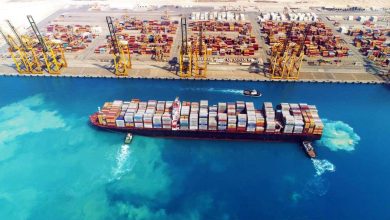
Furthermore, Saudi Ports Authority (Mawani) has introduced logistics corridors aimed at redirecting cargo flows from ports in the Eastern Region and across the Gulf toward Jeddah Islamic Port and other Red Sea facilities, to reduce reliance on Hormuz and maintain the continued flow of trade.
Mawani also reported a 20.89% year-on-year increase in container throughput in February 2026, reaching 667,882 twenty-foot equivalent units (TEUs).