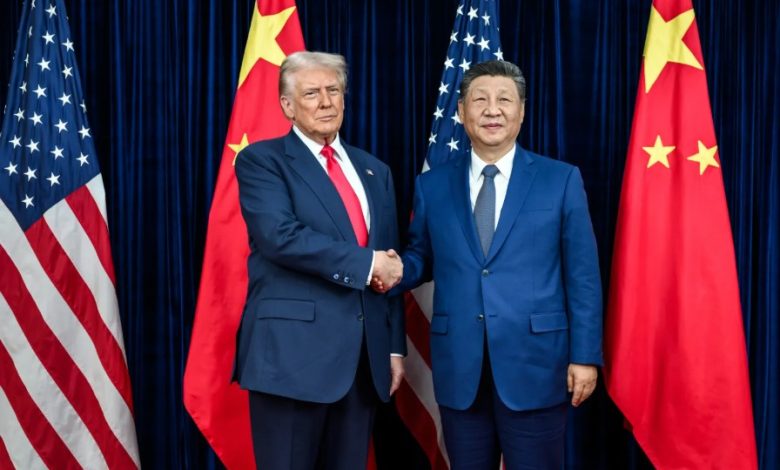
US President Donald Trump is set to meet with his Chinese counterpart Xi Jinping this week, in his first visit to China since 2017.
The leaders of the world’s two superpowers will hold high-stakes talks, discussing a range of issues including the war in Iran, trade ties, artificial intelligence (AI) and nuclear weapons.
Trump’s Trip to China
Trump will visit China from May 13-15, 2026 upon an invitation from Xi. “At the invitation of President Xi Jinping, President of the United States of America Donald J. Trump will pay a state visit to China from May 13 to 15,” a Chinese foreign ministry spokesperson confirmed on Monday.
The US President will arrive in Beijing on Wednesday evening and will hold discussions with this Chinese counterpart on Thursday and Friday, in their first face-to-face talks in more than six months.
According to the White House Principal Deputy Press Secretary Anna Kelly, the visit “will be of tremendous symbolic significance.”
She told reporters that the visit will focus on “rebalancing the relationship with China and prioritizing reciprocity and fairness to restore American economic independence.” Kelly added that Xi and his wife will pay a reciprocal visit to Washington later in 2026.
Trade Ties
As the leaders of the world’s two largest economies, Trump and Xi will try to stabilize their trade ties, reported Reuters and AFP citing anonymous US officials.
The US and China will discuss establishing the Board of Trade and Board of Investment to facilitate trade and investment ties, with expected announcements covering purchases related to Boeing airplanes, American agriculture and energy.
Furthermore, Washington and Beijing will likely discuss discuss extending their year-long trade truce, reached last October in Busan. “It doesn’t expire yet. I’m confident we’ll announce any potential extension at the appropriate time,” one of the officials told reporters.
Iran War
The war in Iran, launched by the US and Israel on February 28, will likely dominate talks between Trump and Xi. Due to Beijing’s strong ties to Tehran, Trump will seek to push China to use its influence to press Iran for making a deal with the US to end the war.
“The president has spoken multiple times with General Secretary Xi Jinping about the topic of Iran and about the topic of Russia, to include the revenue that China provides to both those regimes, as well as dual-use goods, components and parts, not to mention the potential of weapons exports,” one of the officials said.
“I expect that conversation to continue,” he added, saying that the talks will likely touch upon the recent US sanctions on Chinese firms over the Iran war.
China is the world’s largest importer of oil and fossil gas and a major buyer of Iranian oil, making it one of the countries most impacted by disruption of shipping caused by the war.
Iranian Foreign Minister Abbas Araghchi visited China last week and met with his Chinese counterpart Wang Yi in Beijing. China called for ending the war and reopening the Strait of Hormuz.
Taiwan Issue
The Trump-Xi talks are expected to cover relations with Taiwan – a longtime sticking point in ties between Washington and Beijing. China claims the entire island of Taiwan as its own territory and has threatened to take it by force, if necessary, in what it calls “reunification.”
Meanwhile, the US has maintained a policy of “strategic ambiguity” on the China-Taiwan issue, which is to keep both Beijing and Taipei in uncertainty about whether the US would intervene in case of a war. It has also strengthened security and economic commitments to Taiwan.
One of the US officials said that Trump and Xi have held “an ongoing conversation” about Taiwan. “Certainly, the last couple times they’ve interacted it has been a point of discussion,” he added.
Another official said that the US policy on Taiwan will not change, despite China’s increased military presence near the island.
AI & Nuclear Weapons
The talks will also cover issues related to AI and nuclear arms. The Trump administration has voiced concerns over China’s advanced AI models and believes the two sides should establish “a channel of communication” to avoid conflicts that could emerge from their use.
“What that looks like is yet to be determined, but we want to take this opportunity with the leaders meeting to open up a conversation and to see if we should establish a channel of communication on AI matters,” one of the officials told reporters.
Despite persistent US efforts to initiate nuclear talks with China, Beijing remains firmly opposed to holding discussions regarding its arsenal. The official noted that the Chinese government has privately conveyed to Washington that “they have no interest in sitting down and discussing any kind of nuclear arms control or anything along those lines at this point.”