The Gulf Cooperation Council (GCC) Secretary-General, Jasem al-Budaiwi, emphasized the need to include Gulf State in any potential talks between the US and Iran to end the ongoing conflict.
Al-Budaiwi warned that Iranian aggressions against the Gulf region pose a serious threat to regional security and economic stability.
Iran’s Attacks
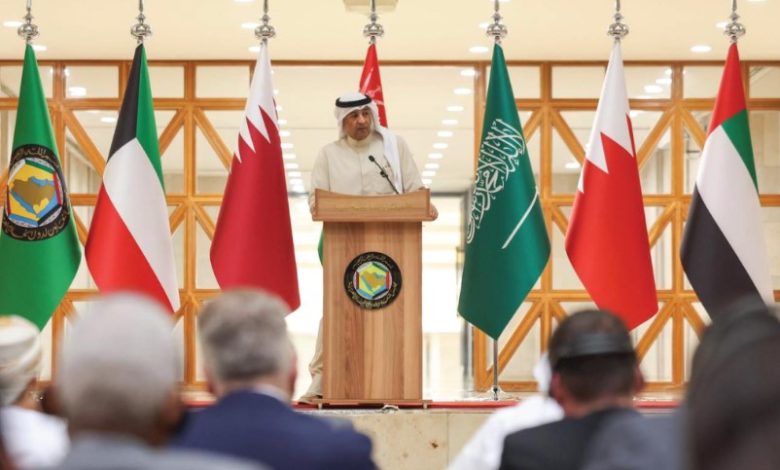
Speaking at a press conference on Thursday in Riyadh, the GCC chief noted that Iran has directed 85% of its attacks at Gulf States, despite offering assurances that they would not be involved in the conflict and making intensive efforts to prevent its escalation.
“Iran targeted hotels, embassies, water facilities, and airports, striking civilian sites and resulting in civilian deaths,” he said.
Furthermore, he accused Iran of launching “systematic attacks” against critical energy facilities, including “oil refineries in Saudi Arabia, Qatar, the UAE and Kuwait,” in addition to targeting sites near the Strait of Hormuz.
GCC Role in Talks
Al-Budaiwi held Iran responsible for the recent escalation, calling for an immediate halt to the attacks. He also stressed Gulf States’ right to self-defense under international law, although they favor diplomacy.
“The international community must send a unified message to Iran to stop its attacks,” he noted, calling for coordinated global pressure to prevent conflict escalation.
Importantly, he highlighted the need to involve Gulf countries in any potential negotiations aimed at settling the conflict.
“We emphasize the necessity of involving the GCC countries in any talks or agreements to resolve this crisis, in a way that contributes to strengthening their security and stability,” he said.
Moreover, al-Budaiwi rejected any effort to turn the Gulf countries into “arenas for regional score-settling.” He also rejected any post-conflict arrangements that would seek to redraw the map of the region.
Hormuz Blockade
During his address, al-Budaiwi condemned Iran’s reported demand for transit fees in the Strait of Hormuz as a “breach of international law,” affirming that global regulations prohibit any disruption to navigation in international straits and that no country has the right to impose such restrictions.
The Strait of Hormuz is a crucial waterway linking the Arabian Gulf with the Gulf of Oman and the Arabian Sea, serving as the main shipping route for crude oil from the Gulf region to the rest of the world.
Around a fifth of daily global oil supplies (about 20 million barrels per day), as well as a fifth of global liquefied natural gas (LNG) supplies, pass through the Strait of Hormuz, according to the US Energy Information Administration (EIA).
The ongoing US-Israeli war with Iran has led to the partial closure of Hormuz, blocking shipping through the strategic water corridor and disrupting regional supply chains.
US-Iran War
The US and Israel launched a joint attack on Iran on February 28, 2026, eliminating its Supreme Leader Ali Khamenei along with several top commanders and triggering an Iranian response that involved waves of drone and missile strikes across the region.
These Iranian attacks directly violated the sovereignty of several Arab States, including Saudi Arabia, Gulf countries, Iraq and Jordan. As a result, the UN Security Council and the UN Human Rights Council adopted resolutions strongly condemning Iran’s “egregious attacks” and demanding an end to “all unprovoked attacks” against Gulf States and Jordan.
The US and Iran have recently initiated indirect talks – mediated by Pakistan, Egypt and Türkiye – to resolve the conflict. Tehran is currently reviewing a 15-point proposal presented by Washington, according to Pakistani Deputy Prime Minister and Foreign Minister Ishaq Dar.