Endurance in Exile: The Untold Story of Sudan’s Turbulence
Surviving the Storm: A Sudanese Family's Tale of Resilience

Interview by Mennatullah Youssef
The people of Sudan have lived through difficult times that seemed like an eternity. They were dominated by feelings of fear mixed with anxiety and terror at facing an unknown future. How hard it is to be forced to flee your homeland!
The year 2023 was not an ordinary year for the people of Sudan. The country witnessed tragic events, the hardest and worst in its history, including a fierce war between the army and the Rapid Support Forces. The conflict, which started in the heart of the capital, Khartoum, spread to over 60% of the country, resulting in thousands of deaths, victims, and injuries, and the displacement of millions both within and outside the country.
Exclusive Interview with a Sudanese Family Head
Leaders-Mena magazine connected with the head of a Sudanese family who narrated his suffering and the story of his displacement due to the current situation in his country.
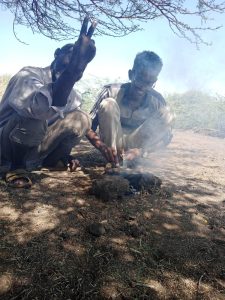
Pivotal Moments
Ahmed Salah, a Sudanese man, experienced painful moments during his displacement journey with his family, which included infants, children, and women.
Ahmed Salah opened up to Leaders-Mena magazine, saying: “I am a resident of Madani city in Sudan. A few days ago, the Rapid Support Forces threatened to enter and destroy the city. During those days, my entire family experienced continuous terror and anxiety. We heard distant bombing and gunshots, especially from the east.”
He added: “Thankfully, my family is safe, but one of my relatives was shot in the hand and another in the leg. However, our house was demolished like most in the city. It was a difficult feeling, for sure, because this is my city where I grew up, graduated, and lived my happiest memories. When the Rapid Support Forces started their attack, I refused to leave, saying, ‘I would rather die on my land than leave our home.'”
Escape Journey
“In the circumstances we witnessed, the women were terrified and wanted to flee. We were three men in the family, torn between fleeing and clinging to our lives, land, and memories.”
Salah continued sadly: “Unfortunately, the situation was stronger than us. We didn’t have enough money for the journey and to flee the country, as transportation prices had skyrocketed by about 300%. A ticket that cost 6,000 Sudanese pounds became 80,000.”
Facing the Future
“When the situation worsened and we faced danger, I suggested to my family that we leave on foot. The family included seven women with their children, including infants. We walked long distances to reach a village called ‘Umm Sunut’.”
Two Days on Dry Bread!
Recalling the journey, he said: “On the way, we faced the toughest moment when fleeing soldiers warned us that the Rapid Support Forces were following us. So, we had to enter a village west of the Sennar road called Al-Shakaba, where we spent a whole day. Later, a large truck stopped and agreed to take the women and children at a reasonable price, leaving us men on the street. We reached Sennar at sunset.”
He added: “We found the women still on the road, not knowing where to go, without enough money for transportation, and unsure of the direction. We survived two full days on the Sennar road living only on dry bread.”
End of Food and Supplies
“No one could help us. Everyone was only concerned with themselves,” the Sudanese man continued. “When we reached the women, there were two paths: one east and the other west, with a bridge in between. The women went west, and we followed them.

Struggle for Survival
Afterward, we reached a village called Mayerno until we got to the Blue Nile. Our final destination was a village east of the Nile called Sheikh Talha. After a long struggle and confusion, we found a car at 9 PM. At this point, our food and supplies had run out.
He pointed out that his family, especially the 12 children, had been without food or drink for over 12 hours. But thankfully, upon reaching the Blue Nile, travel became easier. We found a ferry crossing the Nile at a relatively cheap price of 500 Sudanese pounds per person, and then we reached our home in Sennar.
Currently, in the house, there are more than eight families, all gathered in a single apartment with two rooms and two halls. Every day, we spend more than 20,000 Sudanese pounds just on meals. None of us work, and we don’t know how we will meet our needs in the coming period.
Mid-Journey Crisis
He concluded his story, saying: “Most of the people support the official army. But at the same time, there was a framework agreement between the military side (the army + Rapid Support Forces) and the civilian side (Freedom and Change + other political parties
Related Topics:
KSrelief Resumes Its Aid to Sudan
Sudanese Military Factions Commit to Humanitarian, Trust-Building Measures
US Thanks Saudi Arabia for Hosting Sudanese Military Discussions in Jeddah