
A Homegrown Model: How Riyadh Envisions a New Regional Security Architecture
The ongoing conflicts across the Middle East raise a fundamental question: how to stop recurring rounds of regional escalation from becoming permanent? Saudi Arabia’s Advisor and Special Envoy of the Minister of Foreign Affairs for Negotiations and Peace Efforts, Manal Radwan, offered a thorough answer.
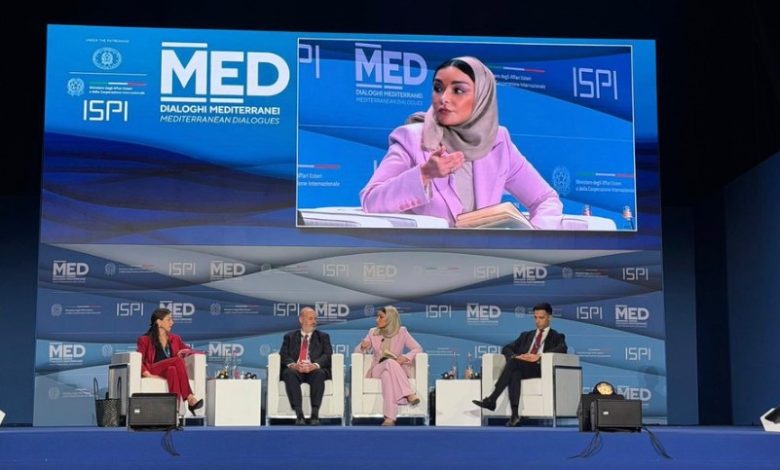
Speaking at the Mediterranean Dialogues (MED 2026) forum in Naples, Italy, Radwan outlined the Kingdom’s vision for a regional security architecture anchored in mutual guarantees to achieve lasting stability and peace.
Interdependent Security
The Big Picture: Participating in a session titled “Redefining Security: Iran, the Straits, and the Future of the Regional Order,” Radwan elaborated that in this sustainable regional security architecture, a state’s security cannot be separated from the stability of its neighbors. This model is based on mutual security guarantees that ensure the permanent settlement of conflicts.
Why It Matters: Building on the broader Gulf-Mediterranean diplomatic roadmap outlined in Naples by Saudi Vice Foreign Minister Waleed Al-Khuraiji and GCC Secretary-General Jasem Albudaiwi, the Saudi Special Envoy noted that temporary arrangements will not succeed in managing crises and preventing the renewal of conflicts unless they are aligned with long-term strategic frameworks.
Deterrence & Dialogue
State of Play: Radwan explicitly stated that there is no place in the region for any hegemonic power, emphasizing the close link between regional dialogue and international stability. She underscored the Gulf Cooperation Council (GCC) member states’ unified objectives and complementary roles in supporting mediation, de-escalation, and the prevention of a new war, paving the way for confidence-building.
The Saudi Approach: Radwan highlighted Saudi Arabia’s approach to conflicts and crises, which is based on combining containment, deterrence, and dialogue to defend the Kingdom’s security and the GCC’s stability.
The Context: Riyadh has reaffirmed that the security of the Kingdom and the GCC countries is inseparable, warning that it will not tolerate any threats to its sovereignty or interests. In parallel, Saudi Arabia has played a supportive role in the US-Iran negotiations, engaging with regional and international actors to reach a diplomatic solution to the ongoing conflict.
Flashback: On October 26, 2026, a high-level Saudi delegation, led by Defense Minister Prince Khalid bin Salman, alongside partners from the Makkah Defense Alliance, visited Tehran and held talks with senior Iranian officials to promote dialogue and diplomatic solutions.
Waterway Security Prioritized
Between the Lines: During her speech, Radwan noted that Saudi Arabia places great emphasis on securing critical maritime chokepoints such as the Strait of Hormuz and the Bab al-Mandab Strait, adding that this serves not only the interests of the Kingdom, but also those of the whole world.
The Backstory: The recent military escalation in the Middle East has caused shipping disruption in the Strait of Hormuz, through which around 20% of daily global oil and LNG supplies pass. Moreover, recent Houthi escalation has also affected shipping in the Bab al-Mandab Strait, which handles 10% to 15% of all global trade annually. These disruptions have directly impacted global energy markets and supply chains.
Saudi Maritime Defense: In response to the mounting threats to maritime chokepoints, Saudi Arabia launched the Multinational Maritime Defense Coalition in late July 2026, with 14 founding members, to address and deter the growing threats to maritime security, including attacks against commercial vessels, energy tankers, and naval infrastructure in the Bab al-Mandab Strait, the Red Sea, and the Gulf of Aden.
Confronting Non-State Threats
Zoom In: The Saudi Special Envoy explained that a purely military approach is not enough when dealing with non-state armed groups. This approach needs to be backed by a political vision that addresses the local drivers of the emergence of these groups and their ties to external parties that support and exploit them.
The Yemen Case: Radwan pointed to Yemen as a clear example, noting that the conflict is fundamentally an intra-Yemeni dispute that requires parallel political and economic tracks under the UN roadmap. While Saudi Arabia has consistently backed UN-led mediation to reach a comprehensive settlement and end the suffering of the Yemeni people, the Iranian-backed Houthi militia – which seized the capital Sanaa in 2014 – has repeatedly rejected peace proposals in favor of escalation.
Deterring the Threat: Since July 2026, the Iranian-backed Houthi militia has launched drones and missiles targeting several Saudi cities, including attempted attacks on Makkah and Madinah, as well as airports and energy facilities. Saudi Arabia’s air defenses have demonstrated exceptional operational readiness and efficiency in protecting the Kingdom’s airspace and critical infrastructure from external threats around the clock. Through its leadership of the Coalition to Restore Legitimacy in Yemen, the Kingdom remains committed to supporting the internationally recognized Yemeni government and restoring regional stability against non-state security risks.
Beyond Crisis Management
Go Deeper: Concluding her speech, Radwan warned of the catastrophic repercussions of managing regional crises without addressing their root causes. In this context, she called for collective action to reach a comprehensive and sustainable solution that serves the interests of all parties, enhances regional integration, and keeps pace with global geostrategic shifts.
The Anchor: Radwan tied the regional security architecture to the establishment of an independent Palestinian state. Saudi Arabia has been a steadfast supporter of the two-state solution, which envisions an independent Palestinian state along the 1967 borders with East Jerusalem as its capital, as the cornerstone of Middle East stability.
The Bottom Line: Saudi Arabia leveraged its participation in the MED 2026 forum to outline its vision for broader stability and set the stage for a unified regional security architecture that safeguards state security and respects the interests of neighboring countries.