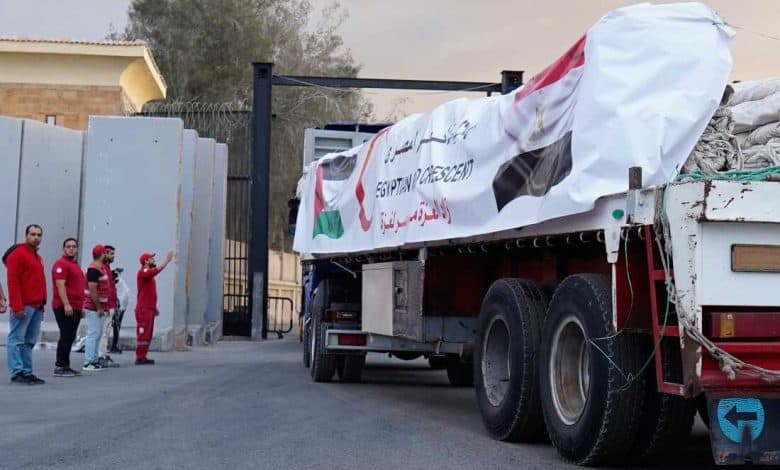
The United Nations and the international Red Cross called on Tuesday for authorities to open all crossings into Gaza, allowing desperately needed humanitarian aid into the Israeli-blockaded Palestinian territory. They argued the fragile truce, introduced under US President Donald Trump’s plan, now requires the immediate opening of all crossings to flood the famine-hit territory with essential aid.
Consequently, International Committee of the Red Cross (ICRC) spokesman Christian Cardon told reporters in Geneva that humanitarians insist all entry points must open immediately due to the territory’s immense needs. Jens Laerke, spokesman for the UN humanitarian agency OCHA, simultaneously emphasized the urgency, stating simply, “We need all of them open.” Laerke acknowledged that not all crossings currently function; indeed, some remain partially destroyed, requiring immediate repair and road clearance inside the Gaza Strip for supply trucks. Therefore, he confirmed, “We are calling for that to be repaired so that they can become operational.”
Aid Blockade and Accusations
The UN previously declared a famine in Gaza on 22 August, making it the first such declaration in the Middle East, after experts warned 500,000 people faced “catastrophic” conditions. Israel initially imposed a total blockade on Gaza on 2 March, allowing nothing in until late May when aid trucks began arriving only at a trickle. However, Israel has accused Hamas of manufacturing the crisis, claiming the group actively steals incoming humanitarian aid shipments intended for the populace.
Furthermore, critics accuse the Israeli army of equipping Palestinian criminal networks in its fight against Hamas, subsequently allowing them to plunder crucial aid deliveries. OCHA’s Jonathan Whittall stated in May, “Criminal gangs carried out the real theft of aid since the war’s beginning, operating under the watchful eye of Israeli forces.” Laerke later confirmed on Tuesday that the UN currently has 190,000 metric tons of essential aid waiting, ready to immediately enter Gaza.
Catastrophic Destruction Hinders Delivery
UNICEF spokesman Ricardo Pires moreover reported that the UN children’s agency currently has 1,370 supply trucks ready to enter the besieged territory, admitting they are “far from that” goal, specifying that the massive level of destruction means they must aim for at least 600 truck deliveries daily. The World Health Organization (WHO) also strongly stressed the immediate need to send more essential medical aid into Gaza.
Spokesman Tarik Jasarevic informed reporters, “We need to scale up the delivery of medical supplies because the intense pressure on hospitals will not ease overnight.” He stressed they must bring the maximum possible number of supplies right now to ensure health workers still providing care possess necessary equipment. The WHO has, consequently, brought eight trucks loaded with medical supplies into Gaza since the ceasefire between Israel and Hamas took effect on 10 October.
Rebuilding and Recovery
Laerke indicated that even after the aid gets into Gaza, the “very fluid situation” on the ground will still make the final delivery extremely challenging. For instance, over the weekend, roughly 310,000 Palestinians moved from southern Gaza toward the north, while another 23,000 relocated in the opposite direction. At the same time, the UN development agency simultaneously described the overwhelming destruction in Gaza as “almost beyond comprehension.” Jaco Cilliers, the UNDP’s special representative for assistance, stated the debris alone could fill Central Park up to 12 meters high, equalling 13 Great Pyramids of Giza. Speaking from Jerusalem, Cilliers stressed that removing this “devastating” rubble remains absolutely vital for the efficient movement and delivery of aid.