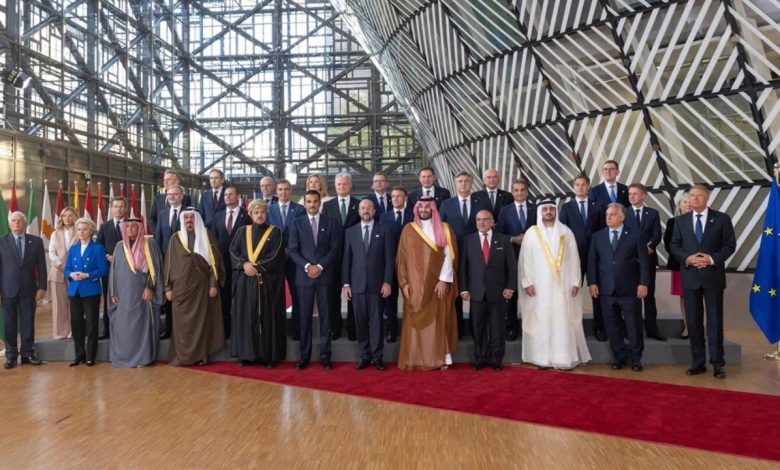
The big picture: Saudi Arabia will host the second summit between leaders of the Gulf Cooperation Council (GCC) and the European Union on 24 October, 2026, in Riyadh. Consequently, this high-level gathering highlights the Kingdom’s expanding influence as a central diplomatic bridge and economic power in the Middle East. Meanwhile, the multilateral summit will bring together leaders from 27 EU member states and six GCC nations (Saudi Arabia, Bahrain, Kuwait, Oman, Qatar, and the United Arab Emirates). European Council President António Costa will co-chair the event alongside European leaders. European Commission President Ursula von der Leyen will also represent the European bloc.
Why it matters: Saudi Arabia continues to solidify its role as an indispensable regional peacebuilder and global economic hub. Furthermore, the Kingdom’s robust bilateral relationship with the EU anchors broader multilateral cooperation between Europe and the Gulf. As regional security challenges grow, both blocs seek deeper political alignment, maritime safety cooperation, and energy integration.
António Costa emphasized that political dialogue, coordination, and engagement anchor the EU-GCC strategic partnership to promote peace, security, and prosperity. “Our past, present, and future are interconnected,” Costa said. “Therefore, the time has come to deepen the EU-GCC partnership,” he added.
Driving Regional Stability and Global Diplomacy
Between the lines: Saudi Arabia’s diplomatic weight in the Middle East provides a strong foundation for this summit. Moreover, the Kingdom actively drives conflict de-escalation, mediates disputes, and promotes regional economic integration under Vision 2030. Indeed, European partners increasingly view Riyadh as an essential ally for maintaining stability across vital trade corridors, including the Red Sea and Bab Al-Mandab Strait.
Furthermore, security integration remains a central priority for both regions. European defense firms actively contribute to regional technology transfers, industrial ecosystems, and cyber defense initiatives. Meanwhile, joint naval and diplomatic efforts safeguard crucial maritime routes, protecting global supply chains from ongoing geopolitical volatility.
Additionally, a 1989 cooperation agreement laid the initial foundation for structured dialogue across economic relations, energy, climate change, environment, and research. However, current global developments require an evolved operational security and trade framework between both regions.
By the numbers:
- Total goods trade: Economic exchanges between the EU and six GCC nations reached SAR 686.2 billion ($182.9 billion / €165.6 billion) in 2025.
- EU exports to Gulf: European suppliers delivered goods worth SAR 455.9 billion ($121.5 billion / €110 billion) to GCC markets.
- Gulf exports to EU: GCC states exported SAR 230.4 billion ($61.4 billion / €55.6 billion) in goods to Europe, with fuels comprising over 75% of imports.
- Decade trade growth: Two-way goods trade expanded nearly 30% over ten years, while Gulf exports to Europe surged almost 54%.
- Services trade surge: Bilateral services trade doubled over a decade, hitting SAR 349.8 billion ($93.2 billion / €84.4 billion) in 2024.
- EU service exports: European providers exported SAR 232.9 billion ($62.1 billion / €56.2 billion) in services, whereas GCC providers exported SAR 116.9 billion ($31.1 billion / €28.2 billion).
- Foreign direct investment: European FDI stock in the Gulf reached SAR 675.9 billion ($180.2 billion / €163.1 billion).
- Gulf investment in Europe: GCC FDI stock across EU member states reached SAR 786.6 billion ($209.7 billion / €189.8 billion).
- Energy dominates: Fuels account for more than 75% of EU goods imports from GCC countries.
Expanding Strategic and Economic Investment
Following the inaugural Brussels summit, the Riyadh gathering will accelerate joint initiatives in clean energy, defense technology, and supply chain security. Consequently, Saudi Arabia and its Gulf partners are positioning themselves as global leaders in green hydrogen and renewable energy exports. Meanwhile, European companies are investing heavily in Saudi gigaprojects and industrial ecosystems under Vision 2030.
In addition, clean energy initiatives drive the next phase of bilateral relations. Gulf nations continue to expand solar capacity and hydrogen production to meet European sustainability targets. Therefore, the Riyadh summit offers a crucial opportunity to align regulatory frameworks, stimulate cross-border investment, and secure shared economic interests.
Furthermore, both sides emphasize digital transformation and technological innovation as pivotal growth drivers. Joint ventures in artificial intelligence will diversify revenues. Ultimately, this upcoming landmark summit in Riyadh will transform political ambitions into long-term strategic action.
What’s next: The two blocs still must turn goodwill into real agreements. Talks on an EU-GCC free trade deal date back to the 1990s, and they remain stalled. Officials, however, keep pushing a parallel strategic dialogue on trade facilitation. Negotiators are also working through a Schengen visa waiver for Gulf nationals. Gulf governments see this as a priority for citizens and business travelers alike.
Saudi Arabia’s hosting role next month gives Riyadh a direct hand in shaping the agenda. It also fits a broader shift underway in Europe. European capitals increasingly treat Gulf partners as essential players in energy security and regional stability, not just distant trade partners. EU-GCC relations trace back to a 1989 cooperation agreement. Yet the scale of today’s engagement, and Saudi Arabia’s growing role in driving it, marks a genuinely new chapter.