The US and Iran are sending delegations to Qatar this week amid conflicting statements about scheduled talks in Doha. While US President Donald Trump insists that both sides will meet, Tehran denies any planned talks with the American delegation.
The inconsistency follows days of reciprocal attacks around the Strait of Hormuz, with each side accusing the other of violating the terms of a recently signed Memorandum of Understanding (MoU) to halt hostilities and negotiate a comprehensive agreement.
US Confirms Doha Meeting
Trump on Monday said that Tehran had asked for a meeting with the US and that it would take place in the Qatari capital. “IRAN HAS REQUESTED A MEETING. IT WILL TAKE PLACE TOMORROW IN DOHA!” he posted on Truth Social.
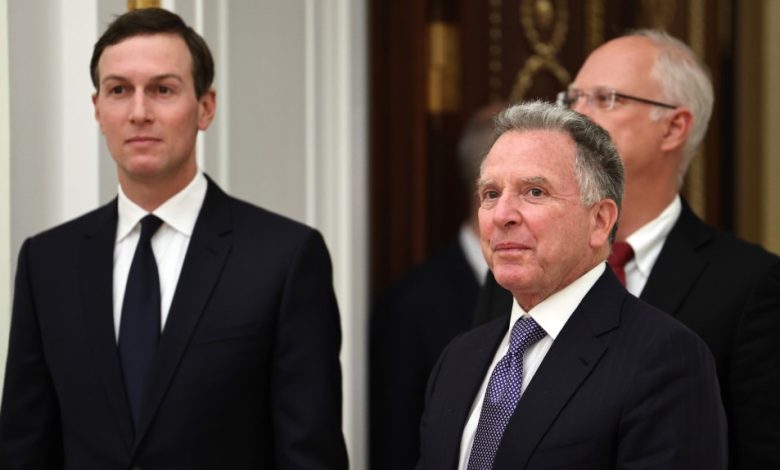
Shortly after, White House Press Secretary Karoline Leavitt confirmed that Trump’s envoys Steve Witkoff and Jared Kushner would travel to Qatar to attend the meeting.
“Special Envoy Witkoff and Jared Kushner will be flying to Doha for high-level meetings this week, as we continue to discuss the memorandum of understanding. On the sidelines of those high-level talks, will be the technical talks,” she told Fox News.
“As far as we’re concerned, we’re holding up our end of the ceasefire. Violence will be met with violence,” she added.
Speaking to reporters in the Oval Office, Trump said that the meeting in Doha “is going to be perhaps important, perhaps not. We’re going to find out.”
Iran Pushes Back
In response to Trump’s claim, Iran denied any scheduled talks with the US. Iranian Foreign Ministry Spokesperson Esmaeil Baghaei said that Tehran was sending its technical delegation to Qatar this week.
However, he noted that the Iranian team would discuss terms of the interim deal without engaging with the US at any level. “We will not have any negotiation meetings at any level with the American side in the coming days,” Baghaei said.
In a similar vein, Iran’s top negotiator and Deputy Foreign Minister Kazem Gharibabadi confirmed that no technical meetings have been arranged for this week, according to IRNA.
Frozen Iranian Assets
Baghaei said that the Iranian delegation would discuss the planned release of frozen Iranian assets and other issues related to the US-Iran preliminary deal. However, US officials emphasize that no frozen Iranian assets have been released.
On Monday, Iran’s President Masoud Pezeshkian argued that $6 billion out of $12 billion of frozen Iranian assets held in Qatar would be released and transferred back to Iran under recent arrangements, reported IRNA.
He also described the Islamabad MoU with the US as a “great victory for the Iranian people,” emphasizing that it includes the removal of sanctions on Iran’s oil and petrochemical sectors.
Meanwhile, a US official told the Associated Press (AP) that the released frozen assets would be used to purchase US food products for the Iranian people.
The Future of Hormuz
The US and Iran exchanged strikes over the past days, as vessels transited the Strait of Hormuz using a passage not approved by Iran. The Islamabad MoU states that Tehran “will make arrangements using its best efforts for the safe passage of commercial vessels through the waterway”.
The fifth provision of the agreement notes that Iran and Oman will hold discussions with other Gulf littoral countries to “define the future administration and maritime services in the Strait of Hormuz.”
In light of this, Tehran and Muscat on Monday held the first meeting of the Joint Hormuz Committee to discuss the future administration of the waterway in line with the MoU.
Following the meeting, Omani Foreign Minister Badr Albusaidi said that both countries were considering charging service-related fees for commercial ships transiting the Strait of Hormuz.
These services could include water safety measures, pollution prevention, navigational assistance and preparedness for incidents such as fires, he told Radio Monte Carlo.
However, he made clear that Oman opposes imposing transit fees on vessels. “This is internationally forbidden, and we are abiding by these rules,” he stressed.
Separately, Iranian Deputy Foreign Minister Gharibabadi asserted that clearing mines from the critical waterway “is carried out solely by Iran and by no other country” in response to remarks by French President Emmanuel Macron suggesting that France, Oman and others would collaborate in this regard.