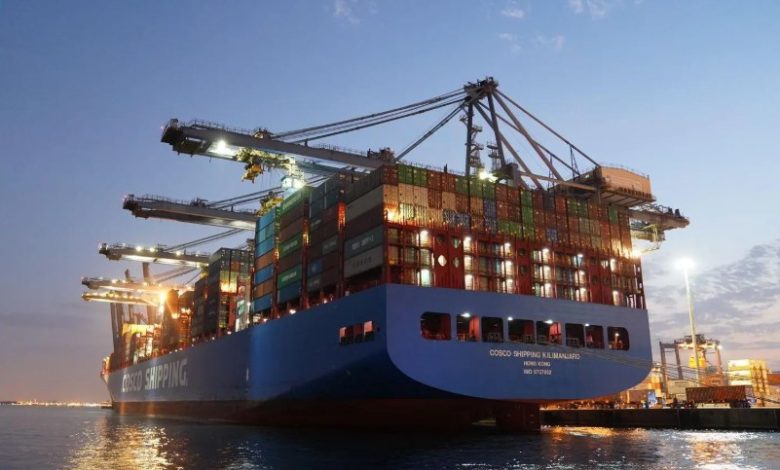
Saudi Arabia’s Jeddah Islamic Port has emerged as a key logistics hub and an alternative lifeline to the Strait of Hormuz, amid rising tensions in the Arabian Gulf.
The ongoing US-Israeli war with Iran has led to the partial closure of Hormuz, blocking shipping through the strategic water corridor and disrupting regional supply chains.
War Impact on Shipping
The Strait of Hormuz is a crucial waterway linking the Arabian Gulf with the Gulf of Oman and the Arabian Sea, serving as the main shipping route for crude oil from the Gulf region to the rest of the world.
Around a fifth of daily global oil supplies (about 20 million barrels per day), as well as a fifth of global liquefied natural gas (LNG) supplies, pass through the Strait of Hormuz, according to the US Energy Information Administration (EIA).
Military tensions in the region have caused traffic disruption across ports in the Gulf region which imports about 85% of its food.
Data from MarineTraffic showed that over 60 ships en route to ports in the Arabian Gulf had to divert, with some returning to ports in China and India. Meanwhile, other vessels headed to ports on the Arabian Peninsula along the Arabian and Red seas.
Shipping companies are cooperating with governments in the region to prioritize which commodities to deliver first, with food and medicine topping the list.
“The region is extremely import-driven, which means that from all the containers that are coming into the region, every single commodity that you could think of would be within those containers,” the regional managing director of shipping giant Maersk, Charles van der Steene, told CNN.
Logistics Corridors Initiative
On March 11, 2026, Saudi Arabia launched the “Logistics Corridors Initiative” to reroute shipping from ports in the Arabian Gulf to the Kingdom’s Red Sea ports amid the US-Israeli war with Iran.
The initiative is designed to establish dedicated operational corridors to receive redirected cargo from ports in Gulf Cooperation Council (GCC) countries and the Eastern Region to Jeddah Islamic Port and other ports along the Red Sea coast. This, in turn, stabilizes regional supply chains and accelerates the flow of goods across the Kingdom.
Furthermore, the Saudi Ports Authority (Mawani) has forged a SAR 3 billion ($800 million) partnership with DP World to expand the South Container Terminal at Jeddah Islamic Port to bolster operational capabilities and boost its capacity from 1.8 million to 4 million TEUs.
Boosting Operational Efficiency
Saudi Arabia has also eased customs and regulations, in addition to building a network of roads and trucks, to facilitate shipments to its neighboring countries.
As a result, more than 94,000 outbound trucks have been recorded at all land borders between February 28 and March 18, CNN reported citing Saudi officials. Officials at the Jeddah Port also expect a 50% spike in inbound traffic over the coming two weeks due to heightened demand.
Saudi Shipping Infrastructure
Saudi Arabia is the only country that shares borders with all its Arab neighbors in the Arabian Gulf. Thus, the Kingdom has heavily invested in infrastructure that reduces reliance on the Strait of Hormuz to connect Gulf cargo to global markets without passing through the strait.
The East-West Crude Oil Pipeline, also known as Petroline, is a 700-mile-long pipeline that runs from the Abqaiq oilfield in the Eastern Province to Yanbu along the Red Sea coast.
Most recently, Aramco announced that Petroline’s capacity had surged to 7 million barrels a day, contributing to a one-third hike in overall Red Sea traffic since the war began.
While the Petroline secures Saudi Arabia’s energy exports via Yanbu, Jeddah Islamic Port serves as the corresponding gateway for the Kingdom’s – and the region’s – essential commercial and consumer imports.
Jeddah Islamic Port
Jeddah Islamic Port is located on the Red Sea, connecting major markets in Africa, Asia and Europe. As the second-largest and second-busiest port in the Arab world, the Jeddah Islamic Port accounts for about 75% of Saudi Arabia’s maritime trade.
Spanning approximately 12.5 square kilometers, the port can accommodate vessels carrying up to 19,800 TEUs. Each year, it receives around 5,000 vessels and handles 130 million tons of cargo.
The port has 62 berths for handling passengers, containers, general cargoes, livestock, bulk grains, and vehicles. It also has four main terminals, including North and South Container Terminals and the Red Sea Gateway Terminal, with a combined annual capacity of 7.5 million TEUs.
Regional Support
While focusing on the Red Sea gateway, Mawani simultaneously continues to provide support for vessels operating in the Arabian Gulf. In light of this, it launched an initiative that utilizes its capabilities across ports in the Eastern Region to deliver integrated services that meet vessel needs efficiently and promptly.
These services include providing food supplies, medical supplies, crew change services, as well as bunkering and water supply services, in addition to any other operational requirements that ensure the smooth and efficient continuity of maritime voyages.