The Governor of Saudi Arabia’s Public Investment Fund (PIF) and Chairman of Aramco, Yasir Al-Rumayyan, underscored the Kingdom’s economic resilience in the face of the current geopolitical tensions.
Furthermore, Al-Rumayyan said that the PIF will unveil its next five-year strategy in the coming weeks, amid a strategic shift in the fund’s approach to attract investments from around the world.
Economic Resilience
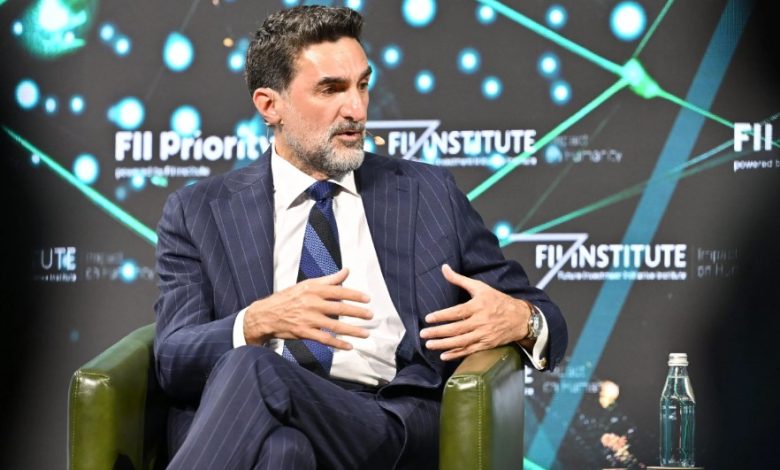
Speaking at the Future Investment Initiative (FII) Priority Summit 2026 in Miami, Al-Rumayyan confirmed that the current conflict in the Middle East has no effect on Saudi Arabia’s economic growth.
“The Saudi microeconomic and physical position remains strong, stable and resilient, and PIF’s portfolio is well diversified and structurally resilient,” he said.
The PIF Governor attributed this to the fund’s strategy of operating as a long-term investor. “We measure our returns not in quarters but in decades. And PIF remains committed to its investments around the world,” he added.
PIF’s Evolution
Al-Rumayyan highlighted the PIF‘s successful journey since its establishment in 1971 as a “nation builder” that created various sectors within the Kingdom’s economy.
Then, the second transition took place from the year 2015 to 2020, during which the fund “accelerated a number of different sectors,” he said.
The third phase, from 2021 to the end of 2025, saw a lot of things changed as the PIF made heavy investments in the domestic economy, according to Al-Rumayyan.
PIF Strategy
With regards to the PIF’s new strategy, Al-Rumayyan said that the fund will reveal its strategy for the next five years “in the coming few weeks.” This strategy will focus on attracting more global investments by encouraging third-party capital and creating more opportunities.
“We built the foundation for many of these investments initially, and under the previous strategy we wanted to do most of the investments by ourselves. It’s all equity,” the PIF Governor said.
“Now we’re looking in a greater way, how to invite people to come and work with us. And I’m not talking only about domestic investors, local investors … I’m talking about international investors,” he added.
Al-Rumayyan noted that this strategy has started to pay off as several major asset managers, such as BlackRock and Franklin Templeton, have established new funds with the PIF to invest in the Saudi economy.
Encouraging Global Investors
Al-Rumayyan said that the fund’s main priority has shifted from introducing the PIF to the world to inviting global investors to Saudi Arabia.
“The main thing that we tried to achieve is how to bring Saudi to the world, how different investors around the world will know who PIF is, and what Saudi and what investments in Saudi could feel or look like,” he said.
“Now we’re in a stage where we want to bring the whole world to come and invest in Saudi. And for the past 10 years or so, we built the foundation for these investments for the right environment, the right ecosystems for people to come and invest with us,” he added.
Importantly, he emphasized that the PIF is moving beyond traditional joint ventures to offer more diverse entry points for global capital.
“And there could be different parts of investments. It doesn’t have to be all in the form of JVs (joint ventures) or an actual investment into our companies, but to come and work with us and the investments that we’re (already) in,” he explained.
Areas for Investment
In addition to urban development and real estate projects, Al-Rumayyan outlined various areas for investment in the Saudi economy. These include data centers, pharmaceutical sectors, infrastructure and renewable energy.
He added that the PIF’s new strategy aims to “crowd in” the private sector – domestic and global – to work with the fund. In light of this, Al-Rumayyan cited Red Sea Global (RSG) as a “stunning” model of development, bringing in around 19 hotel operators from across the world.
Furthermore, he pointed out that “de-risking” is one of the fund’s key priorities for projects within the Kingdom.
AI Potential
Al-Rumayyan noted that Saudi Arabia is “very well-positioned” to take advantage of artificial intelligence (AI), stressing that AI is not a race.
“We have the accessibility of procurement … We have the energy to ignite it, which is something very important to put (in) all of these data centers. On top of that, we have the right ecosystem for it, the right regulations, the right treatment from the government to the users of AI,” he said.
Moreover, he said that the fund views AI as a tool, not an end product. “The end product is what our companies are doing, how our companies can cut costs and be more efficient, delivering on their promises faster than expected. That’s how we’d like to get to work with AI as a major tool,” he clarified.
Al-Rumayyan said that the PIF has invited major US tech firms, including Microsoft, Google, and Oracle, to invest in Saudi Arabia. “And I think the progress in Saudi Arabia is one of the best, even globally when it comes to the uses of AI,” he stated.
In this regards, he cited Aramco as a great example of utilizing AI to reduce the cost of drilling by about 20% and improve the delivery of end products by nearly 30%.