Ireland plans to curb its proposed sanctions on Israel, blunting a law central to its protest over the war in Gaza, after pressure from business groups concerned about the impact on investment, according to Reuters.
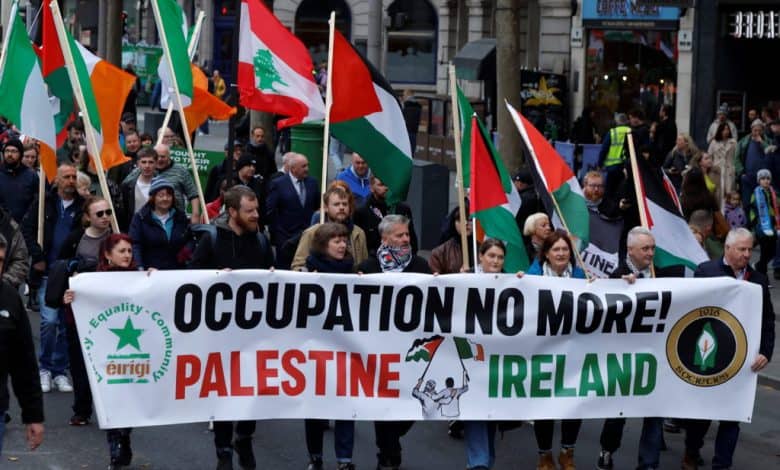
Ireland’s government has been one of the most outspoken critics of Israel’s assault in Gaza. However, unlike others such as Spain, it hosts the European headquarters of some of the US’s biggest companies, making it uniquely vulnerable to pressure from the US.
Mainly US-owned foreign multinationals employ around 11% of Irish workers and contribute most of the corporate tax that makes up almost a third of all Irish tax receipts. Although many governments have condemned Israel’s offensive in Gaza and its annexation of territories in the West Bank, it has remained largely unsanctioned, shielded from economic pressure by its close alliance with Washington.
Corporate Pressure
Business representatives in Ireland have this year urged the government to delay any law and reduce its scope, the sources said, to avoid antagonising US companies and investors, discouraging them from investing in Ireland. Moreover, business lobby groups and company representatives have in recent months visited government officials, underscoring their concerns that the bill will further upset relations with the US and Israel, the people said.
Additionally, the Irish Business and Employers Confederation, the biggest industry lobby group, whose members include pharmaceutical, software and banking companies, has publicly shared its concerns about Ireland’s stance, saying the US could penalise multinational companies in Ireland for boycotting Israel.
Government Response
Consequently, government officials are now planning to limit the scope of the legislation to goods only, catching a handful of products imported from Israeli-occupied territories such as fruit that are worth just 200,000 euros a year. This would exclude the wider category of services that opposition parties have demanded be added, a move the government has been considering.
Although the government has not made a final decision, the report claims it will likely follow the advice of some senior officials and business organizations who argued against widening the bill to services.
Foreign Minister Simon Harris has told parliament he would receive advice from the attorney general “shortly” on whether services can be included. He previously flagged concerns that it may not be legally possible.
A spokesperson for the foreign ministry pointed Reuters to comments by Harris in parliament on Thursday that parliament would debate the bill before it breaks for holidays in mid-December but that wider European measures would have far more weight.
International Context
Ireland is pushing for a swift vote on proposals from the EU Commission to suspend free-trade arrangements on Israeli goods. However, getting this through in the face of German opposition is in question.
After Ireland became the first EU country to commit to trade restrictions last October, Slovenia introduced a ban on imports of goods in August while Belgium, Spain and the Netherlands announced similar bans on goods last month.
Ireland’s relations with Israel have been fraught. Last December, Israel shut its embassy in Dublin amid a row over Ireland’s criticism of its war in Gaza, including Ireland’s recognition of a Palestinian state last year.
“I believe the idea that foreign investors would leave Ireland has been much exaggerated,” said Alice-Mary Higgins, a member of the joint committee on foreign affairs and trade, charged with scrutinising the bill, who backs the inclusion of services. “What is the alternative? To reward profiteering in goods and services on stolen land?”