From Relief to Reconstruction: Saudi Arabia Advances Multi-Billion Support for Palestine
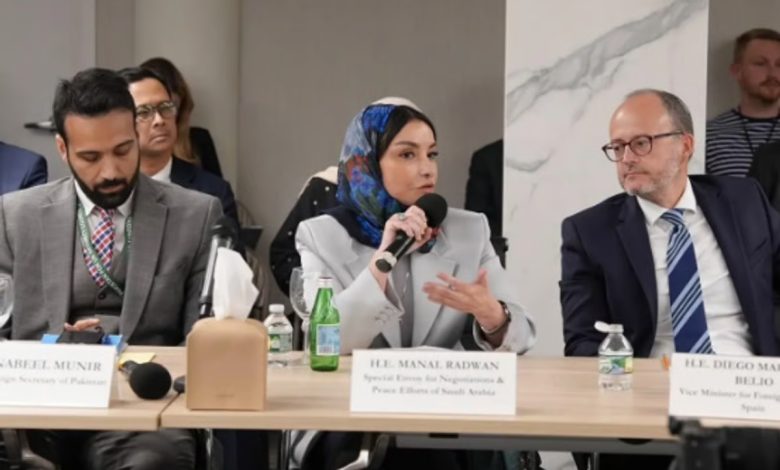
The big picture: Saudi Arabia urged all parties on Thursday to finish the first phase of the Gaza peace plan and move ahead with Phase Two. Dr. Manal Radwan, adviser and special envoy to the foreign minister for negotiations and peace efforts, delivered the message in New York, speaking on behalf of the Saudi foreign minister.
What happened: Egypt hosted the high-level roundtable, titled “From Sharm El-Sheikh to Phase II: Consolidating Peace and Early Recovery,” at its Permanent Mission to the United Nations. France, Germany and the European Commission co-chaired the meeting. Regional and international partners, UN agencies and the Board of Peace also took part.
Diplomatic Mobilization and Structural Recovery
Dr. Radwan praised Egypt’s efforts to support the end of the war, the humanitarian response, early recovery and reconstruction in Gaza. She then called on every party to honor the outcomes of the Sharm El-Sheikh summit in full. She also urged progress on President Trump’s comprehensive plan and UN Security Council Resolution 2803, in a way that reinforces Palestinian ownership.
Radwan voiced concern over worsening humanitarian conditions as winter approaches. Aid, she said, must enter without obstacles or preconditions. She rejected any use of the humanitarian file as a pressure tool or a way to push Palestinians out.
In her official address, Dr. Manal Radwan issued a clear call for international accountability regarding humanitarian delivery:
“The international community must ensure the unhindered entry of humanitarian aid without preconditions. We firmly reject the politicization of humanitarian assistance or its use as an instrument for pressure and forced displacement.”
Why it matters: Riyadh ties relief to politics, and it has said so consistently. At the Global Alliance for the Implementation of the Two-State Solution, Radwan said security and a political solution are inseparable. Stability without a credible political horizon, she added, will prove temporary. She also affirmed full Saudi support for the Palestinian government’s reform program, as a step toward its return to Gaza while preserving the unity of Gaza and the West Bank.
The Kingdom has kept up the same message in other forums. In July, Radwan represented Saudi Arabia at the Palestine Donors Group in Brussels. She said Gaza’s humanitarian situation remained critical nine months after the ceasefire, citing Israeli military control over nearly 70% of the territory. She also warned that settlement expansion and settler violence in the West Bank make the crisis political, not only humanitarian.
Comprehensive Relief and Bilateral Economic Support
Saudi Arabia also acts alongside its Arab and Islamic partners. Its foreign minister joined counterparts from the UAE, Qatar, Jordan, Indonesia, Pakistan, Turkey and Egypt in a joint statement on September 22. The ministers reiterated their categorical rejection of the expulsion or forced displacement of Palestinians. They also backed a road map for Phase Two that covers full Israeli withdrawal, deployment of an International Stabilization Force, and the launch of early recovery and reconstruction.
Moreover, the Kingdom backs its diplomacy with funding. Radwan said the King Salman Humanitarian Aid and Relief Center (KSrelief) has carried out roughly 160 projects in Palestine. The Kingdom has also given direct support to the Palestinian government and continues to back UNRWA.
By the numbers:
- SAR 19.5 billion ($5.2 billion): Saudi Arabia delivered this total historic aid package to Palestine since 1999.
- SAR 2.05 billion ($548 million): KSrelief allocated this total amount across 159 humanitarian projects in Palestine.
- SAR 1.875 billion ($500 million): KSrelief dedicated this estimated value toward active relief operations in Palestinian lands.
- SAR 450 million ($120 million): The Kingdom provided this direct financial grant to support the Palestinian National Authority.
- SAR 3.75 billion ($1 billion): Saudi Arabia contributed these funds to UNRWA over the last ten years.
- 160 projects: KSrelief successfully implemented these emergency initiatives spanning food, health, and shelter sectors across Gaza and the West Bank.
Leading Global Peace Initiatives
Beyond direct humanitarian relief, Saudi Arabia actively drives international diplomatic campaigns for Palestinian rights. Recently, Saudi Foreign Minister Prince Faisal bin Farhan established the Global Alliance for the Implementation of the Two-State Solution. Consequently, this alliance builds international momentum to establish an independent Palestinian state based on 1967 borders.
Furthermore, the Kingdom regularly convenes high-level summits with Arab, Islamic, and global partners to protect civilians. Through these continuous diplomatic efforts, Saudi Arabia champions official international recognition of Palestine. The Kingdom maintains that lasting regional security requires a sovereign, independent Palestinian state with East Jerusalem as its capital.
What’s next: Winter will test the aid pipeline first. Radwan’s call for unconditional access reflects that urgency, because shelter, food and medicine are the immediate priorities.
Phase Two carries the larger political weight. The road map links it to decommissioning, full Israeli withdrawal, the arrival of stabilization forces, and a national committee taking over administration across Gaza. Saudi Arabia says it will keep working with its partners to speed early recovery. Radwan stressed that recovery must preserve the unity of Palestinian land, strengthen the institutions of the Palestinian National Authority, and pave the way to a just and lasting peace.
Meanwhile, KSrelief continues its field work. Under a directive from King Salman, it runs a popular campaign that supports Gaza’s residents.