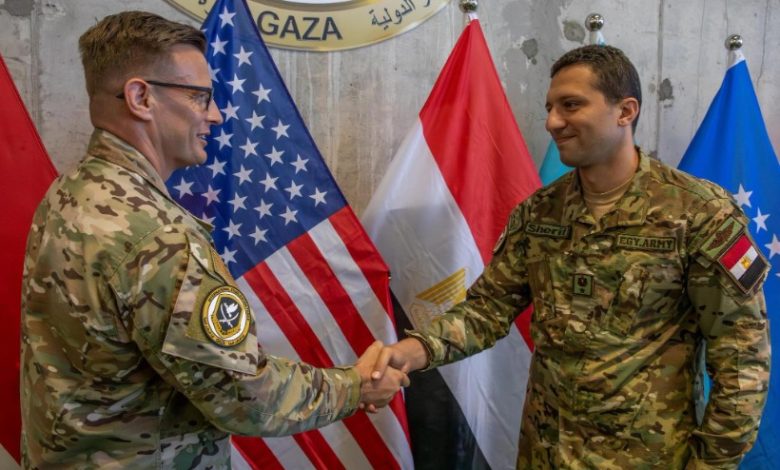
The Gaza Board of Peace (BoP) announced that Egypt has joined the International Stabilization Force (ISF) which is set to be deployed to the Strip during the second phase of the peace plan.
Meanwhile, talks have resumed in the Egyptian capital between Hamas, Palestinian factions and mediators to discuss the implementation of the ceasefire agreement and preparations for the second phase.
Egypt Joins ISF
In a post on X, the BoP shared photos of Egyptian troops joining the ISF, doubling down on the significance of Egypt’s contributions to the ISF, which will help the force “scale up operations to create a safer & more secure Gaza.”
“As a country sharing a border with Gaza, the participation and leadership of Egypt in this shared effort is critical to mission success,” the BoP said.
Egypt's contributions will help the #ISF scale up operations to create a safer & more secure Gaza. As a country sharing a border with Gaza, the participation & leadership of Egypt in this shared effort is critical to mission success. pic.twitter.com/QVTc0Ld5uQ
— Board of Peace (@BoardOfPeace) June 4, 2026
Egypt is a key mediator and guarantor of the Gaza ceasefire agreement signed in October 2025 between Hamas and Israel. It is also a member of the BoP‘s Gaza Executive Board, aimed at supporting the work of the National Committee for the Administration of Gaza (NCAG).
ISF Mission
US President Donald Trump’s 20-point peace plan, endorsed by the UN Security Council in November, authorizes the formation and immediate deployment of the ISF in Gaza, led by Major General Jasper Jeffers III. The ISF‘s mission includes security operations, supporting comprehensive demilitarization of Gaza, and enabling the safe delivery of humanitarian aid and reconstruction materials.
The force is set to be deployed during the second phase of the ceasefire plan. It will work with Egypt, Israel and newly trained Palestinian police to gradually replace Israeli troops, help maintain security and demilitarize the Gaza Strip.
According to plans revealed earlier by the ISF commander, 20,000 soldiers will be deployed in five different sectors of Gaza, beginning with Rafah. This will be followed by a new police force, comprising 12,000 personnel, with Egypt and Jordan committing to training officers in the future.
Countries that have officially committed to contributing personnel to the ISF include Indonesia, Albania, Kazakhstan, Kosovo and Morocco.
Advancing Phase Two
Cairo is hosting a new round of negotiations to advance the Gaza ceasefire agreement and move forward with the deal’s second phase.
A senior Hamas delegation, led by Khalil Al-Hayya, began on Saturday a round of talks with Egyptian officials, mediators and other Palestinian factions to discuss the implementation of the agreement’s first phase and establish mechanisms for entering the second phase.
Hamas spokesperson Hazem Qassem said in a statement that the talks focus on ensuring full implementation of the first phase, including ending Israeli violations, reopening border crossings and allowing humanitarian aid into Gaza.
Furthermore, he said that negotiations aim to address issues related to the agreement’s second phase, including the deployment of international forces and the disarmament of Palestinian factions.
Qassem noted that Hamas has approached the negotiations with a sense of national responsibility, prioritizing the interests of the Palestinian people and working to prevent the return of the war.
The Israeli war on Gaza has killed nearly 73,000 Palestinians and injured over 173,000, most of them women and children. Despite a ceasefire taking effect in October 2025, Israel has killed more than 950 Palestinians and wounded over 2,900, according to Gaza’s Health Ministry.
Disarmament Dilemma
The second phase of the peace plan calls for the disarmament of Hamas, the comprehensive demilitarization of the Gaza Strip and the launch of the reconstruction process.
However, disarming Hamas remains a sticking point as the Palestinian movement has repeatedly rejected giving up its weapons before complete Israeli withdrawal.
The BoP High Representative for Gaza Nikolay Mladenov told the UN Security Council in May 2026 that the ceasefire was stalled over “Hamas’ refusal to accept verified decommissioning, relinquish coercive control, and permit a genuine civilian transition in Gaza.”
He also said that Hamas’ rejection of disarmament has paralyzed progress. “Reconstruction cannot commence where weapons have not been laid down,” he noted.
In response, the Palestinian group said the report “contains a number of fallacies that absolve the occupying government of its responsibilities for the daily violations of the ceasefire agreement in Gaza,” calling on the Security Council and Mladenov to compel Israel to fulfill its commitments under the ceasefire deal’s first phase.
In late May, Israeli Prime Minister Benjamin Netanyahu unveiled plans to push Israeli military control from 60% of Gaza to 70%. “My directive is to move to… 70%,” he said, adding: “We’re squeezing them from all sides. We’ll deal with what’s left afterwards.”