
Driving the Future: Riyadh Commences Construction of Landmark Solar-Powered Expo Metro Station
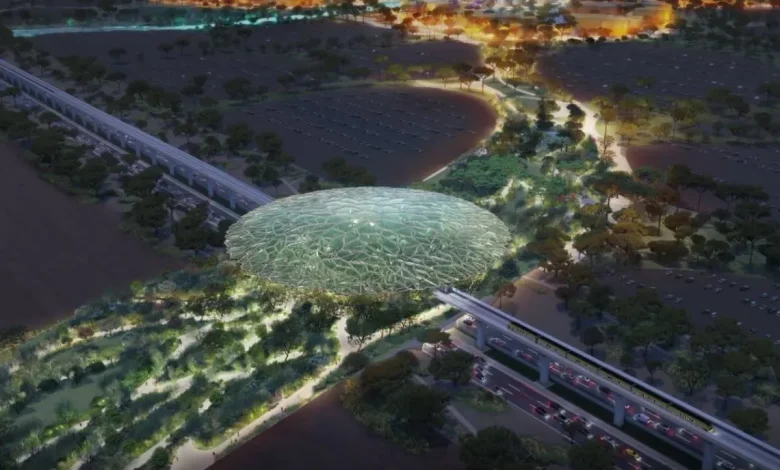
Driving the news: The Royal Commission for Riyadh City (RCRC) has started building the Expo station on the Riyadh Metro. The station will move up to 19,000 passengers an hour and open before Expo 2030 begins.
Why it matters: The station gives Expo visitors a direct rail link to King Khalid International Airport. Furthermore, it will stay in service after the fair ends. Riyadh therefore gains a permanent transit asset, not a temporary event venue.
A Canopy Inspired by Riyadh’s Valleys
Designers drew on the capital’s valleys and its Acacia (Talh) trees. As a result, the station features a steel dome 134 meters wide. Eight branching columns hold up the dome and echo the shape of Acacia (Talh) trees. In addition, the canopy shades visitors from the desert sun.
The station covers about 70,000 square meters. Around 44,000 square meters of that space will be green areas. Meanwhile, solar systems will supply roughly 25% of the station’s electricity. Consequently, the project supports both efficient operations and environmental goals.
Direct Link to the Airport and the Expo Site
The station sits on the Yellow Line, which connects to King Khalid International Airport. It stretches above King Salman Road inside a green corridor. That corridor links the Expo 2030 site in the east with future urban development areas in the west. Officials expect the station to ease visitor access and strengthen links between the rail network and city destinations. Besides, it leaves room for future growth.
The commission floated a design-and-build tender for the new Line 4 (Yellow Line) station in early 2026. Freyssinet Saudi Arabia later won the contract. Meanwhile, the Expo 2030 Riyadh Company awarded a contract worth about SAR 1 billion ($267 million) in January for the site’s first infrastructure works.
By the numbers:
- 19,000: passengers the station can handle each hour.
- 134 meters: diameter of the steel dome, which rests on eight columns.
- 70,000 square meters: total station area, including about 44,000 square meters of greenery.
- 25%: share of the station’s electricity that solar systems will supply.
- SAR 5.5 billion ($1.47 billion): value of contracts with Siemens and Alstom for 94 new trains, which lift the fleet from 183 to 277 and raise network capacity by 60%.
- 300 million: passengers the metro has carried since it opened, with average ridership up 25% from January to September 2026 compared with a year earlier.
- 7 million: Riyadh Metro journeys in the first half of 2026.
- SAR 240 billion ($64 billion): projected contribution of Expo 2030 Riyadh and its legacy to Saudi GDP, along with about 171,000 direct and indirect jobs.
- 25%: Share of electricity needs that solar systems will supply.
- 176 km: Length of Riyadh Metro’s six-line network.
- 85: Number of stations across the current metro network.
- 6 million: Riyadh Metro’s planned daily capacity.
- 42 million: Expected visits to Expo 2030 Riyadh.
- 197: Countries expected to participate in the exhibition.
Riyadh’s Transit Boom Gathers Speed
The Expo station arrives as Saudi Arabia accelerates its transport build-out. The Riyadh Metro opened on Dec. 1, 2024. Today, the network spans six lines, about 176 kilometers and 85 stations. Few cities have delivered a system of this scale in a single phase.
Demand keeps rising. Saudi rail passenger traffic jumped 16% in the first half of 2026. Moreover, the Riyadh Metro alone carried 30.4 million trips in the third quarter. These figures show that residents have embraced public transport quickly.
Expansion continues on several fronts. The commission opened the Western Station on the Orange Line in May 2026 and started work on two stations at King Saud University in March. Likewise, a contract worth an estimated $800 million to $900 million (SAR 3 billion to SAR 3.4 billion) extends Line 2 toward Diriyah.
Larger fleets will follow. New trains will arrive in batches from 2028, ahead of Expo 2030 and the 2034 FIFA World Cup. Taken together, these projects show a clear strategy: build capacity before demand peaks.
Keeping Traffic Moving During Construction
The commission is delivering the station on a schedule that matches the Expo site’s development works. Therefore, officials say the station will be ready before Expo 2030 Riyadh opens.
At the same time, crews work under a traffic plan agreed with the relevant authorities. The plan provides alternative routes to limit the impact on traffic and nearby residential neighbourhoods. It also keeps the area accessible throughout construction.
What’s next: The station moves from design to steel and concrete over the coming months. Expect visible progress on the dome as the Expo site takes shape around it. After the fair closes, the station will keep serving the surrounding districts and the capital’s growing population.
The bottom line: Riyadh is building rail capacity ahead of demand. The Expo station shows how the Kingdom ties mega-event readiness to lasting urban infrastructure.