

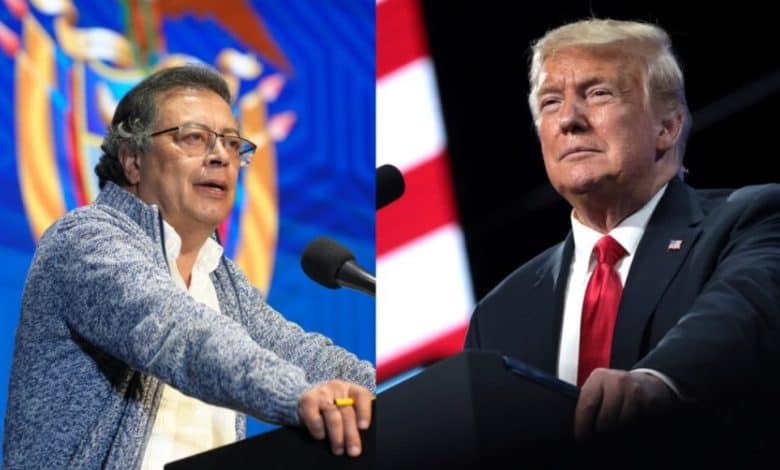
Just hours after Operation Absolute Resolve, US President Donald Trump has shifted his focus from Caracas to Bogotá, threatening Colombia President Gustavo Petro with military action.
Trump and Petro have been locked in a war of words for months amid a US campaign against drug trafficking that led to a military operation in Venezuela and the capture of its President, Nicolas Maduro.
Colombia Is Next
Speaking to reporters aboard Air Force One on Sunday, Trump suggested he could use military force against Colombia and its leader, who is a vocal critic of the US operation in Venezuela, according to Reuters.
“Colombia is very sick, too, run by a sick man, who likes making cocaine and selling it to the United States, and he’s not going to be doing it very long,” Trump said, referring to Colombia’s Petro.
Replying to a question about the possibility of a military operation against Colombia, Trump said: “It sounds good to me.”
Petro Responds
The Colombian President responded to Trump’s remarks, rejecting the allegations of being a drug trafficker. “I profoundly reject that Trump speaks without knowledge; in 50 years, my name has not appeared in judicial archives regarding drug trafficking, neither in the past nor the present,” Petro wrote on X.
“Stop slandering me, Mr. Trump. That is no way to threaten a Latin American president who emerged from the armed struggle and later from the struggle for Peace for the Colombian people,” he said.
Moreover, Petro accused Trump of using these allegations as a political reprisal for his stance on Gaza, punishing him for defending Palestinians and rejecting Israel’s genocidal acts against them.
Trump-Petro Feud
Trump and Petro have been engaged in an escalating war of words over the last few months, amid a growing US pressure campaign against Colombia.
Trump has repeatedly threatened his Colombian counterpart, accusing of involvement in drug production, suggesting the US would expand its military campaign against drugs to Colombia.
In September 2025, the Trump administration officially decertified Colombia as a counter-narcotics partner and revoked President Petro’s visa. Then, in October, the rift widened as Washington halted foreign aid and the President publicly disparaged Petro as an “illegal drug leader,” while Petro claimed the US bombed a Colombian boat carrying civilians.
Moreover, Trump said in December that Colombia was “producing a lot of drugs,” warning Petro to “better wise up or he’ll be next. He’ll be next soon.”
The US President renewed his allegations in late December, calling Petro a “troublemaker” and claiming that Colombia is operating three cocaine factories. “They make cocaine in Colombia, and he’s no friend of the United States,” Trump said, referring to Petro.
Venezuela Fallout
On Saturday, January 3, 2026, the US captured the Venezuelan President, Nicolas Maduro, and his wife, Cilia Flores de Maduro, transporting them to New York to face charges of terrorism and drug trafficking, in a military raid known as Operation Absolute Resolve.
The move has sparked fierce criticism from Latin American countries, which firmly rejected the military operation as a breach of Venezuela’s territorial integrity and political autonomy.
In response, Colombia reaffirmed its unwavering commitment to regional peace and security, the sovereignty of states, and the UN Charter, sending troop reinforcements to borders with Venezuela.
It also offered mediation to find a diplomatic solution to the crisis, calling for unity and solidarity among the people of Latin America in the face of foreign government interference.
Furthermore, the Colombian President Petro strongly denounced the attack on Caracas, saying it makes the US “the first country in human history to bomb a South American capital.”
In light of this, he called for unity among Latin American countries, calling on them to change their commercial partners and engage with the entire world, not only with the US.


