
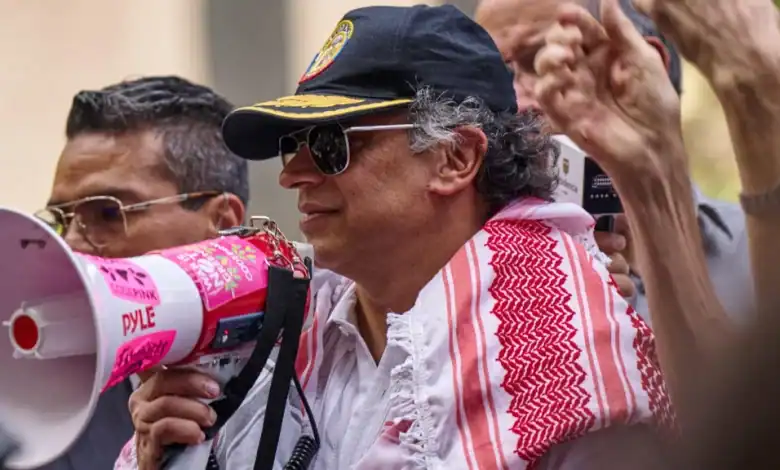
The US State Department announced on Friday it revoked Colombian President Gustavo Petro‘s visa following his “incendiary actions” during a recent pro-Palestinian street protest in New York City. This consequential decision directly resulted from the leftist leader’s public appearance while he was visiting the city for the annual United Nations General Assembly.
According to Colombian media reports, President Petro was already traveling back to Bogota from New York late Friday night when the visa revocation was formally announced.
Earlier this week, Petro criticized the Trump administration’s airstrikes on alleged drug-trafficking boats in the Caribbean Sea. He described these actions as an “act of tyranny” during an interview with the BBC. On Friday, Petro shared a video on social media, addressing a large crowd in Spanish through a megaphone. His translator conveyed his call for “nations of the world” to contribute soldiers for an army “larger than that of the United States.”
Inciting Disobedience
Petro urged US soldiers not to follow orders that could lead to violence, stating, “From here in New York, I ask all soldiers in the United States Army not to point their rifles at humanity.” He further implored them to “disobey Trump’s order! Obey the order of humanity!” This rhetoric drew sharp criticism from the State Department.
In a post on X, the State Department condemned Petro’s actions, stating, “Earlier today, Colombian president @petrogustavo stood on a NYC street and urged US soldiers to disobey orders and incite violence.” Consequently, they announced the revocation of Petro’s visa due to his “reckless and incendiary actions.”
Colombian Government’s Reaction
Colombia’s Interior Minister Armando Benedetti responded on X, suggesting that Israeli Prime Minister Benjamin Netanyahu’s visa should have been revoked instead of Petro’s. He remarked, “But since the empire protects him, it’s taking it out on the only president who was capable enough to tell him the truth to his face.”
Petro, who leads the world’s largest cocaine-producing country, expressed concerns that some victims of the US boat strikes might be Colombian. The US government maintains that these actions are part of an anti-drug operation off the coast of Venezuela, accusing its president of running a cartel.
Under Petro’s leadership, Colombia has experienced increasingly strained relations with the Trump administration which reflects broader tensions in US foreign policy. Additionally, the US denied visas to Palestinian President Mahmoud Abbas and 80 Palestinian officials, preventing them from attending the UN General Assembly in New York this week.
The revocation of President Petro’s visa highlights the fragile nature of international relations and the impact of political rhetoric. As tensions escalate, the future of US-Colombia relations remains uncertain, particularly under the current administration.