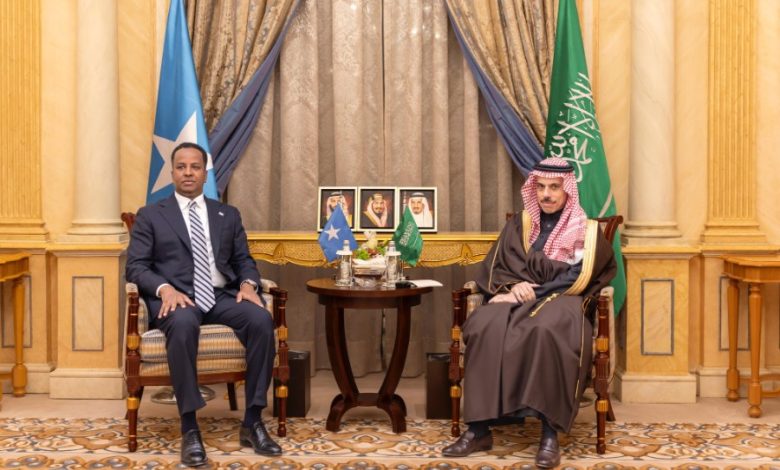
As an anchor of regional stability, Saudi Arabia has consistently supported the sovereignty and unity of Somalia, categorically rejecting any attempts to undermine the Arab-African nation’s security.
Riyadh has spearheaded an Arab and Islamic push to support Mogadishu. This support has been further solidified with bilateral agreements to strengthen defense and economic cooperation.
No Compromise on Somalia’s Stability
What’s New: Saudi Arabia’s Foreign Minister Prince Faisal bin Farhan reiterated to his Somali counterpart Abdisalam Abdi Ali the Kingdom’s position on Somalia’s unity and stability.
During a phone call on Monday, the two ministers reaffirmed the sovereignty of Somalia over its entire territory. They stressed their rejection of anything that undermines its security and stability, according to the Saudi Foreign Ministry.
Additionally, the two ministers discussed Saudi-Somali relations, underscoring the importance of exerting all efforts to ensure the security of international waterways and freedom of navigation.
The Big Picture: In December 2025, Israel formally recognized the breakaway region of Somaliland as an “independent and sovereign state,” signing an agreement establishing full diplomatic relations, including the opening of embassies and the appointment of ambassadors.
Riyadh Mobilizes Regional Consensus
The Israeli move sparked regional and international condemnation. Saudi Arabia spearheaded the response among the Arab and Islamic nations, rallying unified support behind Somalia to safeguard its unity and territorial integrity.
Following the Israeli announcement, the Saudi Foreign Ministry swiftly condemned it as a “unilateral secessionist move that violates international law.”
It reiterated the Kingdom’s full support for Somalia’s sovereignty, unity, and territorial integrity, reaffirming rejection of “any attempts to impose parallel entities that undermine the country’s unity.”
Saudi Arabia also stressed support for legitimate state institutions, reaffirming its commitment to preserving the stability of Somalia and its people.
State of Play: The Foreign Ministers of Saudi Arabia, Egypt, Algeria, Comoros, Djibouti, The Gambia, Iran, Iraq, Kuwait, Libya, Maldives, Nigeria, Oman, Pakistan, Palestine, Qatar, Somalia, Sudan, Türkiye and Yemen, in addition to the Organization of Islamic Cooperation (OIC) issued a joint statement condemning Israel’s decision to recognize Somaliland.
They expressed their unequivocal rejection of the Israeli move, warning of its “serious repercussions” on peace and security in the Horn of Africa, the Red Sea, as well as on international peace and security.
They also strongly condemned the Israeli decision as a grave violation of the international law and the UN Charter, which uphold the principles of state sovereignty, unity and territorial integrity.
Defending the Red Sea Corridor
Somalia stretches south of the Equator up to the Gulf of Aden, strategically situated on the Horn of Africa – a vital geostrategic peninsula also including Djibouti, Eritrea, and Ethiopia.
Why It Matters: The Horn of Africa sits at the crossroads of Africa, the Middle East, and Asia, directly bordering the critical maritime chokepoint of the Bab al-Mandab Strait at the entrance of the Red Sea.
As key stakeholders, Saudi Arabia and Egypt on many occasions stressed their firm support for Somalia’s unity, sovereignty and territorial integrity, rejecting any unilateral measures to divide the Arab-African country or compromise its sovereignty.
State of Play: Most recently, the Foreign Ministers of Saudi Arabia, Egypt and Türkiye met with Senior Advisor to the US President for Arab and African Affairs Massad Boulos in Cairo. They discussed the developments in Africa and ways to strengthen joint coordination to boost security and stability across the continent.
While in Cairo, Prince Faisal bin Farhan held a bilateral meeting with Egyptian Foreign Minister Badr Abdelatty during which they exchanged views on the situation in the Red Sea and the Horn of Africa. They also expanded their discussions with their Turkish counterpart Hakan Fidan in a trilateral meeting.
Strengthening Defense Architecture
Building on its long-standing efforts to support Somalia’s territorial integrity, Riyadh finalized a defense cooperation agreement on February 9, 2026, though the exact details remain undisclosed.
The Context: On the sidelines of the World Defense Show 2026 in Riyadh, Saudi Defense Minister Prince Khalid bin Salman and Somali counterpart Ahmed Moallim Fiqi signed a memorandum of understanding (MoU) to strengthen defense and military cooperation between the two countries.
According to a statement by the Somali Defense Ministry, the agreement also covers various areas of mutual interest to both countries.
What’s New: In mid-May 2026, Somalia’s Council of Ministers approved the Saudi-Somali MoU, noting that the agreement will “bolster military and security collaboration between the two nations,” reported Somali National News Agency (SONNA).
The agency added that the approval of the MoU with Saudi Arabia marks an important step in enhancing Somalia’s military and security capabilities.
Boosting Maritime Connectivity
Saudi Arabia immediately reinforced its defense pact with Somalia by another agreement that enhances maritime connectivity and boosts economic relations between the two nations.
The Logistics: On February 19, the Saudi Transport General Authority (TGA) signed a cooperation agreement with Somalia’s Ministry of Ports and Maritime Transport in Riyadh. The agreement aims to facilitate the smooth movement of commercial vessels through sea lanes, increase the operational efficiency of passenger and cargo transport, and enhance the exchange of maritime expertise.