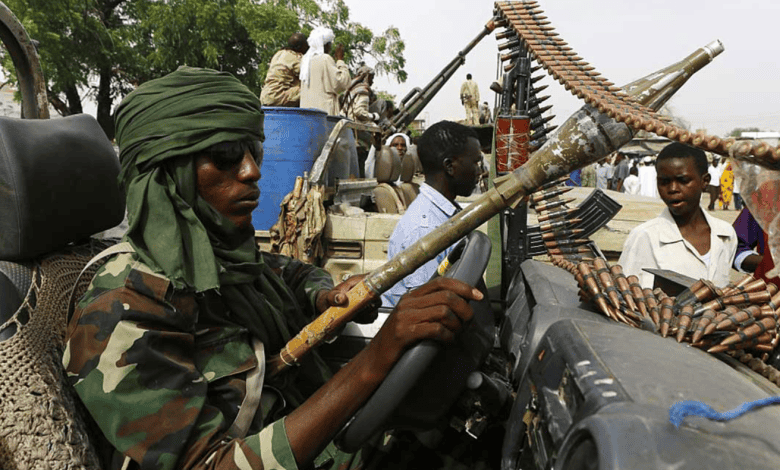
The paramilitary Rapid Support Forces (RSF) dismissed reports of armed clashes with South Sudanese forces at the Heglig oilfield in Sudan’s South Kordofan state.
Juba has deployed troops to the strategic oil field under a tripartite agreement with the Sudanese Armed Forces (SAF) and the RSF, after the paramilitary group seized the site in early December 2025.
RSF-SSPDF Tensions
On Saturday night, tensions erupted between the South Sudan People’s Defense Forces (SSPDF) deployed to protect the Heglig oil field, and the RSF fighters, Asharq Al-Awsat reported citing Juba Times.
The South Sudanese newspaper said that a dispute over control had sparked the clashes, warning of a potential military confrontation between Juba and Nyala.
Meanwhile, the South Sudanese Radio Tamazuj reported, citing sources from both sides, that the clashes have been contained after a misunderstanding between the two sides.
An RSF commander told the broadcaster that an RSF vehicle movement near the oilfield sparked the tensions, but the issue was soon resolved without escalating into violence. “There was no armed confrontation with the South Sudan People’s Defense Forces,” Abdel-Hafeez al-Imam Qasoum said on Sunday.
Similarly, South Sudanese military sources acknowledged a disagreement at the Heglig oil field, but said it was quickly contained before escalating into a military confrontation.
Blaming SAF
The RSF commander rejected reports of violent clashes as “false propaganda,” blaming the SAF leadership for spreading the news to disrupt relations between Nyala and Juba. “This is merely false propaganda intended to cause strife between us and the forces of South Sudan,” he said.
Moreover, the advisor to the RSF leader, Basha Tabiq, dismissed reports of clashes with the SSPDF as “unfounded claims,” accusing the SAF of circulating this propaganda to sow discord between the RSF and South Sudan.
Seizing Heglig
On December 8, 2025, the RSF declared it had taken control of the strategic Heglig oil field in the South Kordofan state, after the withdrawal of SAF troops to South Sudan.
The Heglig oil field is the largest in Sudan, located in one of the country’s two main oil-rich regions. It has a significant economic importance for both Khartoum and Juba. The oil field represents a vital source of revenue for Sudan, which endures dire economic conditions resulting from the war.
Furthermore, the strategic energy hub houses the main processing facility for landlocked South Sudan, which can only export oil through Sudan’s territory due to lack of other pipelines. It handles 130,000 barrels per day (bpd) of crude oil from South Sudan to Port Sudan for export.
Juba-SAF-RSF Agreement
Following the RSF capture of the oil field, Juba deployed troops to Heglig under an unprecedented tripartite agreement involving South Sudan’s President, Salva Kiir; Sudanese Armed Forces (SAF) Chief, General Abdel Fattah Al-Burhan; and RSF leader, Mohamed Hamdan Dagalo.
The agreement aims to completely neutralize the Heglig field from any combat operations, requiring the forces of both SAF and RSF to withdraw from the area and obligating all parties to ensure the continuous, uninterrupted flow of oil.
Fighting in Kordofan
After capturing El-Fasher city in late October, the RSF has been trying to expand its outreach to the east and south of the Darfur region. As a result, the Kordofan region, which provides a strategic route to the capital, Khartoum, and links central Sudan to Darfur, has become a frontline in Sudan’s war.
The RSF and its ally, the Sudan People’s Liberation Movement-North (SPLM-N) forces, have intensified attacks on the South Kordofan state, including heavy shelling of residential buildings in Dilling. Moreover, Kadugli, the capital city of South Kordofan state, has seen a drone strike on a UN logistics base that killed 6 peacekeepers from Bangladesh.
In the light of this, the UN International Organization for Migration (IOM) warned that heavy battles are forcing people to leave their homes in the Kordofan region. “Those displacements from Kordofan are not happening sporadically, they are happening because people are scared,” IOM Chief of Mission in Sudan, Mohamed Refaat, said.
He noted that more displacement waves are coming from Babanusa, Kadugli and Al-Obeid. “In the town of Kadugli, we estimate that there are around 90,000 to 100,000 people in this area who will be displaced if something happened if the fighting continued, if they get access to leaving the city,” Refaat said.
Furthermore, he said that Al-Obeid, the capital city of North Kordofan state, appeared to be just “one or two steps from being the next city under attack.” The IOM official estimated that “more than half a million are already going to be impacted.”