Iran’s Worst Drought in Century: Tehran Braces for Water Supply Cuts

Iran is planning to cut off water supplies to Tehran neighborhoods as the country battles with the worst drought in a century.
Meanwhile, the Iranian President, Masoud Pezeshkian, warned that Tehran could be evacuated if there was no rainfall before the end of the year.
Water Cuts in Tehran
On Saturday, Iranian officials said they were developing plans for periodic water supply cuts to Tehran’s neighborhoods, home to nearly 10 million people, reported AFP. The move comes as rainfall in the Iranian capital this year has recorded its lowest level in a century, with half of Iran’s provinces not seeing rain in months.
In response to water scarcity, the Iranian government plans water cuts in Tehran to save water. Local news outlets reported pipelines running dry overnight in several areas.
“This will help avoid waste even though it may cause inconvenience,” the Iranian Energy Minister, Abbas Ali Abadi, said on state television.
In the light of this, Iran’s President Pezeshkian warned on Friday that the government might have to evacuate Tehran if no rain falls before the end of this year. However, he did not give details about how this operation would be implemented.
Situation in Tehran
Tehran – Iran’s biggest city – is located on the southern slopes of the Alborz mountains. It is characterized by its hot dry summers, autumn rains and winter snowfalls. According to local media, the city uses 3 million cubic meters of water each day.
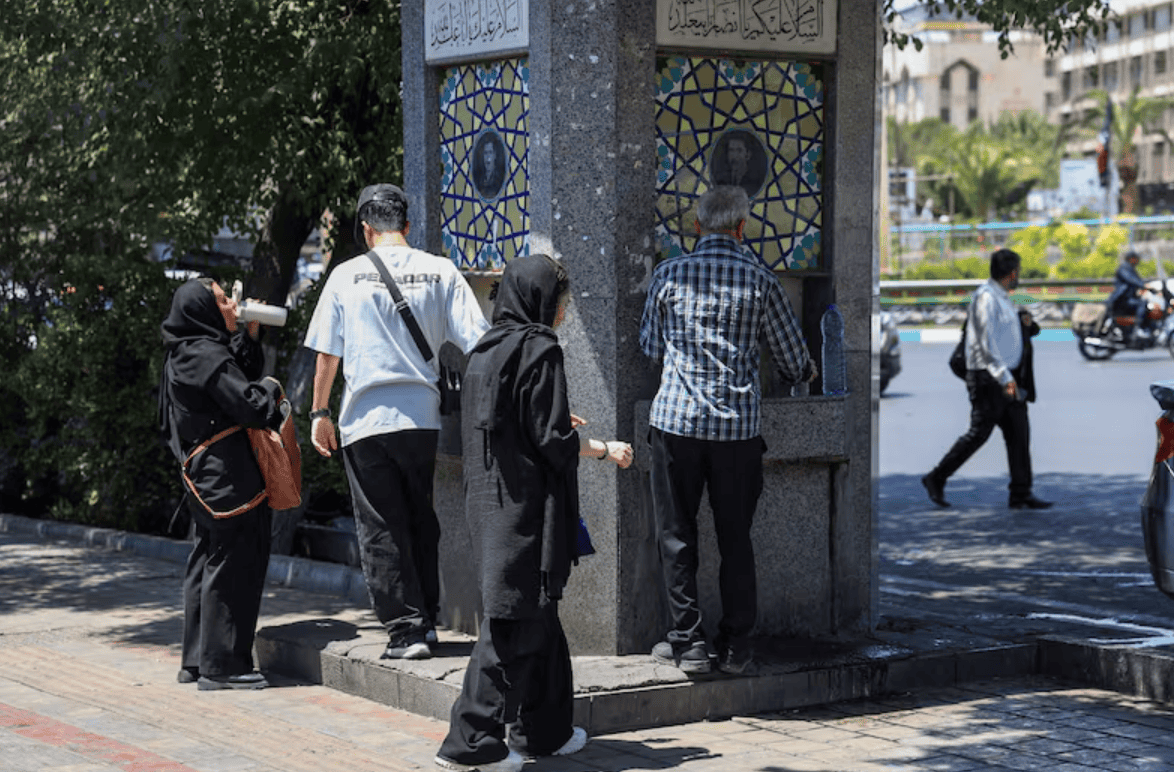
The capital city depends on five reservoirs for water supply. The main one, Amir Kabir dam on the Karaj River, has only 14 million cubic meters – compared to 86 million cubic meters in the same period last year – enough to supply Tehran region for less than two weeks, the director-general of the Tehran water company, Behzad Parsa, said, according to IRNA.
On Thursday, officials warned that Tehran’s surface water reserves were in a “red and fragile” state, with no rainfall recorded since the start of the new water year in late September, reported Iran International.
“The reservoirs supplying Tehran are now at their lowest levels in 60 years, a situation we have never experienced before,” head of Tehran’s Water and Wastewater Company, Mohsen Ardakani, said.
“We are in a highly sensitive and risky phase. Only through collective cooperation and at least 10 percent additional savings in water consumption can we prevent the capital from entering a state of absolute crisis,” he added.
Drought in Iran
Several cities across Iran have recorded water shortages this year. The state television on Saturday broadcast photos showing lower water levels compared to previous years at multiple dams serving Isfahan city in central Iran and the northwestern city of Tabriz.
Moreover, the governor of Mashhad – Iran’s second largest city – said officials were considering plans for regional water rationing, including nighttime water cuts.
Meanwhile, the head of Isfahan city council, Mohammad Noursalehi, warned in late October that the region was at risk of a drinking water crisis “within 45 days” if no action was taken to reduce non-potable water consumption and finish delayed transfer projects.
Iran’s Water Crisis
According to environmental experts, years of excessive consumption, unauthorized extraction, unscientific dam-building and poor management have led to the current crisis in Iran, known as “water bankruptcy.” The crisis is further exacerbated by climate change and harsh economic sanctions, leaving the country in a struggle with drought for almost five years, according to the Guardian.
“There is currently a problem with water, electricity and gas. There is no water behind the dams. The wells beneath our feet are also running dry. Those who claim there is water should come and tell us where this water is…,” Iran’s President Pezeshkian acknowledged in September 2025.
Iran’s vice-president and head of the government’s Environmental Protection Agency, Shina Ansari, explained the depth of the problem during an interview with the Guardian. “Iran is located in the so-called dry belt of the Earth, and we have faced challenges for a long time,” she said.

“But over the past three decades the temperature has risen by 1.8C and over the past five years there has been a 30% reduction in rainfall. Right now, we are in the fifth consecutive year of near drought,” Ansari noted.
Lake Urmia in northwestern Iran is a stark example of the impact of drought on Iran’s water sources. Once the Middle East’s largest lake, the world’s sixth largest saltwater lake and a prominent tourist destination, Lake Urmia has been reduced to a water depth of only half a meter.