Saudi Ancient Roots: Tabuk Hosted Oldest Human Settlement on Arabian Peninsula

In a groundbreaking milestone that underscores Saudi Arabia’s deep roots, the Saudi Culture Minister announced the discovery of the oldest known human settlement on the Arabian Peninsula in Tabuk, reported the Saudi Press Agency (SPA).
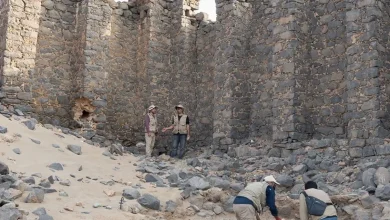
The settlement – discovered in the “Masyoun” site northwest of Tabuk – dates back to the Pre-Pottery Neolithic period, specifically 11,000 to 10,300 years ago.

The discovery took place during ongoing archaeological excavations by the Saudi Heritage Commission in partnership with Kanazawa University of Japan, and in collaboration with NEOM.
Unearthing History
The excavations led to unveiling semi-circular granite architectural units, featuring residential buildings, storage areas, passageways, and hearths which demonstrate advanced functional planning tailored to the period’s lifestyle of hunting and grain cultivation.
Moreover, the excavations discovered a large collection of stone tools including arrowheads, knives, and grinding stones likely used for processing grain. The discoveries also included decorative items made from amazonite, quartz, and shells, along with raw materials indicating productive activity within the settlement.

Additionally, the excavation teams uncovered rare remains of human and animal skeletons, as well as decorated stone fragments with geometric lines, providing researchers with a deeper dimension for understanding the social, economic, and cultural lifestyle in the region during the Early Neolithic period.
Archeological Excavations
The “Masyoun” site was listed in the National Antiquities Register in 1978. However, since December 2022, new field studies have highlighted its historical significance as the oldest known human settlement on the Arabian Peninsula.
As part of a joint scientific collaboration, the #SaudiHeritageCommission, in partnership with Japan’s Kanazawa University, announces the discovery of the oldest Neolithic human settlement in the Arabian Peninsula at the #Musaywin site in the Tabuk Region. pic.twitter.com/NFighF9T3R
— هيئة التراث (@MOCHeritage) September 25, 2025
The Heritage Commission, in collaboration with Kanazawa University, carried out four intensive excavation seasons concluded in May 2024, during which researchers also documented surrounding rock art and inscriptions.
The landmark discovery underscores the Heritage Commission’s efforts to document Saudi Arabia‘s archeological sites and expand cooperation with international universities and research centers, in line with Vision 2030 which aims to establish the Kingdom’s status as a global knowledge hub for human heritage.