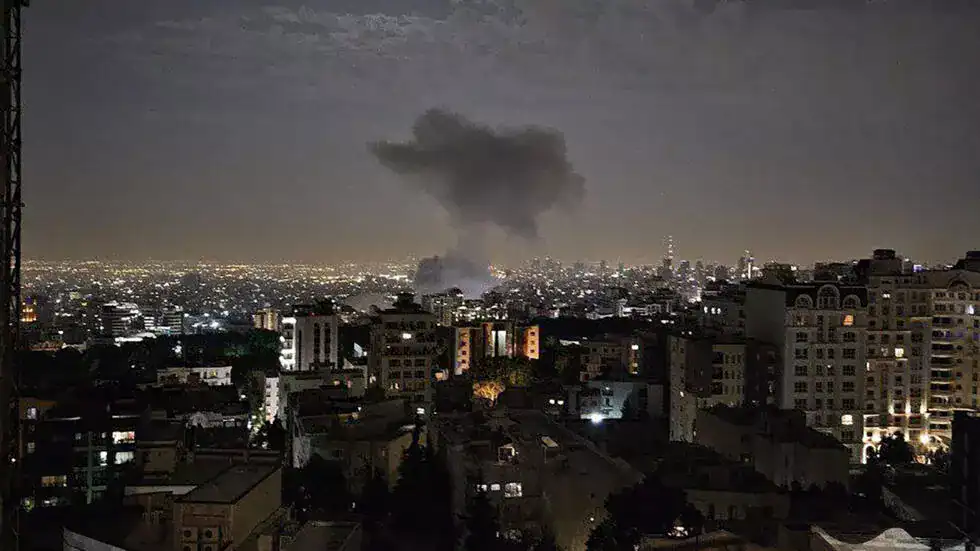
Israel launched strikes against Iran on Friday, targeting nuclear and military sites, following a warning from US President Donald Trump about potential massive conflict in the region. Prime Minister Benjamin Netanyahu announced that the strikes targeted the core of Iran’s nuclear enrichment program, including the Natanz facility and nuclear scientists. Netanyahu emphasized that the operation would persist for as many days as needed to achieve its objectives.
Iranian state media reported that residential buildings in Tehran were also hit, resulting in civilian casualties including women and children. Fire and smoke were seen at a key site for Iran’s Revolutionary Guards, and explosions were heard in Natanyeh city. Iranian media confirmed that the leader of the Guards, Hossein Salami, was killed in the strikes. Air traffic was halted at Tehran’s Imam Khomeini International Airport, and neighboring Iraq also closed its airspace and suspended all flights at its airports.
Responses and Reactions
Israel declared a state of emergency and closed its airspace, with Defense Minister Israel Katz warning of possible retaliatory action from Tehran. Katz stated that following Israel’s preemptive strike against Iran, a missile and drone attack against Israel and its civilian population was anticipated soon. An Israeli military official noted that the army believed Iran could strike Israel at any moment.
US President Donald Trump indicated that a deal on Iran’s nuclear program was close but warned that an Israeli attack could disrupt negotiations. Secretary of State Marco Rubio warned Iran not to target US interests or personnel, stating that Washington was not involved in the strikes. The United States also announced it was reducing embassy staff in Iraq, a long-standing zone of proxy conflict with Iran.
Oil prices surged by as much as 8%, while stocks plummeted following the Israeli strikes, which came after Trump’s warning. Trump told reporters at the White House that while he did not want to say an attack was imminent, it looked like something that could very well happen. He also mentioned that a good deal on Iran’s nuclear program was close but that an attack could jeopardize it.

Historical Context and Ongoing Tensions
Israel, which relies on US military and diplomatic support, views Iran as an existential threat and has targeted Iranian air defenses in the past. Netanyahu has vowed less restraint since the unprecedented October 7, 2023, attack on Israel by Tehran-backed Hamas, which triggered a massive Israeli offensive in Gaza. The United States and other Western countries, along with Israel, have repeatedly accused Iran of seeking nuclear weapons, which Iran has consistently denied.
Iran’s nuclear chief, Mohammad Eslami, criticized the resolution as extremist and blamed Israeli influence. In response, Iran announced it would launch a new enrichment center in a secure location and replace first-generation machines with advanced sixth-generation machines at the Fordo uranium enrichment plant. Iran currently enriches uranium to 60%, significantly above the 3.67% limit set in the 2015 deal and close to the 90 percent needed for a nuclear warhead.