Through its vast expanse of 1,969,000 km2, Saudi Arabia is a haven for a remarkable diversity of animals notably rare and endangered species.
The wildlife in the Kingdom is highly impressive, boasting 93 mammal species, 432 bird species, 9 freshwater fish species, 103 reptiles, and 7 amphibians.
In 2024, the Kingdom spotted several rare animals across various regions including geckos, turtles, cats, and others.
Leaders MENA offers you a list with these animals accompanied by magnificent photos.
Dazzling Geckos

In June, Scientists unveiled that some desert geckos from the Arabian Peninsula have a brilliant neon green glow under the moonlight, reported CNN.
The reason behind this mechanism is the skin pigment cells that make them glow under the moonlight, according to a study published in Scientific Reports.
These geckos have prominent skin fluorescence only previously seen in geckos in the sprawling Namibia desert of Africa.
The function of the fluorescence is to enable the reptiles to see and meet other members of the same species.
“One night we were looking with the UV light, and we saw that actually these desert geckos were fluorescing. It was very surprising for us,” Dr Bernat Burriel-Carranza, of the Museum of Natural Sciences of Barcelona and the first author of the study, said.

Humans can see the fluorescence of the geckos only by using UV lamps. However, it is probably visible to geckos without UV illumination because their eyes detect light.
“As soon as we saw this fluorescence, we realized that the web-footed geckos must use a new mechanism. The bright, neon-green fluorescence patterns were clearly produced in the skin of the lizards,” said, David Prötzel, Ludwig Maximilians University of Munich in Germany.
Researchers found these dazzling geckos during a field trip to a desert area of Sharjah in the UAE in June 2022. Subsequently, they observed these glowing geckos at Al-Ula region in Saudi Arabia in April 2023.
Sand Cat

The Northern Borders region spotted the rare species sand cat in the east of Arar in October, Saudi Press Agency (SPA) reported.
The sand cat is a nocturnal animal that only comes out after dark to search for food. It may travel up to 5 kilometers from its burrow, according to some studies. It is a small-sized wild animal threatened with extinction due to poaching and natural habitat destruction.
Currently, the cat reappears again in Saudi Arabia thanks to the spread of natural reserves and its pivotal role in preserving the ecosystems.
Interestingly, this rare cat prefers to stay away from humans and live in stony desert areas with rugged terrain in which plants are accessible.
Thus, it stays in burrows during the day to avoid high temperatures, and to stay hydrated and satiated.
Nasser Al-Majlad, president of the Aman Environmental Association in the Northern Borders region, stated that the area is full of several wild animals of different categories, species and types.
Such diversity is mainly due to the various surrounding conditions, such as the diversity of the terrain; mountains, plateaus, plains, valleys and reefs, as well as the spread of different kinds of annual and seasonal plants.
Al-Majlad explained that the sand cat depends on small rodents, lizards and snakes as main food.
Amazingly, it hunts its prey at night as it has the ability to see fully in the dark, and can survive without water as it obtains all hydration from its prey.
Distinctive Features
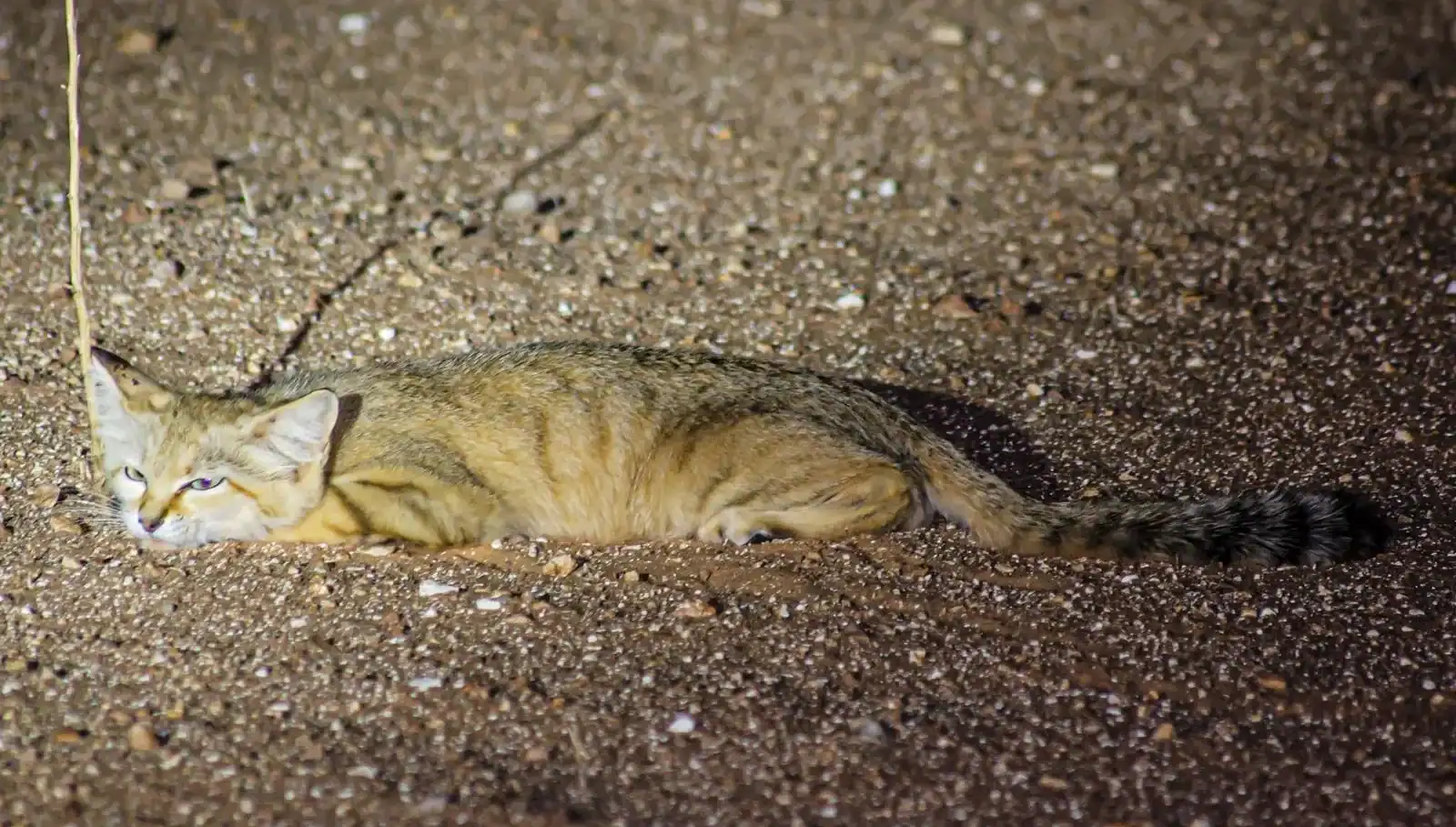
Al-Majlad clarified that the cat has a sandy color, tending to pale yellow-orange, with light-colored markings on the top of its body.
The front legs have two black rings, with a tail surrounded by (2-5) black rings that are not completely round, alternating with orange bands. The cat has a white belly, a broad flattened head, and large, black-edged and triangular ears.
Moreover, it enjoys sharp hearing with thick hair spreading between its fingers and feet to protect its bare feet from the heat of the ground in the summer.
Sea Turtle

Saudi Arabia has unveiled the discovery of the largest sea turtle nesting site ever recorded in Saudi waters in the Red Sea, the Saudi Press Agency (SPA) reported.
Represented by the General Organization for the Conservation of Coral Reefs and Marine Turtles in the Red Sea (SHAMS), the discovery stands as a living proof of the Kingdom’s protection of sea turtles in the Red Sea.
Crucially, these efforts are an integral part of a broader plan aiming to transform 30% of the Kingdom’s land and sea areas into nature reserves by 2030.
Interestingly, the Four Sisters Islands: Marmar, Dahreb, Malathu, and Jadir significantly boast high density of sea turtle nesting sites.

Currently, over 2,500 turtle nests have been recorded on these islands.
Thus, they became a vital breeding area for endangered turtles in the Red Sea, especially since the turtles that nest there return to the same sites each year.
In other words, they represent a haven for several endangered green turtles and critically endangered hawksbill turtles.
As a result, they secured a prestigious place among the most significant sea turtle nesting sites in the region.
False Cobra

In December, a “false cobra” was spotted in Saudi Arabia’s Northern Borders region, reported the Saudi Press Agency.
The mildly venomous snake can grow over a meter long and has great significance for the local ecosystem.
Despite its venomous bite, the pale-colored snake does not pose any threat to humans. In the light of this, experts warned against unnecessary killing.
“The false cobra, scientifically known as Rhagerhis moilensis, is a mildly venomous species commonly found in the region and across the Kingdom. Unlike some other snakes, it does not hibernate during colder periods,” Adnan Khalifa, a member of the Aman Environmental Association, said.

As for its physical appearance, the false cobra is characterized by its pale color and black spots behind its eyes, resembling secondary eyes.
The female false cobra usually lays approximately 22 eggs in late spring. However, only a small number survive to adulthood.
Crucially, the false cobra poses minimal threat to human beings as its rear fangs can deliver weak venom to subdue prey.
However, people unnecessarily kill it out of fear despite its central role in keeping ecological balance.
Related Topics:
Discover Most Wild Animals That Settled in Saudi Arabia
King Khalid Royal Reserve Releases Dozens of Endangered Animals
Bin Salman Royal Reserve Becomes New Sanctuary for 85 Endangered Animals