
From Fragmentation to Future: Saudi Arabia’s National Day and the Vision 2030 Revolution
Saudi Arabia marks its 96th National Day on 23 September under the banner “Our Pride Lies in Our Nature,” a slogan the General Entertainment Authority (GEA) carried over from last year’s identity. But this year’s celebration lands at a different moment. It falls just months after Vision 2030 marked its own tenth anniversary, and the coincidence gives the Kingdom’s oldest secular holiday a sharper edge: a chance to measure a century of state-building against a decade of economic transformation.
Why it matters: National Day has always done double duty in Saudi Arabia. It commemorates a specific 1932 decree, and it also functions as the country’s annual referendum on how it wants to be seen, by its own citizens, by the Gulf, and increasingly by the world. As Vision 2030 enters its second decade, that self-portrait is shifting fast, and National Day is where the shift becomes visible.
From Fractured Peninsula to Unified Kingdom
Flashback: Before 1932, the Arabian Peninsula was not one country. It was a patchwork of rival emirates, tribal confederations, and holy cities under loose Ottoman oversight. The House of Saud’s own story began centuries earlier, in 1727, when Muhammad bin Saud founded what historians call the First Saudi State from the small settlement of Diriyah, just outside modern Riyadh.
That state allied with religious reformer Muhammad bin Abd al-Wahhab and expanded across much of the peninsula, only to be crushed by Ottoman-Egyptian forces in 1818, when Diriyah itself was destroyed. A Second Saudi State rose and eventually fell too, and by 1891 the Al Saud family was living in exile.
The turning point came on 15 January, 1902, when a young Abdulaziz bin Abdulrahman Al Saud, known to history as Ibn Saud, led a small band of followers in a daring nighttime raid to retake Riyadh from the rival Al Rashid clan. What followed was three decades of patient, often brutal campaigning. Ibn Saud absorbed Al-Hasa in the east by 1913, unified Najd and the Hejaz by 1925 after defeating the forces of Sharif Hussein, and secured British recognition of his sovereignty through the 1927 Treaty of Jeddah.
Then, on 23 September, 1932, he issued Royal Decree No. 2716, merging his territories into a single state and renaming it the Kingdom of Saudi Arabia. Arabic became the national language, and the Quran was declared the country’s constitution.
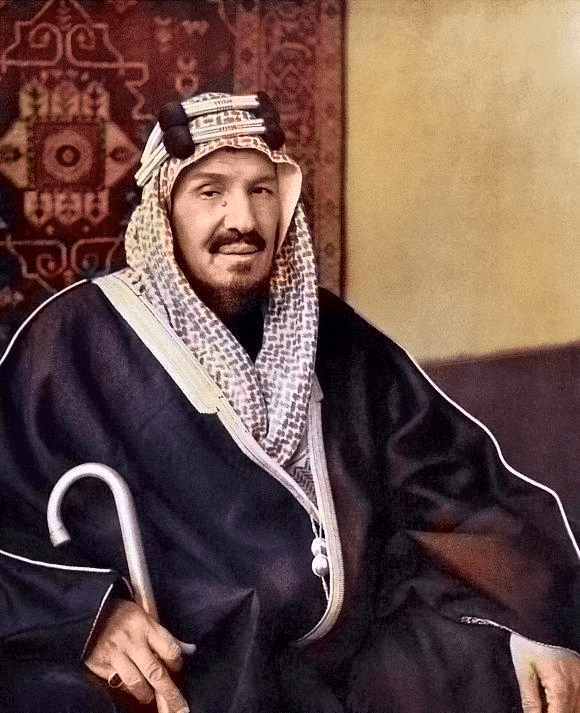
Zoom in: Here’s a distinction Saudi historians insist on: National Day marks unification, not independence from a colonial ruler, since Saudi Arabia was never formally colonized. That’s why the holiday’s tone has always leaned toward pride in nation-building rather than liberation.
Between the lines: The 1932 decree stirred real emotion at the time. Saudi Gazette has reported that telegrams of loyalty poured into Riyadh from governors and citizens alike in the days after the announcement, recorded in the official gazette Um Al-Qura as evidence that the new name resonated well beyond the royal court. Even so, National Day stayed a modest, government-only affair for decades.
King Faisal formally designated 23 September as National Day by royal decree in 1965, but Saudi Arabia’s deeply conservative religious establishment continued to prioritize the two Islamic holidays, Eid al-Fitr and Eid al-Adha, over any nationalist occasion. Some clerics actively discouraged participation well into the 2000s, arguing that celebrating a worldly anniversary sat uneasily with religious tradition.
That changed in 2005. King Abdullah declared National Day an official paid public holiday for every sector, a decision made partly to channel youth energy into a unifying national identity after Saudi Arabia had weathered a wave of domestic terrorist attacks. It wasn’t universally welcomed. Religious scholars continued to issue fatwas questioning the holiday for years afterward.
Still, the decision stuck, and celebrations grew steadily larger: fireworks, folk dances, and, for the first time in 2017, mixed-gender crowds at King Fahd International Stadium watching a commissioned operetta trace the Kingdom’s founding story. That year, under newly appointed Crown Prince Mohammed bin Salman, National Day arrived amid what analysts at the Arab Gulf States Institute have described as a surge of hypernationalism, complete with a new General Entertainment Authority producing concerts on Riyadh’s Tahlia Street.
Quantifying the Transformation: Saudi Arabia’s Economic Ascent
By the numbers:
Saudi Arabia’s Vision 2030 economic program turned ten in April 2026, and its own annual report offers the clearest measure of how far the Kingdom has moved since National Day 2016.
- Non-oil GDP share: climbed to roughly 56% of the economy, up from about 45-47% in 2016
- Non-oil government revenue: rose from SAR 186 billion ($49 billion) in 2016 to SAR 502 billion ($132 billion) in 2024
- Total economic output: crossed $1 trillion (about SAR 3.75 trillion), an 80% expansion since 2016
- Women’s workforce participation: more than doubled, from 17% in 2017 to roughly 36% today
- Unemployment: nearly halved, falling from 12.3% in 2016 to about 6.4% in early 2026
- Tourism: welcomed 122.6 million visitors in 2025, already past the original 2030 target of 100 million, spending an estimated SAR 300 billion ($81 billion)
- PIF assets under management: grew from USD 192 billion in 2016 to roughly $749 billion (about SAR 2.8 trillion) in 2024
- Vision 2030 KPIs: 93% of 390 active indicators were fully or partially met as of the tenth-anniversary report
- 10,000+ national events: The total number of entertainment, cultural, and sports activities hosted nationwide during National Day season.
What they’re saying: Crown Prince Mohammed bin Salman summed up the milestone by saying the Kingdom had built “an exceptional model” for turning strategy into results. King Salman, for his part, said Vision 2030’s achievements had put Saudi Arabia on a path toward a better future that citizens can feel directly. PIF Governor Yasir Al-Rumayyan captured the fund’s next phase in a single word when it unveiled its 2026-2030 strategy in April: efficiency.
Yes, but: The picture isn’t without strain. Saudi Arabia has run a budget deficit in nine of the past ten years, and a 2026 regional conflict cut into oil production and widened that gap further, pushing the IMF to trim its 2026 GDP growth forecast to 3.1% from 4.5% the year before. Diversification of output, analysts note, is running well ahead of diversification of exports.
A Decade of Vision 2030, a Nation Recast
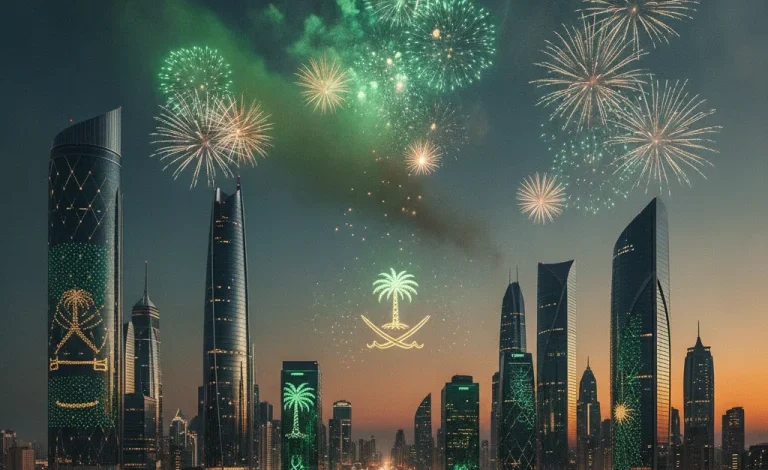
State of play: National Day today looks almost nothing like the government-ceremony affair of the 1960s through 1980s. Cities across the Kingdom, from Riyadh and Jeddah to Dammam, Khobar, and Tabuk, wash themselves in green for the occasion; the Saudi Hawks aerobatic team streaks green smoke overhead, and drone shows have joined fireworks as a fixture. Crucially, National Day no longer stands alone on the secular calendar. King Salman added Founding Day on 22 February in 2022, commemorating that original 1727 state in Diriyah, while Flag Day rounds out a trio of national, as opposed to religious, occasions.
The big picture: Vision 2030 gave National Day a new vocabulary to celebrate. The GEA-run Saudi Seasons, led by Riyadh Season, drew a record 17 million visitors in its most recent edition alone, and MDL Beast has turned Riyadh into a stop on the global electronic-music circuit, both unthinkable under the pre-2016 entertainment landscape. That cultural opening runs parallel to, and reinforces, the economic story: a tourism sector that didn’t issue leisure visas until 2019 is now racing toward a revised target of 150 million annual visitors by 2030.
Zoom in: This year’s identity, “Our Pride Lies in Our Nature”, leans deliberately into that balancing act. GEA describes the phrase as honoring traits the Kingdom considers inherently Saudi, courage, generosity, ambition, authenticity, rather than achievements imported from outside. It’s a message crafted for a domestic audience navigating rapid change, reassuring citizens that modernization and heritage aren’t competing forces.
The global angle: National Day has also become a soft-power instrument. Saudi embassies worldwide mark the occasion with receptions that double as investment pitches, and the date increasingly coincides with international coverage of Vision 2030’s progress, from Davos panels to tourism-sector reports citing the Kingdom’s 122-million-visitor year. For a country that spent most of the 20th century largely closed to outside observers, that visibility is itself a form of national statement.
What’s next: With Vision 2030 now managing its final four years under a leaner, “efficiency”-first PIF strategy, expect future National Days to lean harder into results rather than announcements, fewer giga-project unveilings, more scorecards. The story the Kingdom tells each 23 September has moved from “here is what we are building” toward “here is what we built.” Whether that narrative holds through 2030 will depend on oil markets, regional stability, and a diversification push that, by its own numbers, is genuinely reshaping the economy underneath the fireworks.