France and the UK have reaffirmed their readiness to deploy a multinational naval mission to secure shipping through the Strait of Hormuz.
The European powers voiced their position following the announcement of a preliminary deal between the US and Iran to end their war. The deal involves the reopening of the critical waterway without tolls.
Hormuz Mission Ready
Following the announcement of the US-Iran deal, the leaders of France, Britain, Germany, Italy, Japan, Canada, Australia, Greece, and Cyprus welcomed the agreement, stressing the need for the “urgent re-opening of the Strait of Hormuz with unconditional and unrestricted freedom of navigation.”
“We are committed to playing our part to achieve this —in accordance with our respective constitutional requirements— including through a strictly defensive and independent mission to reassure commercial shipping and conduct mine clearance operations,” they said in a joint statement.
In a similar vein, French President Emmanuel Macron said that the agreement “must enable the urgent and unconditional reopening of the Strait of Hormuz.”
Macron noted that the French-UK multinational mission is ready to support such effort. “The resources are in place and ready to be deployed,” he said in a statement on X.
How the Mission Will Work
In an interview with French broadcaster TF1, ahead of the G7 Summit on Monday, Macron said that the mission could be deployed “in two to three days” if a deal was confirmed between Washington and Tehran.
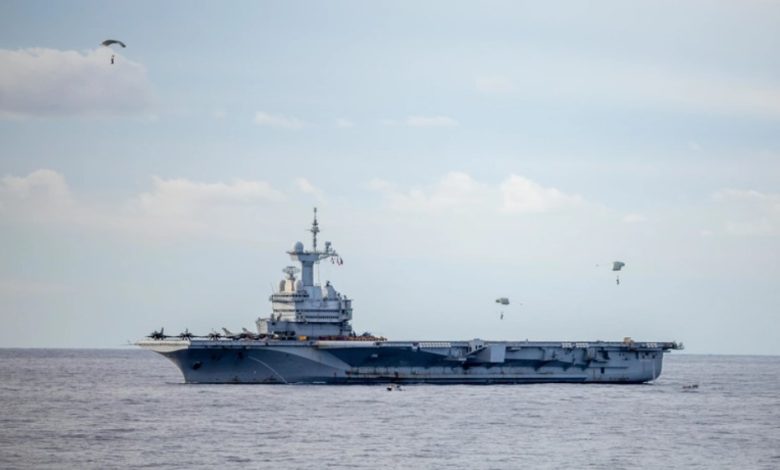
“We are ready … as early as tomorrow we can have fighter jets for surveillance missions, a frigate in the area tomorrow, and the Charles de Gaulle [aircraft carrier], mine-clearing capabilities and everything that comes with the Charles de Gaulle within two, three days,” the French leader said.
The naval mission includes mine-clearing vessels tasked with sweeping the Strait of Hormuz of diverse underwater threats – ranging from rocket-propelled and moored mines to seabed explosives triggered by sound, pressure, or light.
Speaking on the sidelines of the G7 Summit in Evian, Macron noted that several nations are involved in the mission, including the UK, the Netherlands and Italy, and ready to act quickly.
“Of course, all this supposes that it is desired and requested. Perhaps it will not be wanted and perhaps it will not be necessary. But in any case, it reflects our willingness to help,” he said.
US-Iran Deal
The US and Iran announced a preliminary deal that halts fighting and sets a 60-day period for detailed negotiations to reach a final agreement, with formal signing set for June 19 in Geneva.
US President Donald Trump said the Strait will be completely open to shipping upon the formal signing of the deal on Friday to ensure mine removal.
In response to Macron’s offer, Trump said he doesn’t see a need for “much help” because the waterway will be open under the deal.
“But I don’t think it’s a bad idea to have a ship or two up here from a few countries. You’d be a great country to do it,” he told Macron during the G7 Summit.
French-UK Mission
France and the UK have announced a multinational defensive mission to protect commercial shipping through the maritime corridor and conduct mine clearance operations when conditions permit.
To this end, both countries positioned assets in the region. The UK dispatched its HMS Dragon destroyer to the Middle East and France deployed its Charles de Gaulle Aircraft Carrier Group into the southern Red Sea and the Gulf of Aden.
Moreover, Italy said it would move two minesweepers closer to the Strait, in preparation for a multinational defensive mission once a deal to end the Iran war is reached.
Australia also said it would join the French-UK mission, contributing a Wedgetail E-7A surveillance aircraft.
However, European diplomats told Reuters that participation remains limited, with most of the burden likely to fall on France and the UK.
Coordination with Iran
The mission’s deployment hinges on the position of Iran, which has signaled strong opposition to any foreign military presence in Hormuz.
“Any presence of foreign countries, whether to safeguard shipping or clear mines, is unacceptable … This is a trick to bring naval forces to the Strait, and it will not be accepted,” a senior Iranian official told Reuters.
Another Iranian security official said Tehran had “zero trust in foreign countries” and insisted control of the Strait rests with Iran and, to some extent, Oman.
Despite this Iranian pushback, France’s Foreign Minister Jean-Noël Barrot said that he discussed the European-led mission with his Iranian counterpart Abbas Araghchi last week.
While US Vice President JD Vance told CNBC there was an understanding with Iran that the Strait would reopen “in a toll-free way for the long term,” Iran’s Foreign Ministry stated that the deal would allow it to charge maritime service fees on ships transiting the waterway, rather than imposing “tolls.”