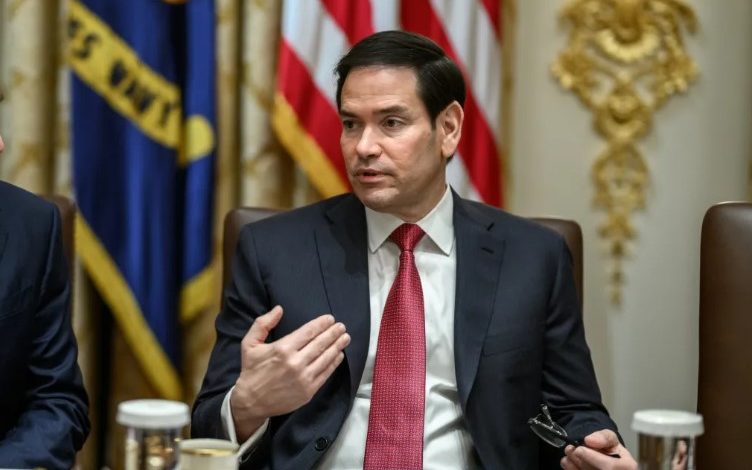
US Secretary of State Marco Rubio will mediate a historic meeting between the ambassadors of Lebanon and Israel in Washington on Tuesday, marking the first direct talks between the two countries in decades.
The meeting aims to reach a deal that ends the war in Lebanon, which erupted against the backdrop of the US-Israeli war with Iran. However, prospects for sealing an agreement remain dim as Hezbollah signaled its opposition to any resulting agreements.
Lebanon-Israel Talks
Washington is set to host a face-to-face meeting on Tuesday between Lebanese Ambassador Nada Hamadeh and Israeli Ambassador Yechiel Leiter to launch direct negotiations between Lebanon and Israel.
The talks will be mediated by Rubio, with the attendance of US Ambassador to Lebanon Michel Issa and State Department Counselor Michael Needham, according to Axios.
Discussions will center on the possibility of reaching a ceasefire and the disarming of Hezbollah on the longer term, as well as a peace deal between Lebanon and Israel, sources told Axios.
“As a direct result of Hezbollah’s reckless actions, the Israeli and Lebanese governments are engaging in open, direct, high-level diplomatic talks – the first such talks since 1993 – brokered by the United States,” a State Department official said.
Disarming Hezbollah
The official noted that the talks will focus on establishing long-term security for Israel’s northern border while supporting Lebanon’s efforts to reassert full sovereignty over its territory and political life.
Meanwhile, Israeli government spokeswoman Shosh Bedrosian said that the discussions aim to disarm and remove Hezbollah and establish peaceful relations between Lebanon and Israel.
However, she emphasized that the talks will not discuss a ceasefire with the Iranian-backed group due to its attacks against Israel.
Israeli Prime Minister Benjamin Netanyahu said on Saturday that Israel’s main goal was the dismantling of Hezbollah’s weapons and a “real peace agreement that will last for generations.”
Similarly, Lebanese President Joseph Aoun said on Monday he hoped the talks would lead to “an agreement… on a ceasefire in Lebanon, with the aim of starting direct negotiations between Lebanon and Israel.”
Hezbollah-Israel War
Lebanon has been drawn into the ongoing US-Israeli war with Iran after the Iranian-backed Hezbollah decided to join the fighting in retaliation for the killing of Iran’s Supreme Leader Ali Khamenei on February 28, 2026, resulting in a heavy fighting and an Israeli ground invasion of southern Lebanon.
The US and Iran agreed on a two-week ceasefire on Wednesday. Hours later, Israel launched more than 100 strikes across densely populated areas in Beirut, the Bekaa Valley and southern Lebanon, in the deadliest day since the conflict erupted on March 2.
The conflict has so far displaced more than 1 million people in Lebanon and killed more than 2,000, including more than 500 women, children and medical workers, according to the Associated Press (AP).
As a key mediator in the US-Iran ceasefire talks, Pakistani Prime Minister Shehbaz Sharif said that the truce would include Lebanon.
However, Netanyahu said that the ceasefire agreement did not apply to Lebanon and operations against Hezbollah would continue. US President Donald Trump echoed similar statements, saying that Lebanon was not part of the ceasefire agreement “because of Hezbollah.”
Fearing that this could impact talks with Iran, the US pressured Israel to de-escalate fighting and hold direct talks with the Lebanese government. As a result, Israel scaled back strikes on Beirut and its southern suburbs but has continued intense fighting in southern Lebanon.
Hezbollah’s Position
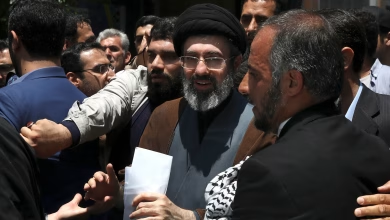
Hezbollah leader, Naim Qassem, rejected talks with Israel and called them “futile.” In a televised speech on Monday, Qassem called on the Lebanese government to withdraw from the talks, portraying it as a scheme to pressure Hezbollah to give up its arms.
“Israel clearly states that the goal of these negotiations is to disarm Hezbollah, as Netanyahu repeatedly states. So, how can you go to negotiations whose objective is already clear?” Qassem said.
“We will not rest, stop or surrender. Instead, we will let the battlefield speak for itself,” he noted, warning that northern Israeli areas “will not be safe, even if the Israelis were to enter any area of Lebanon.”
This position was echoed by Wafiq Safa, a high-ranking member of Hezbollah’s political council. In an interview with the AP, Safa said that the Lebanese group would not abide by any agreements resulting from the talks in Washington.
“As for the outcomes of this negotiation between Lebanon and the Israeli enemy, we are not interested in or concerned with them at all. We are not bound by what they agree to,” he said.