The UN World Food Program (WFP) has issued a stark warning regarding a looming food crisis in Sudan amid a severe shortage of funding.
The war in Sudan marked 1,000 days of conflict in early January, leaving thousands dead and over 12 million displaced, as the country struggles with spreading famine and cholera outbreaks.
Looming Crisis
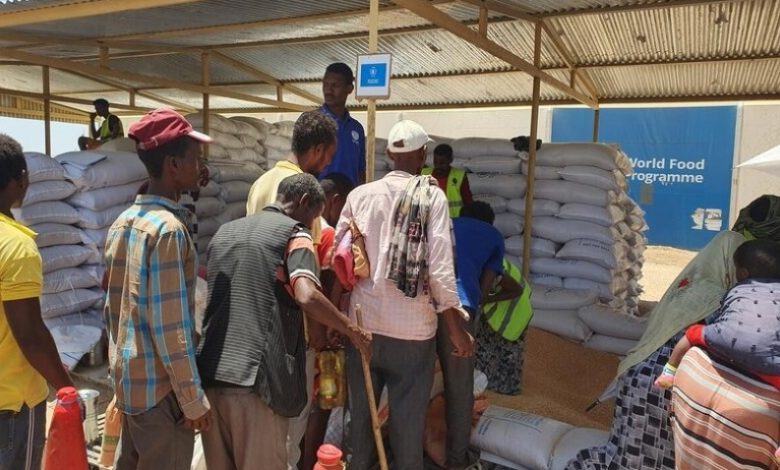
The WFP on Thursday warned that its food stocks in Sudan will empty by the end of March, leaving millions of people at risk of starvation.
“By the end of March, we will have depleted our food stocks in Sudan. Without immediate additional funding, millions of people will be left without vital food assistance within weeks,” WFP Director of Emergency Preparedness and Response, Ross Smith, said in a statement.
Since the breakout of the war in April 2023, the WFP has reached over 10 million of the most vulnerable women, men, and children in Sudan with emergency food, cash, and nutrition assistance. However, it “has been forced to reduce rations to the absolute minimum for survival,” Smith noted.
Lack of Funding
Smith added that the UN agency is operationally ready to offer help and prevent famine, but it lacks financial support. “WFP has teams on-the-ground and the access to scale up and save more lives, funding permitted,” he said.
Within this context, Smith said that the WFP requires $700 million to be able to resume its operations in Sudan from January to June.
“Every single day that fighting continues, families are falling deeper into hunger and communities are pushed further to the brink. We can turn the tide and avert famine conditions spreading further, but only if we have the funding to support these most vulnerable families,” he stated.
Famine in Sudan
As the war nears its three-year mark, more than 21 million people face acute hunger, while 3.7 million children and pregnant and breastfeeding mothers are malnourished.
Moreover, famine was declared in El-Fasher in North Darfur and Kadugli in South Kordofan. Meanwhile, civilians are experiencing famine conditions in Dilling, South Kordofan’s second largest city.
The latest UN data showed that 9.3 million people are internally displaced and 4.3 million have fled Sudan, pushing neighboring states to a breaking point, while over 20 million people require health assistance.
Furthermore, 12 million people – mostly women and girls – are vulnerable to gender-based violence amid the raging battles between the Sudanese Armed Forces (SAF) and the paramilitary Rapid Support Forces (RSF).
Humanitarian Push
As the UN and its partners struggle to address the humanitarian needs in Sudan under a staggering funding deficit, Germany and Britain unveiled plans to co-host an aid conference to raise emergency relief funds for Sudan next April.
Similarly, the US Senior Advisor for Arab and African Affairs, Massad Boulos, said that Washington was planning to host a donors’ conference and establish a fund for Sudan to address the dire humanitarian conditions in the war-torn country.
Cairo Meeting
On Wednesday, Egypt hosted the 5th meeting of the Consultative Mechanism to Enhance Coordination of Peace Efforts in Sudan, with the participation of high-level Arab and Western diplomats, as well as representatives from regional and international organizations.
During his speech, the Saudi Deputy Foreign Minister, Waleed Al-Khuraiji, stressed the need for a Sudanese-Sudanese political solution based on respecting Sudan’s unity and territorial integrity and supporting the state institutions.
In light of this, he voiced firm rejection of the formation of a parallel government in Sudan, warning that the establishment of parallel entities outside the framework of legitimate institutions is deeply concerning, as it disrupts political efforts aimed at reaching a solution.
He also underscored the urgency of preventing foreign interference and halting the flow of illegal weapons and foreign fighters into Sudan in order to achieve a ceasefire and facilitate humanitarian efforts by opening safe corridors.