Saudi Youth Reach for the Stars at International Astronomy Olympiad in Vietnam
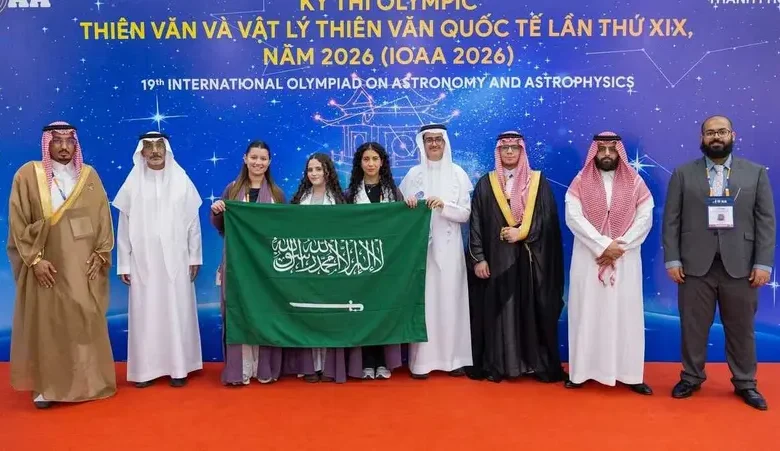
Driving the news: Five Saudi high school students entered a major international scientific arena in the Vietnamese capital of Hanoi on 25 September, 2026. The students represent Saudi Arabia at the 19th International Olympiad on Astronomy and Astrophysics (IOAA 2026).
The competition runs through 5 October, 2026, as it gathers elite secondary school talent from more than 60 countries.
Why it matters: The Kingdom continues to rapidly expand its global scientific footprint. Saudi Arabia actively nurtures exceptional young minds to build a competitive, knowledge-based economy aligned with Saudi Vision 2030.
Meet the Saudi Astronomy Team
The national team features top performers chosen from three major educational regions across the Kingdom:
- Jeddah Education Directorate: Fatima Nazeeh Damlakhan and Eline Hani Azhari.
- Eastern Province Education Directorate: Hisham Ayman Rafiq.
- Riyadh Education Directorate: Omar Khalid Al-Shehri and Maram Abdulaziz Al-Barrak.
These five students earned their seats after an intensive scientific qualification journey. The King Abdulaziz and His Companions Foundation for Giftedness and Creativity (Mawhiba) organized the training in a strategic partnership with the Ministry of Education. Tatweer Education Holding sponsored the effort through the Mawhiba International Olympiad Program.

A Rigorous Three-Year Qualification Journey
The big picture: A student’s path to international competition does not begin overnight. The qualification journey spans two to three years of intense preparation.
Candidates begin their journey by participating in the National Talent Olympiad – Scientific Track (“Nasmo”). High-performing students then transition into the Physics track within the Mawhiba International Olympiad Program.
Throughout this multi-year pathway, students undergo rigorous specialized training camps and qualification tests.
Between the lines: Mawhiba leaves nothing to chance. Prior to arriving in Hanoi, the Saudi astronomy team completed an intensive overseas training camp in Slovenia. The camp ran from August 16 to August 29, 2026.
The Slovenian camp provided an ideal environment with minimal light pollution. Consequently, the young scientists practiced real-time night sky observation and advanced simulation software under optimal astronomical conditions. Furthermore, expert trainers guided students through complex data analysis and theoretical physics calculations to prepare them for international pressure.
Building a Future Generation of Scientific Leaders
Saudi Arabia’s focus on talented students reflects a key commitment under the Vision 2030 Human Capability Development Program.
The Kingdom treats gifted students as strategic human capital. Mawhiba offers accessible entry points, including baseline qualification exams costing SAR 500 ($133). Beyond initial entry, the government heavily subsidizes elite nurturing pathways.
For advanced students, Saudi Arabia invests substantial resources into international camps, research mentorships, and university placement programs. Industry experts value these advanced preparation tracks at over SAR 150,000 ($40,000) per student annually. Consequently, Saudi youth receive world-class preparation without facing financial barriers.
By the numbers:
- 244,000+ gifted students identified across Saudi Arabia through Mawhiba’s cognitive aptitude screening system.
- 3rd: Saudi Arabia’s participation in IOAA, after debuting in 2024.
- 107 global awards: won by Saudi students across 25 international science competitions between September 2023 and September 2024.
- 582,000+ students: competed nationally in Mawhiba-organized contests that same year, including 260,308 in the National Olympiad for Programming and AI (ATHKA) alone.
- 691 international medals and certificates of appreciation won by Saudi students across global scientific Olympiads.
- 6 international awards secured by Saudi Arabia in its previous two IOAA participations in 2024 and 2025 (comprising 1 Silver medal, 3 Bronze medals, and 2 Certificates of Appreciation).
- 10 days of intense testing in Hanoi, spanning 25 September to 5 October, 2026.
- 60+ countries competing alongside Saudi Arabia in the 19th edition of the IOAA.
- SAR 201 billion ($53.6 billion): Saudi Arabia’s 2025 education budget, the government’s second-largest allocation
- SAR 50 billion ($13.3 billion): projected private-sector investment opportunities in Saudi education by 2030, spanning roughly 5,000 projects
Pushing the Boundaries of High School Science
The IOAA challenges secondary school students under 20 years old through a comprehensive evaluation process. The contest goes far beyond textbook knowledge.
How it works: Students face four distinct testing modules designed by global experts:
- Theoretical Astrophysics: Candidates solve complex scientific problems regarding gravity, orbital mechanics, and stellar physics.
- Astronomical Observation: Students identify celestial bodies and constellations using specialized equipment and naked-eye sky mapping.
- Data Analysis: Participants analyze real observational data collected by modern research observatories.
- Simulation Software: Competitors utilize modern astronomical software to model complex space phenomena.
Organizers launched the International Olympiad on Astronomy and Astrophysics in 2006, holding its inaugural competition in Thailand in 2007. Saudi Arabia makes its third appearance in the prestigious event, building upon its growing collection of international medals.
What’s next: The joint initiatives of Mawhiba and the Ministry of Education aim to elevate Saudi youth into global scientific leaders.
As the Hanoi competition unfolds through October 5, the Kingdom expects strong performances from its five ambassadors. Ultimately, these national programs do not merely prepare students for competitions. They build the researchers, engineers, and space pioneers who will lead Saudi Arabia’s high-tech future.