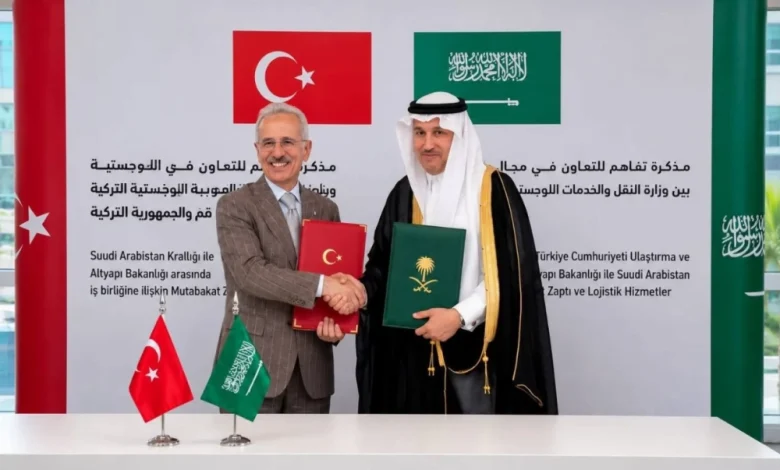
Saudi Arabia and Türkiye have signed two landmark Memorandums of Understanding (MoUs) to advance railway and logistics cooperation, marking a significant step toward establishing an overland trade corridor linking the Gulf with Europe.
Saudi Minister of Transport and Logistic Services Saleh Al-Jasser and his Turkish counterpart, Abdulkadir Uraloglu, signed the agreements. The logistics MOU focuses on developing and operating logistics centres, sharing knowledge and conducting joint activities. Meanwhile, the railway MOU seeks to expand cooperation in technology, infrastructure, training and human resources across the rail sector.
Consequently, Uraloglu described the deals as the start of a new chapter in bilateral cooperation. “We are launching a new phase that will strengthen the exchange of expertise and technical cooperation across a wide range of areas, from logistics centres to modern applications,” he said.
Corridor to Connect Gulf to Europe via Syria and Jordan
The agreements form part of broader regional efforts to build an overland route through Türkiye, Syria and Jordan. Transport ministries in those three countries have already agreed on a roadmap to rehabilitate cross-border infrastructure over the next four to five years. Turkish authorities have also begun restoring railway lines near the Syrian border that sat idle for nearly 15 years.
Under current plans, the corridor would link Türkiye’s rail network with southern Europe, then extend through Aleppo and Damascus, continue to Amman and reach Jordan’s Red Sea port of Aqaba. The route aims to offer a faster and more cost-effective alternative for moving goods and passengers between the Gulf and Europe.
Trial runs have already validated the concept. “Two test runs starting from Türkiye through Iraq and extending to Saudi Arabia have clearly demonstrated the feasibility of this route,” Uraloglu said.
Separately, Uraloglu announced plans to modernise the historic Hejaz Railway and eventually extend it to Oman, offering an additional trade route that reduces dependence on maritime shipping through the Strait of Hormuz.