Saudi Arabia Localizes Heavy Industry as Rolls-Royce, MAKEEN Sign Landmark Engine Licensing Deal
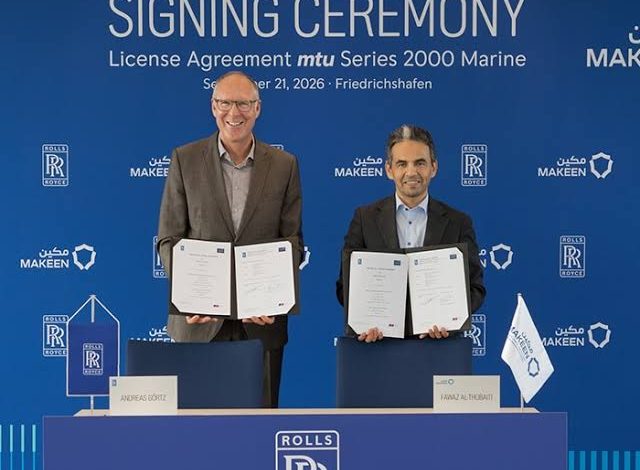
Driving the news: Rolls-Royce Power Systems and the Saudi Engines Manufacturing Company (Makeen) signed an individual license agreement for mtu Series 2000 marine engines. The deal paves the way for the first licensed local production of high-speed engines in the Kingdom.
Why it matters: Saudi Arabia is extending its localization drive from vehicles to the engines that power them. As a result, the Kingdom gains new skills, new suppliers and a deeper industrial base.
Inside the Rolls-Royce–Makeen Deal
The agreement lets Makeen manufacture and assemble the engines inside Saudi Arabia, which supports Vision 2030 localization goals. Rolls-Royce called the deal an important milestone in its industrial cooperation with the Kingdom. The company said local production helps build an advanced industrial base and brings specialized expertise and technology to Saudi Arabia.
The licence follows a framework agreement the partners signed in November 2023. That earlier deal set the legal and commercial foundations for localizing mtu products in the Saudi market. Together, the two agreements give Makeen a clear path from paperwork to production floor.
The first phase focuses on marine applications. However, the partners plan to extend their cooperation to the rail sector later. Both sides will develop local capacity to build one of Rolls-Royce’s most widely used and dependable high-speed engines. The Series 2000 delivers power of up to 1,939 kilowatts, according to mtu. Rolls-Royce expects the step to strengthen local supply chains and open new opportunities in advanced engineering.
Rolls-Royce brings deep roots to the partnership. Its technologies have served the Kingdom since the 1960s across air, sea and land transport. Andreas Görtz, president of the Mobile & Sustainable Solutions business unit at Rolls-Royce Power Systems, explained the rationale. “Saudi Arabia is investing heavily in industrial development, infrastructure and energy projects,” he said.
Makeen also carries serious backing. The joint venture unites Saudi Aramco, HD Hyundai Heavy Industries and Dussur. At the time of the framework deal, Aramco held 55%, HD held 30% and Dussur held 15%. Makeen’s chairman said then that the partnership would create jobs, build technological know-how and reduce heavy reliance on imports.
Saudi Arabia’s Wider Push to Build Vehicles at Home
Zoom in: The engine deal fits a larger strategy. The Public Investment Fund (PIF) leads the Kingdom’s drive to build its own automotive industry. Its 2026-2030 strategy targets localizing strategic industries, raising exports and creating skilled jobs.
The results are already visible. Industry Minister Bandar Alkhorayef said the national strategy aimed to attract three global carmakers producing 300,000 vehicles a year in one complex. Hyundai’s arrival alongside Lucid and Ceer achieved that goal.
Each manufacturer adds a different layer:
- Lucid: The company opened its plant in King Abdullah Economic City and targets 150,000 cars by 2029. Saudis make up more than 65% of the workforce at its AMP-2 factory.
- Hyundai: Its Saudi plant plans to start production in the fourth quarter of 2026, with capacity of 50,000 vehicles a year across combustion and electric models.
- Ceer: Crown Prince Mohammed bin Salman launched the brand’s first electric line, the EXOBOT, in sedan and SUV versions in September. Ceer targets 45% local content by 2034.
Supply chains matter just as much as assembly lines. In February, Ceer signed 16 agreements worth about SAR 3.7 billion ($987 million) with Saudi suppliers. In August, the Local Content and Government Procurement Authority signed two localization agreements with Ceer, projecting a SAR 9.213 billion ($2.46 billion) boost to GDP over ten years.
By the numbers:
- 1,939 kW: maximum power of the mtu Series 2000 range.
- November 2023: date of the Rolls-Royce–Makeen framework agreement.
- 55% / 30% / 15%: Aramco, HD Hyundai Heavy Industries and Dussur stakes in Makeen.
- 500,000: annual vehicles targeted from three carmakers in one complex.
- 50,000: Hyundai’s planned annual capacity in Saudi Arabia.
- SAR 18.75 billion ($5 billion): Hyundai plant’s projected GDP contribution by 2045.
- 150,000: Lucid’s annual output target by 2029.
- 65%+: Saudi share of the Lucid AMP-2 workforce.
- 45%: Ceer’s local content target by 2034.
- SAR 3.7 billion ($987 million): value of Ceer’s supplier agreements.
- SAR 9.213 billion ($2.46 billion): projected GDP boost from Ceer’s localization agreements over ten years.
The big picture: The automotive value chain reaches well beyond the finished car, into metals, aluminium, steel, glass, plastics and electronics. Engines extend that chain into precision engineering. Moreover, the skills Saudi engineers build on marine engines can transfer to cars, trains and power systems.
What’s next: Rolls-Royce and Makeen can now establish their initial local production capabilities. Meanwhile, Ceer aims to start vehicle production in the fourth quarter of 2026. Hyundai targets the same window. Rail applications will follow the marine phase.