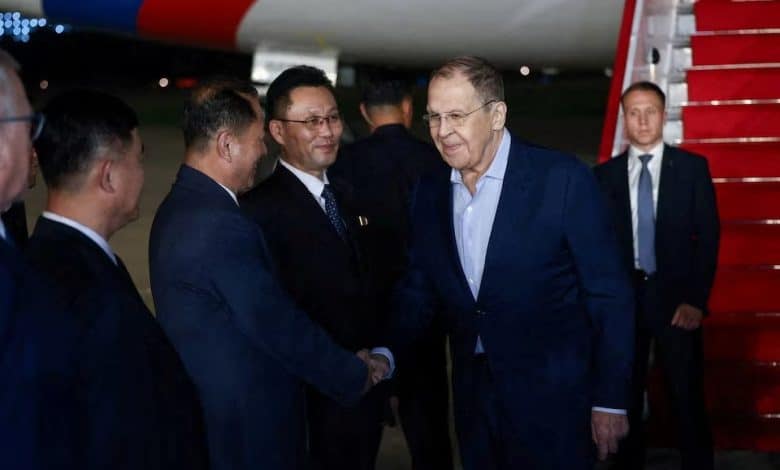
Russian Foreign Minister Sergei Lavrov arrived in North Korea on Friday, state media KCNA confirmed early Saturday. This visit marks the latest in a series of high-level meetings between Moscow and Pyongyang, signaling a significant upgrade in their strategic cooperation.
Lavrov’s visit, scheduled to last until Sunday, includes a meeting with North Korea’s foreign minister, as reported by KCNA. He flew out of Kuala Lumpur, the Malaysian capital, following the ASEAN foreign ministers’ meeting and arrived in Wonsan, a city on North Korea’s eastern coast. Wonsan is known for its missile and naval facilities, as well as a recently opened resort.
Strengthening Strategic Cooperation
This visit is part of a dramatic upgrading of strategic cooperation between Russia and North Korea, which now includes a mutual defense pact. Furthermore, South Korean intelligence services indicate that North Korea may be preparing to deploy additional troops in July or August. Previously, they had sent more than 10,000 soldiers to fight with Russia in the war against Ukraine.
Additionally, North Korea has agreed to dispatch 6,000 military engineers and builders for reconstruction projects in Russia’s Kursk region that saw a mass cross-border incursion by Ukrainian forces nearly a year ago.
Future Plans and Discussions
Russian news agencies also reported Lavrov’s arrival and stated that he would travel to China after North Korea to attend the Shanghai Cooperation Organisation meeting scheduled for Monday and Tuesday. Russia’s state TASS news agency reported that Lavrov and his North Korean counterpart, Choi Son Hui, will discuss the 40-month-old Ukraine conflict and the situation on the Korean peninsula.
TASS also noted that the new coastal resort could boost Russian tourism to North Korea, citing the resumption of direct trains from Moscow to Pyongyang and a project to build a bridge across the Tumen River. This river forms part of the boundary between North Korea, China, and Russia.
Deputy Russian Foreign Minister Andrei Rudenko stated that more high-level delegations would visit North Korea later this year. Rudenko emphasized that the accord on strategic partnership “clearly meets the changing needs over recent decades and strengthens traditionally friendly, good-neighbourly Russian-Korean relations to a qualitatively new level as allies.”