A series of drone strikes, blamed on the Rapid Support Forces (RSF), killed dozens of civilians – more than half of them children – in Sudan’s South Kordofan state.
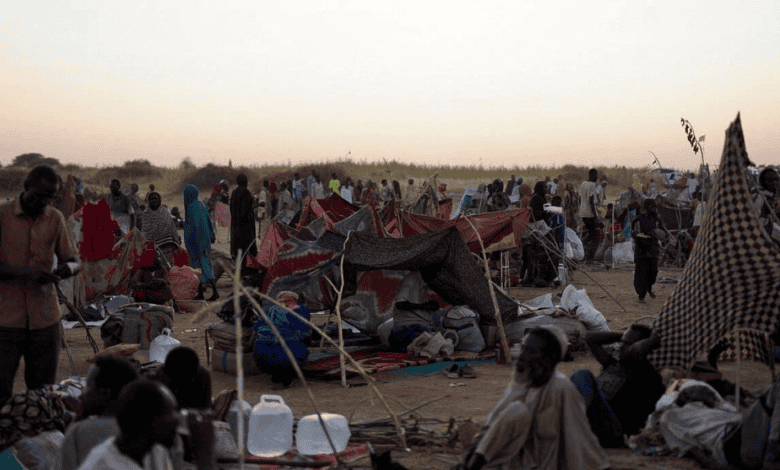
This comes as the war-torn country faces an unprecedented humanitarian crisis, amid severe food shortages and lack of access to essential aid supplies across several areas.
RSF Drone Attack
A drone attack targeting the army-controlled town of Kalogi in the South Kordofan state hit a kindergarten, a hospital and rescue teams who rushed to help, killing dozens of civilians, reported AFP citing head of the Kalogi administrative unit, Essam al-Din al-Sayed.
The attack took place on Thursday involving three strikes, “first a kindergarten, then a hospital and a third time as people tried to rescue the children,” the official said, who accused the RSF and their ally, the Sudan People’s Liberation Movement-North faction (SPLA-N) led by Abdelaziz al-Hilu of conducting the strikes.
The army-aligned Foreign Ministry put casualties at 79, including 43 children and 6 women, while Al-Jazeera reported that the death toll reached at least 110 people, including 46 children.
Targeting Civilians
Sudan’s SAF-aligned Foreign Ministry described the attack as a “heinous crime” that demonstrates the RSF’s “intent to inflict the highest possible number of civilian deaths.”
“The deliberate targeting of children, the wounded, and their saviors in such a horrific act of terrorism is unheard of even from the most savage groups of terror. It moreover constitutes further evidence that the terrorist militia interprets the continued indifference of the international community to its atrocities as encouragement and approval,” the Sudanese Foreign Ministry said in a statement.
The Ministry blamed the international community and the RSF backers for the “continuation of these massacres” amid the lack of measures to “halt the terrorist militia’s ability to commit further atrocities.”
The Sudanese government has repeatedly accused the UAE of providing military support to the RSF – a claim that the Gulf country consistently denies.
Meanwhile, the UNICEF condemned the attack in Kalogi, urging the warring parties to halt fighting and allow unhindered access for humanitarian aid. “Killing children in their school is a horrific violation of children’s rights. Children should never pay the price of conflict,” the UNICEF Representative for Sudan, Sheldon Yett, said in a statement.
Sudan’s Humanitarian Crisis
The war in Sudan, which broke out on April 15, 2023 between the Sudanese Armed Forces (SAF) and the RSF, has triggered what the UN called “the world’s largest humanitarian and displacement crisis.” It has also driven the country closer toward partition, as aid organizations raise alarm over the humanitarian conditions in Sudan.
In the light of this, the World Food Program (WFP) Deputy Executive Director, Carl Skau, has warned of a “massive” humanitarian aid crisis in Sudan amid lack of access to vital food supplies.
In an interview with Al-Jazeera, Skau noted that the needs in Sudan exceeds the WFP’s abilities. “The needs are massive. We’re talking about 20 million people acutely food insecure, some 6 million in starvation. It is a massive crisis and what we’re able to do, which is important, isn’t enough,” he said.
Skau noted that the WFP was providing help to 5 million Sudanese, including 2 million in inaccessible areas. He added that the agency had “tried every way possible” to deliver aid to people in need, through air drops, digital cash transfers and positioning convoys outside besieged areas.
However, it could not reach areas engulfed in fierce fighting, such as El-Fasher, the capital city of North Darfur state which fell to the RSF after an 18-month siege, or Babanusa city in West Kordofan which the RSF claimed it had seized last week, despite SAF’s denial of this claim.
Alarm over Kordofan
The Kordofan region, including North, South, and West Kordofan, serves as a strategic corridor that links Khartoum and central Sudan to Darfur. The region has become a frontline in the war after the RSF took control of the entire Darfur region.
Amid heavy battles between the SAF and the RSF, the WFP official noted that the international community should shift its attention to Kordofan. “The fighting there is intensifying, and they are also besieged areas. World attention needs to be on Sudan now, and diplomatic efforts need to be stepped up in order to prevent the same disaster we saw in El-Fasher,” Skau said.
The UN Human Rights Chief, Volker Türk, has voiced similar concerns over the situation in Kordofan, warning that the fighting could spark “another wave of atrocities” similar to what happened in El-Fasher.