
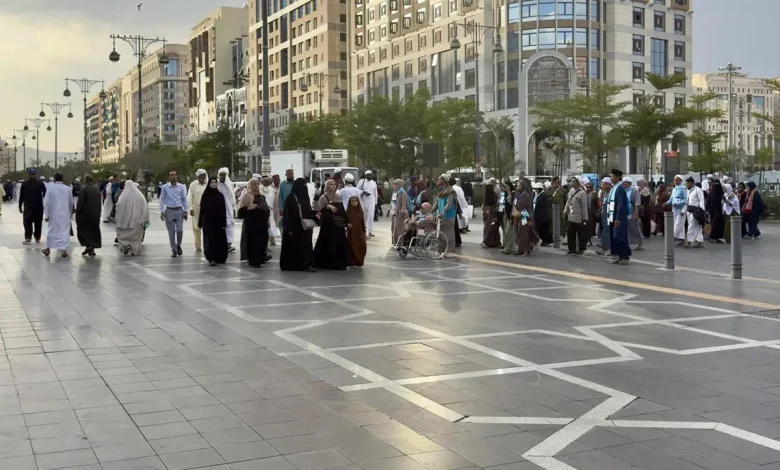
Madinah is advancing its shift toward more sustainable urban mobility through the development of pedestrian paths covering more than 19,000 square meters in the central district around the Prophet’s Mosque.
A More Accessible Walking Experience
The initiative seeks to offer a more accessible walking environment while easing movement for the millions of visitors and Umrah performers arriving in the city each year.
Designed to make movement around the Prophet’s Mosque easier, the pedestrian network connects with the main road system and provides convenient access to key destinations and surrounding services.
The district also features a vast array of facilities that support pedestrians, including accessible walkways for persons with disabilities, improved lighting, green spaces, shaded areas, and diverse accommodation and hospitality options.
These developments form part of Saudi Arabia’s broader efforts to advance sustainable urban development and achieve Vision 2030’s quality-of-life objectives.
How Can Madinah Accommodate Growing Visitor Numbers?
Notably, Madinah welcomes millions of visitors each year, with the Prophet’s Mosque serving as the focal point of religious journeys to the city.
As visitor numbers grow, developing the surrounding infrastructure becomes increasingly important to facilitating movement, managing pedestrian flows, and maintaining convenient access to essential services.
The expansion of pedestrian paths addresses these needs by providing a more connected and accessible walking environment in the central district.
It also recognizes the importance of walking in the visitor experience, particularly for pilgrims moving between the Prophet’s Mosque, nearby accommodation, and surrounding facilities.
The development also reflects a wider shift toward sustainable transport planning.
Sustainable Mobility Meets Vision 2030
Observed annually on November 26, World Sustainable Transport Day was established by the United Nations General Assembly in 2023 to promote safe, accessible, inclusive, and environmentally friendly transport systems.
Saudi Arabia’s investment in pedestrian infrastructure aligns with these principles and its broader Vision 2030 objectives.
By incorporating accessibility, green spaces, shaded areas, and connected pathways into urban development, the Kingdom is placing particular emphasis on human-centered environments that support mobility while preserving the character and significance of its religious destinations.
Connecting Local Development With Global Goals
Saudi Arabia’s investment in pedestrian infrastructure in Madinah also stands as a testament to the intersection between national urban development priorities and international sustainability objectives.
The project illustrates how improving walking environments, expanding accessibility, and connecting public spaces can support the needs of cities that receive substantial numbers of religious visitors.
These priorities perfectly align with the United Nations Sustainable Development Goals, particularly Goal 11 on sustainable cities and communities and Goal 3 on good health and well-being.
For other destinations with significant religious tourism, Madinah’s development offers an opportunity to consider how pedestrian-focused planning can contribute to more inclusive and sustainable visitor environments.
Related Topics:
Madinah Expands Smart Parking as Saudi Arabia Upgrades Roads
Sustainability at the Core: Madinah Emerges as an Urban Transformation Model
How Madinah Is Localizing the Sustainable Development Goals