After commemorating the 80th anniversary of D-Day, French President Emmanuel Macron welcomed his US counterpart Joe Biden on Saturday for an official state visit.
The visit, which comes after a period of relative tensions between the two close allies over a submarine deal with Australia, features a special level of pomp and a parade, in addition to talks on trade, Gaza war and Ukraine, reported Reuters.
Warm Reception
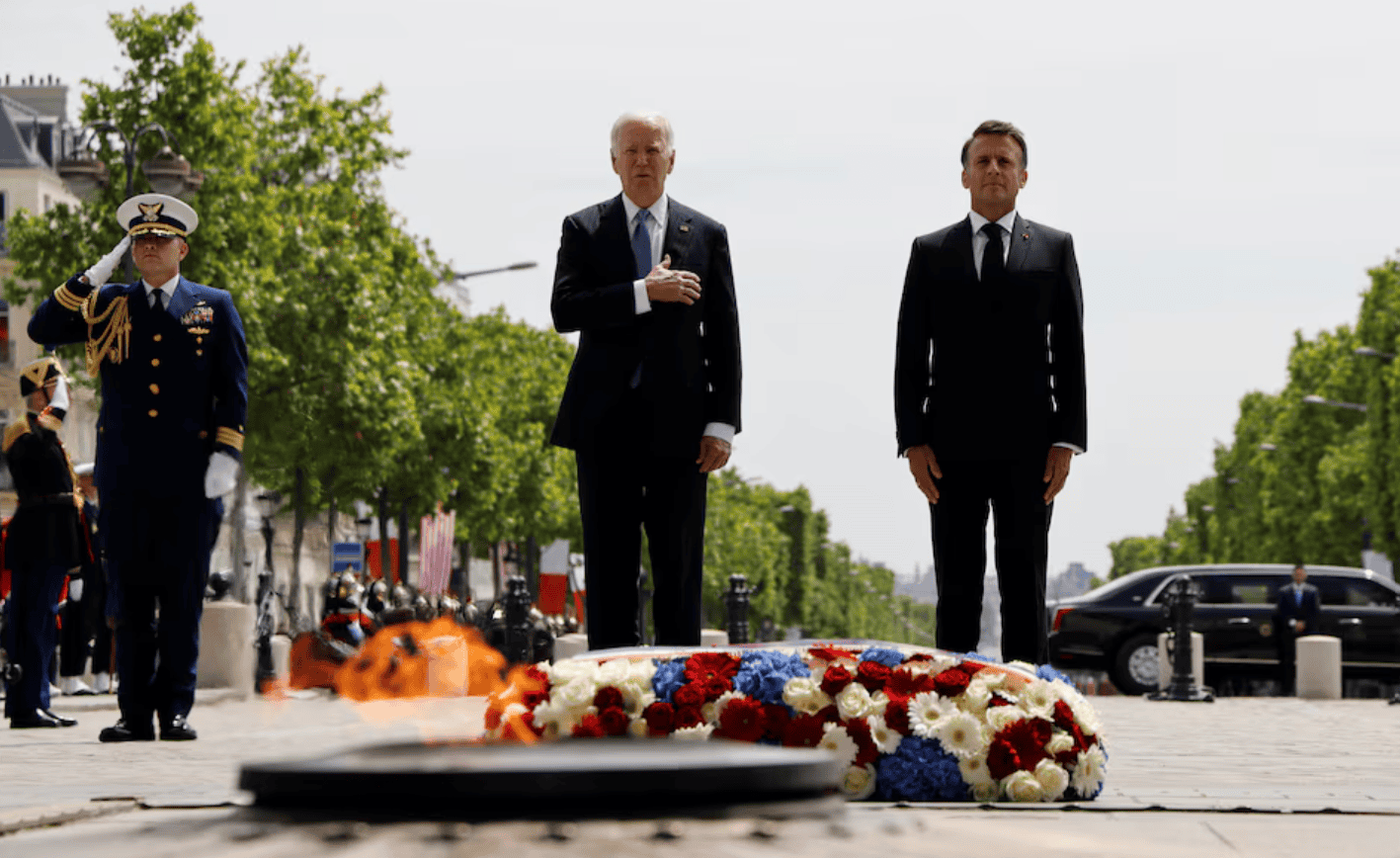
Both leaders participated with their wives in a formal welcoming ceremony at Paris iconic landmark, Arc de Triomphe, where they paid their respects at the Tomb of the Unknown Soldier. Then, they greeted army veterans.
After that, they drove down the Avenue des Champs-Élysées in a parade procession, in their way to the Élysée Palace, where they will hold a meeting to discuss policy issues.
Macron and Biden will deliver statements to the press, but are not expected to hold a formal press conference. Following that, Macron will host a state dinner for Biden and his wife, Jill.
Biden hosted the French president for a state visit at the White House in December 2022.
Solid Alliance
The US national security adviser, Jake Sullivan, told reporters earlier this week: “France is … our oldest and one of our deepest allies. And this will be an important moment to affirm that alliance and also look to the future and what we have to accomplish together.”
Similarly, a top French official told the Associated Press (AP) that Macron and Biden have a friendly and warm relation. He added that the fact that Biden is staying in France for five days reflects the importance he gives to the visit.
Busy Agenda
According to Sullivan, talks between the two leaders will include issues related to Ukraine war, Gaza war, cooperation in the Indo-Pacific region, climate change, artificial intelligence and supply chains.
Meanwhile, the White House spokesperson, John Kirby, said the US and France will announce a plan to cooperate on maritime law enforcement. Moreover, the US coast guard and French navy will discuss enhancing cooperation.
Furthermore, both leaders are expected to discuss ways to strengthen NATO, and have pledged support for Ukraine.
Ukraine War
Both the US and France have given their support for Ukraine in its war with Russia. On Friday, Biden announced a new aid package worth of $225bn and apologized to the Ukrainian president for the delay, reported CNN.
Likewise, Macron has been one of Europe’s staunchest supporters for Ukraine. In response to the war, France has doubled its defense budget, announced it would surpass NATO’s 2% defense spending benchmark, and resumed domestic production of critical military components.

Max Bergmann, a former US State Department official and the director of Europe’s Program at CSIS, stressed the strength of the US-French relations despite occasional disagreements. He told AP: “There’s always tension in Franco-American relations, because the French try to do stuff. They’re bold, they throw up proposals, and that leads to some friction when we push back.”
He pointed to the French proposal of sending Western military trainers to Ukraine, which led to questions of whether this is “really giving Ukraine a major, tangible benefit” or has the “potential to be escalatory and dangerous.”
The Middle East
In regards to the war in Gaza, Macron backed the ceasefire deal proposed by Biden. However, France broke with its Western allies last month when it backed the International Criminal Court (ICC) decision to seek arrest warrants for Israeli officials.
On the other hand, Biden has called the ICC’s decision “outrageous.” The US president has been a steadfast supporter of Israel in its war in Gaza, which has so far killed tens of thousands of Palestinians.
Trade Issues
Macron and Biden are expected to discuss trade issues between both sides. The US Inflation Reduction Act, enacted in August 2022, has drawn the criticism of European officials. They consider it a protectionist move that favors American-made climate technology, such as electric vehicles (EVs), and excludes European investments.

During his visit to the US in 2022, Macron said the US, like China, has “decided not to respect the rules of global trade” by reinforcing protections and subsidies while Europe’s industry remains open and is stuck in overregulation.
He added that the subsidies could “fragment the West” and weaken the post-COVID European recovery at a time the US is seeking allies against China and both sides confront Russia.
On this matter, Gary Hufbauer, nonresident senior fellow at the Peterson Institute for International Economics, told AP that trade with China remains a deadlock between the US and Europe, particularly France.
The US has been eager to put more trade restrictions, especially regarding technology. Biden is also heading towards imposing more tariffs on Chinese EVs and batteries. This move could impact European cars with Chinese components.
Hufbauer said the fear is that “if you’ve got some component from China, we don’t want you in the US. That’s a big worry in Europe. Overall, Europe wants to maintain much more trade with China than the US wants.”