
From Desert Restoration to Neighborhood Parks: Saudi Urban Greening Hits 77% Access Milestone
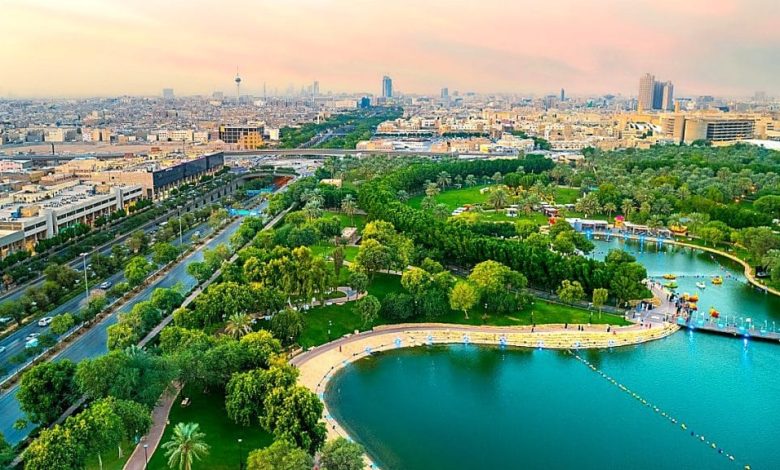
Nearly four in five people in Saudi Arabia now live within a short walk of a park, official figures show.
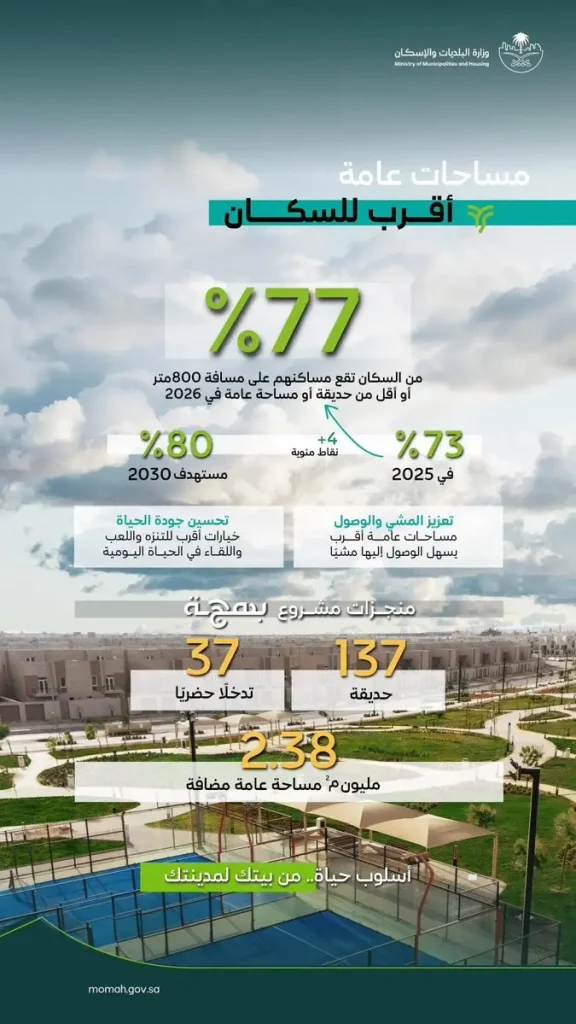
Driving the news: The Ministry of Municipalities and Housing (MOMAH) says 77% of residents live within 800 meters of a park or public space. Moreover, the government aims to reach 80% by 2030. The target forms part of a national drive to green cities and the desert beyond them.
Why it matters: The push puts everyday recreation, shade, and walkable public space at the center of Saudi urban planning, in line with the quality-of-life goals of Vision 2030. It also forms the city-level arm of the Saudi Green Initiative, one of the world’s largest afforestation programs, which counts investments of more than SAR705 billion ($188 billion).
Parks Move to the Neighborhood Scale
The ministry credits the gains to the Bahja project. The program launched in late 2022 to turn unused land into active public space across Saudi cities. Between January and the end of September 2026, Bahja added 2.38 million square meters of new public space. In addition, crews delivered 137 parks and carried out 37 urban interventions across the Kingdom’s municipalities.
The project targets sites ready for daily use, from walking and strolling to play and community gatherings. As a result, officials want public space to sit inside the rhythm of residential life, not at its edge. The ministry works alongside regional mayoralties to link urban planning with residents’ needs. The goal is simple: sites that are easier to reach and use.
Proximity sits at the heart of the design approach. Therefore, planners weigh the character of each site and the needs of its residents. Design quality matters, as do facilities for every group in society.
The program goes beyond adding area, the ministry stresses. Instead, it aims to improve how residents experience their cities. That means spaces for walking, community interaction, and stronger neighborhood identity.
By the numbers:
- 77%: Share of Saudi residents living within 800 meters of a park or public space in 2026.
- 80%: National target for that share by 2030.
- 38 million square meters: Public space added by the Bahja project from January through September 2026.
- 137 parks and 37 urban interventions: Delivered in the first nine months of 2026.
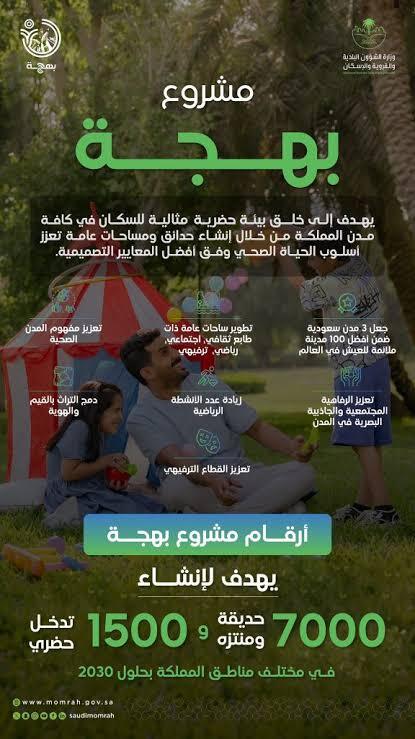
- 7,000 parks and 1,500 urban interventions: Bahja’s nationwide goal by 2030.
- 10 billion trees: Saudi Green Initiative pledge for the Kingdom by 2060.
- 159 million trees and 1 million hectares: Planted and restored by early 2026 under the initiative.
- SAR705 billion ($188 billion): Investment mobilized across Saudi green initiatives since launch.
- More than 74 million hectares of land fall within SGI’s stated rehabilitation ambition.
- 600 million-plus trees should be planted by 2030 under the current SGI roadmap.
- 5 million trees are planned across Riyadh by 2030 under Green Riyadh.
- Green Riyadh projects an economic return of $19 billion, or about SAR 71.25 billion, by 2030.
A Greener Vision 2030
Bahja sits within a wider environmental agenda. Minister of Municipalities and Housing Majed Al-Hogail made the case at the fourth Saudi Green Initiative Forum in Riyadh. He described Bahja as a flagship of that effort.
“The Bahja project serves as a practical model for achieving environmental goals,” Al-Hogail told the forum. The event ran alongside the COP16 desertification summit in December 2024.
Since 2023, he said, the program built 645 parks and 629 urban interventions. Together they cover more than 12 million square meters. He also highlighted irrigation systems that run on treated water, in order to protect freshwater supplies.
“Thanks to Vision 2030, Saudi Arabia has witnessed significant progress and a qualitative transformation in promoting environmental sustainability by expanding green spaces, improving air quality, and working to reduce carbon emissions,” the minister added.
The ministry has also planted trees along streets, medians, walkways, and parks. These efforts back the initiative’s targets. Among them: a cut of 278 million tons in annual carbon emissions by 2030, plus wider green belts around cities.
Desert Restoration at National Scale
Meanwhile, the greening drive reaches far beyond city limits. The Saudi Green Initiative launched in March 2021 under Crown Prince and Prime Minister Mohammed bin Salman. Its pledge: 10 billion trees and 74 million hectares of restored land in the decades ahead.
Progress has accelerated. The Kingdom restored 250,000 hectares by 2024. It then crossed 1 million hectares in early 2026, alongside 159 million trees planted. Green cover has grown in parallel. Program data show 8,328 gardens and parks spanning 161.5 million square meters. Urban areas have gained more than 24 million trees, plus a rising per-capita share of public space.
What’s next: The ministry expects 2027 to bring 80,000 housing units and developed plots, alongside further park work. Riyadh shows the pace at city level. Green Riyadh has planted more than 4.5 million trees and greened 235 kilometers of roads, and three major parks have passed 85% completion.
However, the last three points to 80% will test delivery more than ambition. Each new park needs irrigation, maintenance and staff after opening day. Still, the direction is clear. Saudi cities are moving from landmark projects toward everyday access, measured by the minutes a resident walks from a front door.