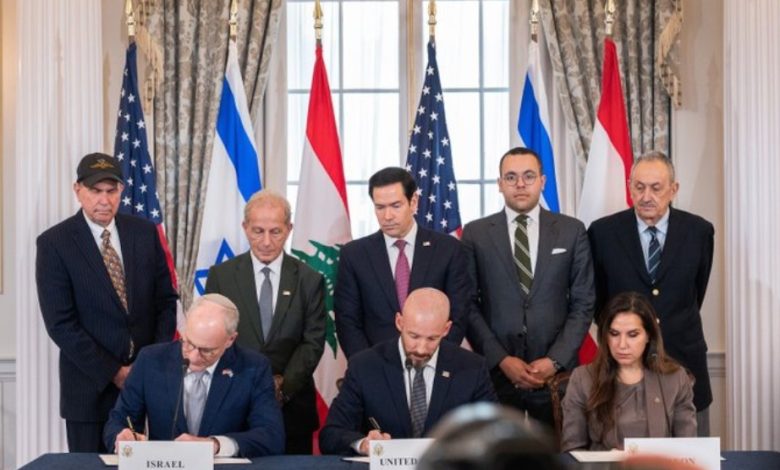
Lebanon, Israel and the US on Friday signed a trilateral framework agreement that will pave the way for a broader peace deal.
The agreement was signed following the conclusion of the fifth round of US-brokered talks in Washington. Under the agreement, fighting will end and Israeli troops will withdraw from two areas in southern Lebanon.
Lebanon was drawn into the US-Israeli war with Iran in early March following Hezbollah’s decision to retaliate for the killing of the Iranian Supreme Leader Ayatollah Ali Khamenei by sending barrages of missiles and drones towards Israel.
Israel responded by launching heavy airstrikes and ground operations into southern Lebanon, seizing control of large swaths of the country.
Trilateral Agreement
US Secretary of State Marco Rubio, alongside the Lebanese and Israeli ambassadors to the US, announced the signing of a 14-point trilateral framework agreement that constitutes the “first step” towards achieving “lasting peace and security.”
“Today we’ve taken the first step in what will be a difficult journey, without a doubt, but an important and an essential and a necessary one,” Rubio said during the signing ceremony.
In a later press statement, Rubio said the agreement “establishes a clear and structured process to restore Lebanon’s sovereignty, disarm Hezbollah and dismantle its terrorist infrastructure, and enable Israel to return to its borders once that threat to its citizens is removed.”
Lebanon’s Ambassador to the US Nada Hamadeh Moawad, for her part, said that the agreement lays the groundwork for “restoring Lebanese sovereignty and territorial integrity, securing a permanent and final cessation of hostilities, enabling our people to go back to their land, and allowing all Lebanese to live in peace, security, and prosperity.”
Meanwhile, Israel’s Ambassador to Washington Yechiel Leiter said that this framework agreement excludes Iran and Hezbollah, noting that its ultimate objective is to achieve real peace “where Israel’s and Lebanon’s sovereignty will be respected, honored, and protected.”
Military Coordination
The agreement states that the Lebanese Armed Forces (LAF) “will restore effective sovereign authority over all Lebanese territory, pending the verified disarmament of non-state armed groups and dismantlement of associated infrastructure,” enabling the Israeli military to progressively redeploy out of the Lebanese territory.
Under the agreement, the US will also facilitate the creation of a trilateral Military Coordination Group for Lebanon (MCG4L) to help Lebanon and Israel implement the framework.
Moreover, Washington will commit resources, including an immediate $100 million in humanitarian assistance in coordination with the UN.
It will also enhance the capabilities of the LAF to secure and maintain sovereignty across Lebanon. In support of the President’s vision for lasting peace in the region, the Department of War will provide over $30 million in reimbursements to the LAF using existing authorized funding.
Israel Remaining in Security Zone
In a recorded video statement on Friday evening, Israeli Prime Minister Benjamin Netanyahu affirmed that Israeli forces will remain in the so-called “security zone” in southern Lebanon until the disarmament of Hezbollah.
Since the outbreak of the war with Iran and Hezbollah’s involvement in the fighting, the Israeli military seized about 10 km of territory in southern Lebanon, calling it a “security zone,” forcing thousands of Lebanese civilians out of their homes, conducting raids on villages and destroying buildings.
“The most important thing, first and foremost, is that Israel will remain in the security zone in southern Lebanon. This is a major achievement, and we will maintain it as long as Hezbollah has not been disarmed and as long as it continues to pose a threat to the State of Israel,” Netanyahu said.
He described the framework agreement with Lebanon as a “major blow” to Iran. “You have no role in Lebanon. Neither you, nor Hezbollah nor any terrorist organization,” he addressed Tehran.
Two Pilot Zones
The agreement notes that the LAF and the Israeli military have agreed on two initial “pilot zones” to begin a phased, verified redeployment of troops. In these mutually agreed areas, the LAF will assume full control once non-state armed groups are successfully disarmed and their infrastructure is dismantled.
This transition will pave the way for international reconstruction efforts and the safe return of Lebanese civilians under exclusive state authority, a process the US intends to closely verify and support.
According to Netanyahu, Israel will allow the Lebanese military to start preparing to take control of territory, while the Israeli military is establishing two pilot zones.
The “pilot zone” is a US proposal that aims to restore Lebanese control in the south, by allowing the Lebanese army to step in and clear the area of Hezbollah weapons and infrastructure.
The Israeli Prime Minister noted that one of the pilot zones lies south of the Litani River and outside the (original) security zone. Meanwhile, the second one is a small area that Israel “does not need” located north of the Litani, within the expanded security zone that the Israeli military seized two weeks ago.
“We are maintaining the original security zone, which covers the range of (Hezbollah) anti-tank missiles. We are not allowing Hezbollah, nor the Lebanese population to enter that area,” Netanyahu emphasized.
Lebanese Government Reaction
Lebanese President Joseph Aoun welcomed the agreement as a first step towards restoring the country’s sovereignty over its territory and enabling Lebanese “to return to their fully liberated lands, and to their certainly rebuilt homes.”
“We swear to continue to work until this is fully achieved. There will be no more occupation, prisoners, subordination or tutelage,” Aoun said in a statement.
Similarly, Lebanese Prime Minister Nawaf Salam said in a statement that the agreement “aims to achieve an Israeli withdrawal from all Lebanese territory, restore state sovereignty over it, and facilitate the return of its citizens.”
Hezbollah Position
On the other hand, the Iranian-backed Hezbollah, which strongly opposes the negotiations with Israel, is unlikely to accept the agreement. Hours before the conclusion of the Lebanon-Israel talks in Washington, Hezbollah leader Naim Qassem said that Israel must withdraw its troops from Lebanon “unconditionally.”
In a televised address on Friday, Qassem said that Hezbollah would accept “no normalization, no cancellation of the state of hostility, no gains for Israel.”
Hassan Fadlallah, a member of Hezbollah’s parliamentary bloc, reiterated that position later in an interview with Al-Mayadeen TV. He warned that Lebanese authorities “will not be able to enforce the agreement signed in Washington unless they go, with American support, to civil war.”