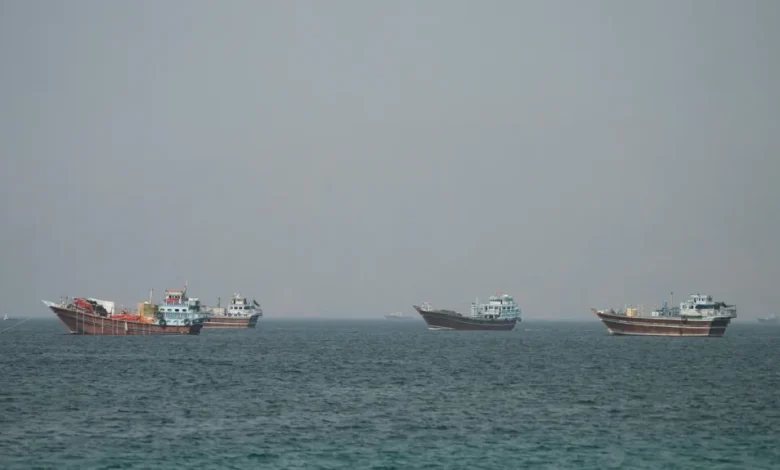
The UN’s International Maritime Organization (IMO) has suspended its emergency evacuation of more than 11,000 sailors stranded in the Strait of Hormuz, after an attack on a cargo ship threatened the safety of the operation.
IMO Secretary-General Arsenio Dominguez announced the pause on Thursday, saying the agency needed to secure “necessary safety guarantees” before resuming the large-scale effort. Several vessels had already completed the evacuation before the suspension.
The British maritime security agency UKMTO reported that the Singapore-flagged cargo ship Ever Lovely was struck by “an unknown projectile” some 7.5 nautical miles southeast of Oman’s port of Dahit. No casualties were reported, and maritime risk firm Vanguard confirmed the vessel continued through the strait without requiring assistance.
US officials, citing media reports, attributed the attack to Iran. Meanwhile, Iran’s Persian Gulf Strait Authority (PGSA) issued a pointed warning on X, “Any consequences arising from the use of unauthorised routes shall be the responsibility of the vessel’s owner, operator and master.”
IMO Distances Itself from Attacked Vessel
Dominguez was quick to note that the Ever Lovely had not transited under the IMO’s evacuation framework. “I have always reiterated that the safety of the seafarers remains paramount,” he said in a statement. “Therefore, to ensure a coordinated approach and navigational safety, we will pause the evacuation plan until we obtain further clarity.”
Ship-tracking service MarineTraffic showed the Ever Lovely entering the strait via the southern route on Thursday morning and exiting on the eastern side at around 15:30 local time.
Hormuz Dispute Clouds Fragile US-Iran Deal
The incident adds fresh uncertainty to a fragile diplomatic arrangement. Last week, Washington and Tehran agreed a 14-point deal to end hostilities, with Iran committing to use its “best efforts for the safe passage of commercial vessels with no charge for 60 days.”
However, Tehran has repeatedly signalled plans to impose what it calls maritime service fees on ships crossing the strait. The US firmly rejects that position. Secretary of State Marco Rubio, currently in Bahrain on a Gulf diplomatic tour, warned on Tuesday that no country has the right to impose tolls on the Strait of Hormuz, which he described as “an international waterway.”
Hundreds of ships and thousands of sailors have remained stranded in the Gulf since February, when US and Israeli military strikes against Iran prompted Tehran to effectively close the strait. The closure sent global oil prices sharply higher and disrupted shipments of vital commodities, including fertiliser.
Since the US and Iran signed a Memorandum of Understanding (MoU) on 17 June launching a 60-day negotiating window on Tehran’s nuclear program, crude prices have fallen significantly.